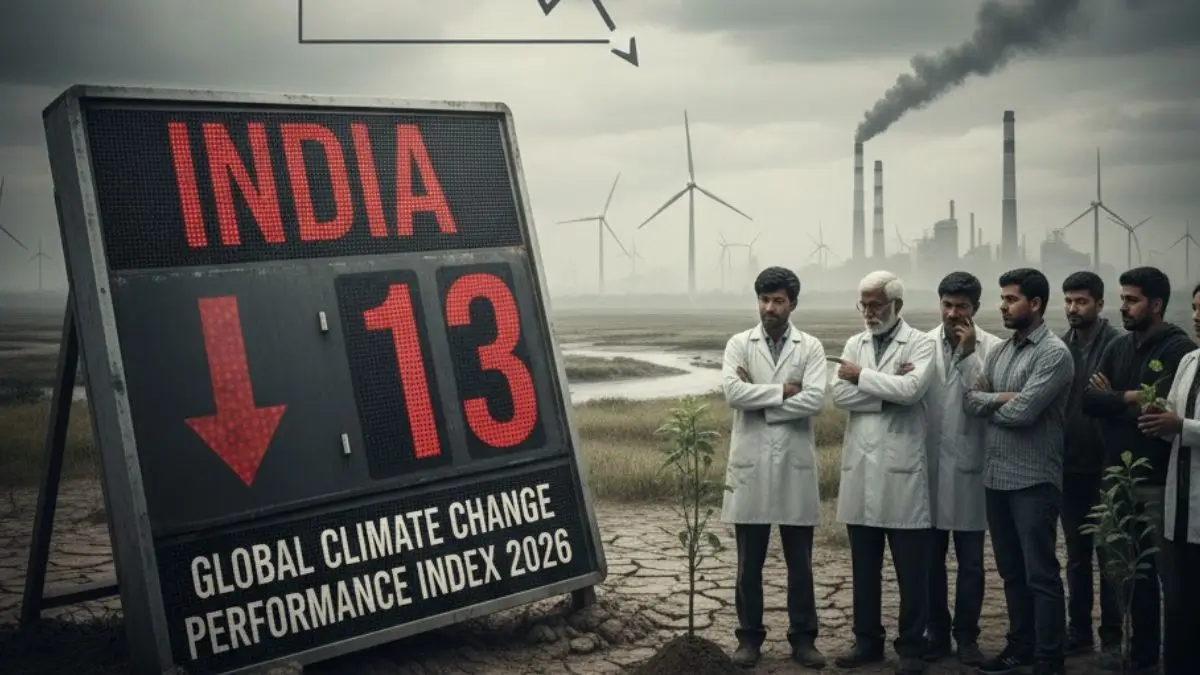
India has seen a significant drop in its climate performance ranking, falling 13 places to 23rd position in the Climate Change Performance Index (CCPI) 2026, released during the UN COP30 Climate Summit in Belém, Brazil. The report, jointly prepared by Germanwatch, NewClimate Institute, and the Climate Action Network, highlights India’s lack of a national coal exit timeline as a major factor behind the downgrade. With a score of 61.31, India has moved from being a “high performer” last year to a “medium performer” this year, even as it continues to be a major producer of coal, oil, and gas globally.
What is the Climate Change Performance Index?
The CCPI is an annual global monitoring tool that evaluates the climate mitigation performance of 63 countries and the European Union, which together are responsible for over 90% of global greenhouse gas emissions. It assesses nations based on four key areas,
- Greenhouse Gas (GHG) Emissions
- Renewable Energy Development
- Energy Use
- Climate Policy
Despite India’s drop in rank, the report notes that no country has met all the criteria needed to prevent dangerous climate change. Therefore, the top three spots remain vacant in the 2026 index. The highest-ranked countries are,
- 4th: Denmark (80.52)
- 5th: Morocco (70.75)
- 6th: United Kingdom (70.8)
At the bottom of the list are,
- 66th: Iran (14.33)
- 65th: USA (21.84)
- 67th: Saudi Arabia (11.9)
Why India’s Ranking Dropped
No Timeline to Exit Coal
One of the key reasons for India’s fall is the absence of a national plan to phase out coal, despite being among the top coal producers in the world. The report points out that new coal blocks are still being auctioned, and there is no roadmap for a coal phase-down, which contradicts global climate targets.
Low Score in Renewable Energy
India received a low rating in the renewable energy category, even though it has made considerable progress. Experts cited concerns over the impact of large-scale solar projects, which have led to land conflicts, displacement, water stress, and human rights issues due to top-down project implementation.
Progress Noted in Climate Policy and Green Energy
Despite the drop in rank, the report acknowledges India’s achievements,
- India reached 50% of installed power capacity from non-fossil sources by 2025, ahead of its 2030 NDC target.
- The country has strengthened green finance mechanisms, including a national carbon market framework and taxonomy for sustainable finance.
- Energy efficiency programmes like the Bureau of Energy Efficiency’s labelling scheme (since 2006) and the PAT mechanism (since 2012) continue to perform well.
- India added 9 GW of rooftop solar capacity in the past year, bringing total rooftop capacity to 20.8 GW as of September 2025.
However, experts flagged that India’s net-zero goal for 2070 is not aligned with the 1.5°C global warming pathway, and that the country lacks interim targets for 2035 and 2040, along with sector-specific strategies and state-level accountability.
Expert Criticism and Areas of Concern
- Fossil subsidies still exist and are being used to support infrastructure that locks in fossil fuel dependence.
- Carbon pricing signals remain weak and inconsistent.
- Public participation and civil society consultation in climate planning are limited.
- Displacement and ecological degradation from renewable projects raise questions about social inclusivity and sustainability.
- These factors have led to India’s classification as a medium-performing country in the 2026 index.
Key Takeaways for Competitive Exams
- Index: Climate Change Performance Index (CCPI) 2026
- Released by: Germanwatch, NewClimate Institute, Climate Action Network
- India’s 2026 rank: 23rd (fell from 10th in 2025)
- Score: 61.31
- Reason for drop: No coal exit plan, fossil expansion, land conflicts in renewable projects


 Philippines Declares Energy Emergency Am...
 Iran’s Ceasefire Conditions After Trump’...
 WMO Warns Earth's Climate Is "Flashing R...