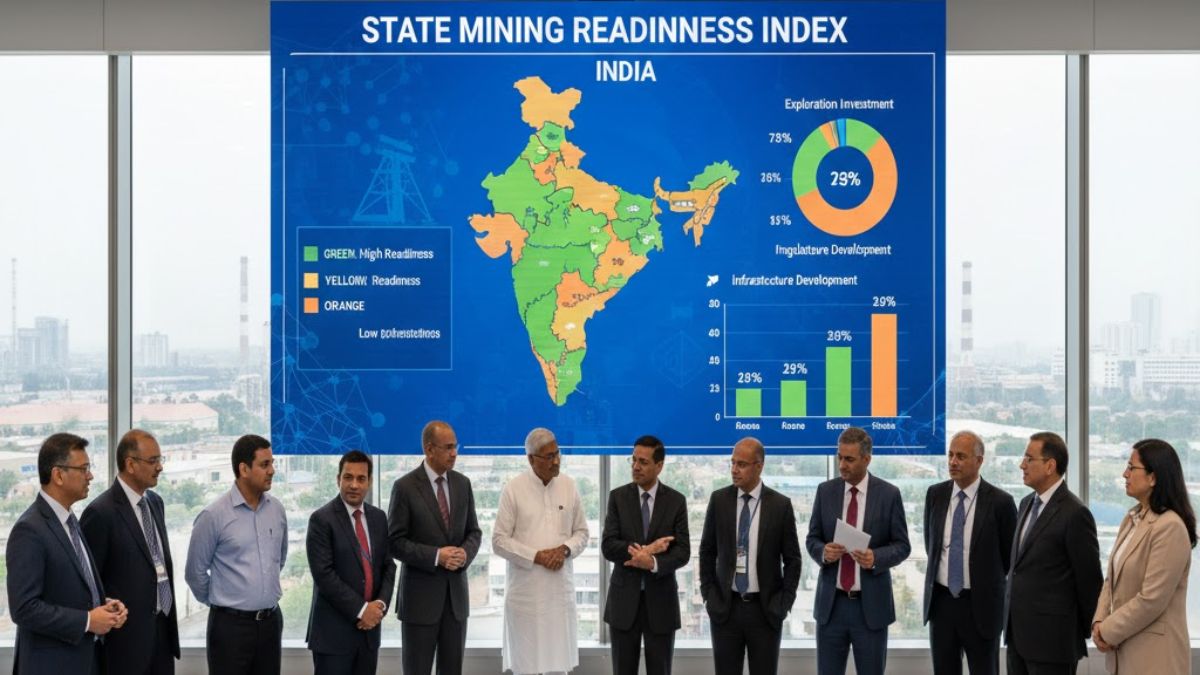
In a major move to modernize India’s mineral governance, the Ministry of Mines has released the first-ever State Mining Readiness Index (SMRI) and State Rankings for 2025. Announced as part of the Union Budget 2025–26, this index aims to benchmark States on how efficiently and sustainably they manage their non-coal mineral resources, ushering in a new era of transparency, accountability, and competition in the mining sector.
What Is the State Mining Readiness Index (SMRI)?
- The State Mining Readiness Index (SMRI) is a pioneering framework to assess and rank Indian States based on their reform-readiness, operational efficiency, and sustainability practices in the non-coal mining sector.
- Developed by the Ministry of Mines, it reflects a data-driven approach to strengthening federal governance in resource management.
- The index is designed to serve as a reform benchmarking tool, incentivizing States to improve their policies and systems in line with national development goals and sustainable mining principles.
Objectives of the SMRI
The SMRI is rooted in three key goals,
- Promote healthy competition among States to improve mining governance and operational efficiency.
- Improve transparency and ease of doing business in mineral auctions and mine development.
- Encourage sustainability, ensuring that mining aligns with India’s climate and social responsibilities.
Criteria and Methodology
States are evaluated based on four major performance indicators,
- Auction Performance – Assesses how transparently and efficiently mineral blocks are auctioned.
- Early Mine Operationalisation – Evaluates the time taken to operationalize auctioned blocks.
- Exploration Thrust – Focuses on investments and initiatives toward discovering new mineral reserves.
- Sustainable Mining Practices – Measures environmental compliance, community engagement, and rehabilitation efforts.
To ensure fair comparison, States are grouped into three categories based on their mineral resource endowment,
- Category A – Mineral-rich States
- Category B – Moderately endowed States
- Category C – Low-endowment States
This tiered approach accounts for inherent geographical disparities and encourages tailored policy interventions.
Focus on Non-Coal Minerals
- The SMRI deliberately focuses on non-coal minerals, particularly critical and strategic minerals such as lithium, rare earth elements, bauxite, and iron ore.
- This diversification is vital for India’s future industrial needs and supports initiatives like energy transition, EV manufacturing, and green infrastructure.
State Rankings 2025: Top Performers
The inaugural rankings for 2025 reveal key insights into State-level leadership in mining governance.
Category A (Mineral-Rich States)
- Madhya Pradesh – Known for aggressive auctioning and speedy operationalisation.
- Rajasthan – Strong on exploration and regulatory reforms.
- Gujarat – Balanced approach combining efficiency with sustainability.
Category B (Moderate Resources):
- Goa – Impressive recovery post mining bans with improved regulatory mechanisms.
- Uttar Pradesh – Focused initiatives on auction reforms and exploration.
- Assam – Emerging interest in diversifying its mineral economy.
Category C (Low-Endowment States):
- Punjab – Effective mineral governance despite resource limitations.
- Uttarakhand – Prioritising sustainability and small-scale mining policies.
- Tripura – Innovations in regulatory and compliance systems.
Significance and Policy Impact
The launch of SMRI marks a transformational shift in how mining performance is evaluated in India. It integrates mining with broader themes of governance, environmental responsibility, and cooperative federalism.
Key benefits include,
- Policy benchmarking for lagging States
- Improved investor confidence and project implementation timelines
- Data to inform future legislative reforms
- Motivation for States to align with national mineral security goals
- It also supports India’s Vision 2047 of becoming a global leader in sustainable resource management.


 UV Index Explained: The Hidden Health Ri...
 QS World University Rankings 2026: India...
 Best Airlines in the World 2026: Best Fu...