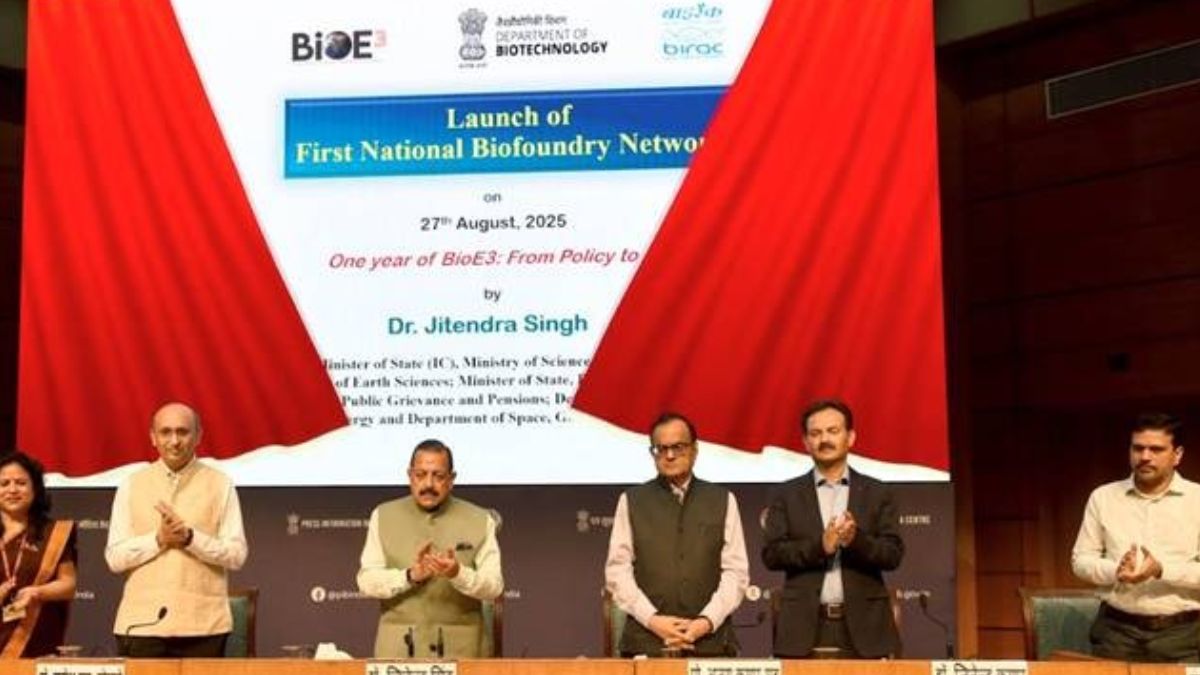
In 2025, India launched its first National Biofoundry Network (NBN) under the BioE3 Policy (Economy, Environment, Employment), marking a major step towards achieving the country’s ambitious $300 billion bioeconomy target by 2030. The initiative, unveiled by Union Science & Technology Minister Dr. Jitendra Singh, positions India as a global hub for sustainable biotechnology and indigenous biomanufacturing.
What is the National Biofoundry Network?
The National Biofoundry Network is a collaborative national-level platform comprising six premier biotechnology institutions. It is designed to translate biotech research into deployable market-ready solutions, fostering innovation in,
- Advanced biomanufacturing
- Synthetic biology
- Gene editing
- Climate-smart agriculture
- Green biotechnology
It acts as a one-stop ecosystem for design, prototyping, testing, and scaling up biotechnology products.
Objectives of the National Biofoundry Network
The initiative has multiple long-term goals,
- Strengthen indigenous biomanufacturing capacity.
- Align with BioE3 Policy goals of economy, environment, and employment.
- Accelerate research-to-market translation of biotech innovations.
- Promote youth-driven innovation, start-ups, and entrepreneurship.
- Position India as a sustainable biotech leader globally.
Features of the Biofoundry Network
- Integrated Network: Six institutions operate as a single collaborative platform.
- End-to-End Facility: Covers design → prototyping → testing → scale-up.
- Cutting-Edge Focus: Works on synthetic biology, CRISPR gene editing, and sustainable biotech.
- Innovation Funding: Linked to the BioE3 Challenge, supporting young innovators.
- Global Collaborations: Ties with international biofoundry networks for knowledge exchange.
- Employment & Start-up Boost: Creates jobs in biotech and incubates start-ups.
- Sustainability Lens: Focus on climate resilience, waste reduction, and bio-based economy.
- Open Access: Provides infrastructure access to academia, industry, and researchers.


 India Adds Highest Ever Wind Power Capac...
 Western Dedicated Freight Corridor Compl...
 ECINet KYC Feature Explained: How Voters...