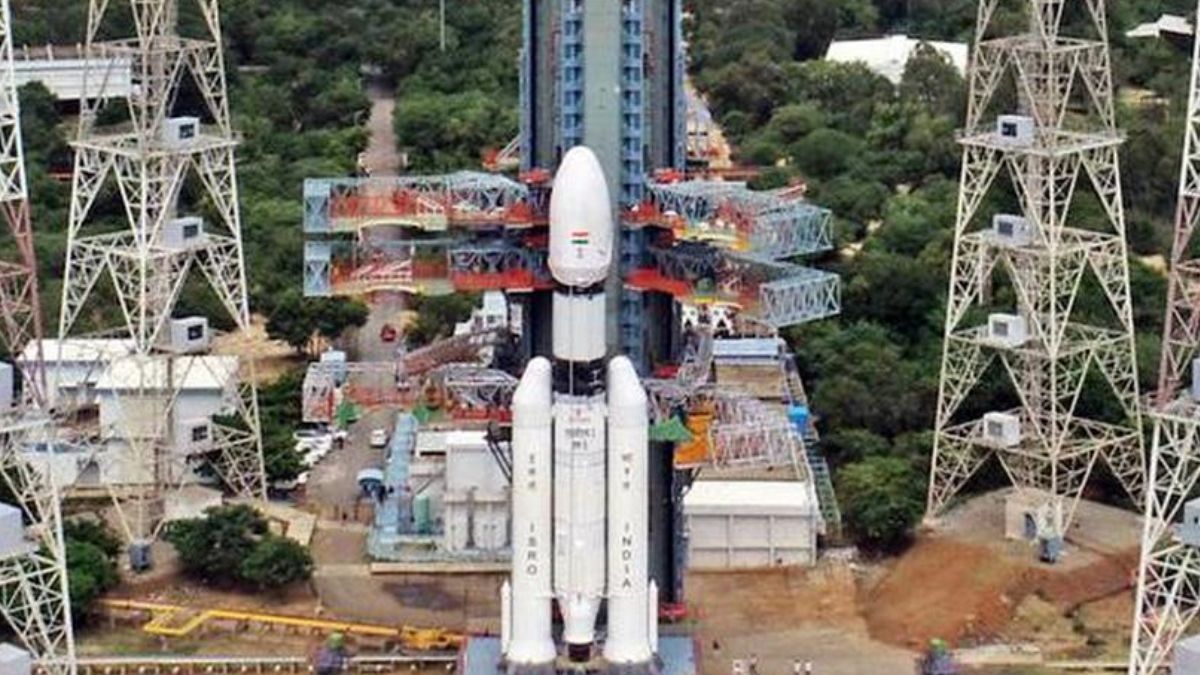
In a landmark achievement for Indian space ambitions, the Indian Space Research Organisation (ISRO) on 2 November 2025 launched the communications satellite CMS‑03, the heaviest such satellite to be launched from Indian soil, aboard the heavy‑lift rocket LVM3‑M5 (also referred to as GSLV‑Mk3). The launch took place from the Second Launch Pad at the Satish Dhawan Space Centre (SDSC) Sriharikota, marking the fifth operational flight of the LVM3 vehicle. This launch underscores India’s increasing self‑reliance in placing heavy satellites into the geo‑synchronous transfer orbit (GTO).
What Is CMS-03?
CMS-03 is a multiband communication satellite designed to boost India’s capabilities in secure, high-capacity communications across civilian and strategic sectors. It will enable,
- Faster internet and data services
- Enhanced broadcast coverage
- Communication support in remote regions
Mission Details
- The rocket had a lift‑off mass of 642 tonnes and a height of 43.5 metres.
- The satellite CMS‑03 weighed 4,410 kg and was successfully placed into GTO about 16 minutes after liftoff.
Flight sequence highlights,
- S200 solid boosters ignited at liftoff and separated at ~131.14 s at altitude ~62.3 km.
- L110 liquid stage ignited at ~106.94 s and separated at ~304.70 s at altitude ~166.9 km.
- C25 cryogenic upper stage ignited at ~307.10 s and burned until ~950.94 s, achieving an inertial velocity of ~10.14 km/s.
- Satellite separation at ~965.94 s at altitude ~179.8 km.
- The target orbit was a GTO with apogee around 29,970 km and perigee ~170 km – slightly lower than standard GTO to accommodate the heavy satellite weight.
Why This Launch Is Significant
- Heavy‑satellite under national launch capability: Until now, India has had to rely on foreign launch services for satellites of this mass to GTO. With CMS‑03, India now demonstrates capability to place heavier satellites itself.
- Strengthening launch vehicle capability: The LVM3 platform, earlier used for crew module tests and lunar missions (e.g., Chandrayaan‑3 on 14 July 2023), continues evolving to carry heavier payloads and support future human‑spaceflight ambitions.
- Strategic communications asset: CMS‑03 is a multiband communications satellite which will enhance India’s indigenous communications infrastructure, reduce dependence on foreign assets.
- Preparation for human spaceflight & larger payloads: The launch paves the way for future upgrades including a new cryogenic stage (C32) and semi‑cryogenic second stage allowing even higher payload mass‑to‑orbit, relevant for India’s crewed missions and space station ambitions.
Looking Ahead: Upgrades & Future Missions
- ISRO is working to introduce a C32 cryogenic upper stage (32,000 kg propellant, ~22‑tonne thrust) to allow more payload mass.
- Studies are underway for a semi‑cryogenic second stage using kerosene + liquid oxygen to boost mass‑to‑orbit capacity significantly.
- A future launch vehicle termed Lunar Module Launch Vehicle (LMLV) is being planned to carry up to 80,000 kg to Low Earth Orbit (LEO), supporting India’s ambitions toward lunar and human spaceflight missions.
Static Facts for Quick Revision
- Satellite: CMS‑03 (4410 kg)
- Launch Vehicle: LVM3‑M5 (GSLV‑Mk3 class)
- Launch Site: Second Launch Pad, Satish Dhawan Space Centre, Sriharikota
- Launch Date: 2 November 2025
- Target Orbit: Geo‑synchronous Transfer Orbit (approx 29,970 km apogee)


 Meet MAI-Transcribe-1: Microsoft’s Fast,...
 What is Outer Space Treaty 1967? Princip...
 What Is Mission Mitra? ISRO’s New Experi...