Another milestone has been reached with Japan placing the first orders for electronically powered train systems manufactured in India. Now Japan will be added to the global market for railway equipment made in India as the country shows its capabilities in manufacturing railway systems.
India is looking to increase their ambitions by exporting more complete train systems. The Railways Ministry has also spoken about the importance of Indian manufacturing in providing cutting-edge railway systems.
What is a Railway Propulsion System?
A railway propulsion system refers to the collection of equipment to produce, transform, and control the power needed to move a train. This can include a combination of traction motors, converters, and inverters.
A propulsion system is used to control how much power is sent to the train’s motors to help accelerate, control speed, and to brake. They are one of the largest parts of a train’s value comprising of almost 40% of the total.
Japan Order for Indian Railway Manufacturing
India has seen growth in becoming a global supplier of railway components, coaches, bogies, locomotives and propulsion systems, due to the ‘Make in India’ and ‘Make for the World’.
Alstom manufacturing in Gujarat has contributed greatly to the exports,
- Maneja (Vadodara): Over 5000 propulsion systems were exported.
- Savli (Vadodara): Over 3800 bogies were exported to countries such as Germany, Egypt, Sweden, Australia and Brazil.
- Flatpacks: Over 4000 modules were supplied to Vienna, Austria.
- India has also exported metro coaches to Australia and Canada. We have also supplied propulsion systems to France, Mexico, Romania, Spain, Germany and Italy.
This order from Japan is an exciting development as it means we are now supplying propulsion systems from India to another country. This will be the first order of propulsion systems from India to Japan.
India Targets Exporting Vande Bharat Trains by 2029-30
India’s target is to export complete Vande Bharat train sets made in India by 2029-30, according to Railway Minister Ashwini Vaishnaw.
This shows our goal to stop exporting individual components and start exporting complete passenger train sets.
The Vande Bharat is an important part of our indigenous train manufacturing and railway modernization. As a result, India has improved our capabilities in train design, propulsion, passenger comfort and manufacturing.
Indigenous High Speed Trains for Mumbai-Ahmedabad Corridor
India are also developing an indigenous high-speed train for the 508km Mumbai-Ahmedabad High Speed Rail Corridor.
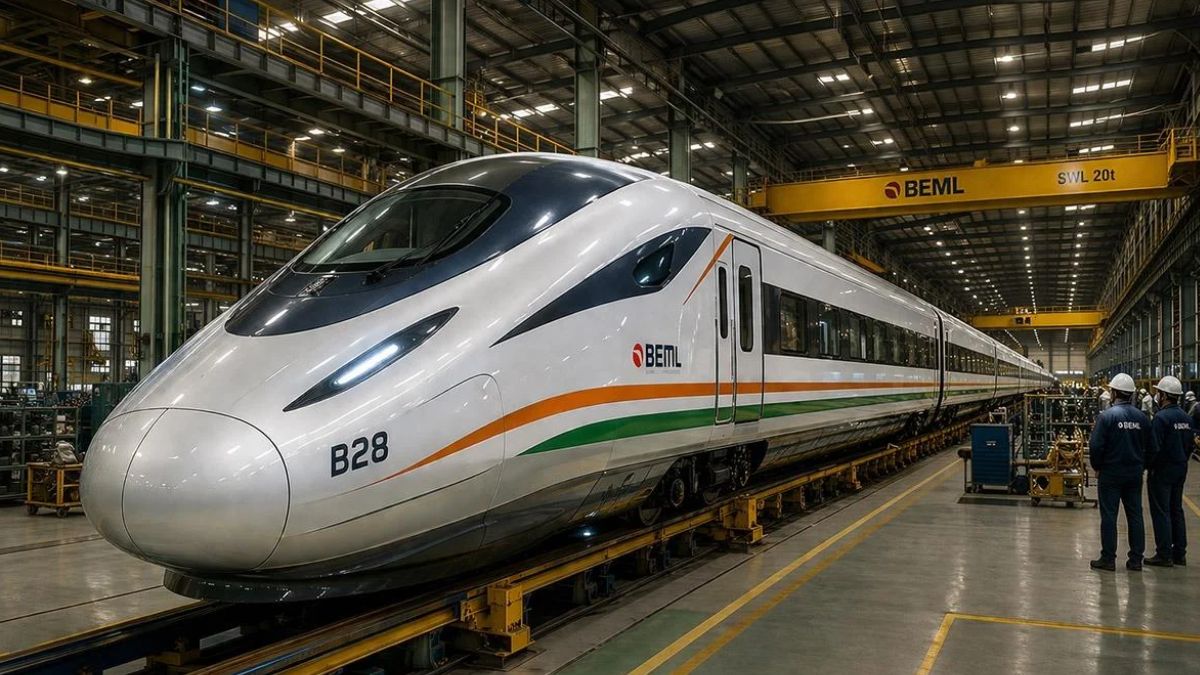
The train set, called the B28 or Vande Bullet, is being manufactured by Bharat Earth Movers Limited (BEML) at their Bengaluru site. It is being developed with the Integral Coach Factory (ICF) in Chennai, who have awarded the contract to BEML to design and manufacture the train sets.
B28 Train Set Features
- Train Name: B28 / Vande Bullet
- Manufacturer: BEML
- Partner: Integral Coach Factory (ICF) in Chennai.
- Corridor: Mumbai-Ahmedabad High Speed Rail Corridor.
- Maximum Speed: 280kmph
- Planned Speed: Approx 250kmph.
- Number of cars: 8
- Length: Approx 202m
- Capacity: Approx 557.
The train has a maximum testing speed of 280 km/h and planned speed of 249kmph. It is being designed to operate in India. The development of indigenous high-speed train sets, along with increasing propulsion system exports shows that India are trying to improve the engineering and manufacturing of railways within the country.





 India Records 38% Decline in TB Mortalit...
 PM Narendra Modi to Attend 23rd ASEAN-In...
 KVS Launches Three Digital Initiatives: ...