

India achieved a major breakthrough in defense technology by successfully testing the Agni-Prime missile from a rail-based mobile launcher. This landmark trial places India among a select group of nations—including the U.S., China, and Russia—with the ability to launch ballistic missiles from rail platforms. The Agni-Prime test is not just a technological milestone; it’s a strategic development that enhances India’s second-strike capability and strengthens its overall nuclear deterrence posture.
What is Agni-Prime?
Agni-Prime, or Agni-P, is the latest addition to India’s Agni missile series, developed by the Defence Research and Development Organisation (DRDO).
Key Features
- Range: Up to 2,000 km
- Propulsion: Two-stage solid propellant
- Launch Type: Canisterised missile, allowing for quick and secure deployment
- Mobility: Previously inducted road-mobile version; this test validated rail-based mobility
As the sixth missile in the Agni series, Agni-Prime is lighter, more accurate, and quicker to deploy than its predecessors.
Autonomous and Advanced Systems
The Agni-Prime missile is equipped with,
- Advanced communication systems
- Independent launch mechanisms
- Protective safeguards for secure handling
Ground stations closely tracked the missile’s trajectory during the test, confirming it met all mission objectives under full operational conditions.
Details of the Successful Launch
- The launch was carried out jointly by DRDO and the Strategic Forces Command (SFC).
- The test was conducted at an undisclosed location.
- The missile was launched from a special rail-mobile platform, showcasing cross-country operational readiness.
- The Defence Ministry confirmed that the entire launch system is fully autonomous, enabling rapid response and stealth operations.
- This is a clear demonstration of India’s growing ability to integrate strategic assets with its civil infrastructure for defense readiness.
Strategic Significance
Enhanced Second-Strike Capability
Rail-based launchers add a crucial layer to India’s nuclear triad—which comprises land, air, and sea-based delivery systems—by enhancing survivability and retaliation ability in case of a first strike.
Faster Deployment, Wider Reach
The ability to launch missiles from rail networks reduces the response time drastically, especially during conflict. It also ensures that India’s missile forces can be repositioned swiftly based on strategic needs.
Reduced Vulnerability
Fixed missile silos are easily identifiable and can be targeted. However, mobile platforms like trains make it significantly harder for enemy intelligence to predict or track missile deployments.
Key Points to Remember
- First successful rail-based launch of the Agni-Prime missile
- 2,000 km range with precision strike capability
- Strategic mobility and reduced detection via rail deployment
- Strengthens India’s nuclear deterrent posture
- DRDO and SFC jointly executed the test under operational conditions


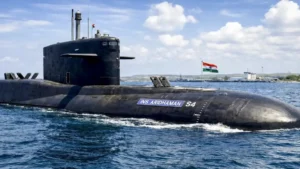 INS Aridhaman Nuclear Submarine Joins In...
 INS Sunayna Reaches Male, Boosting Marit...
 BRO's Project Chetak Turns 47: How It St...











