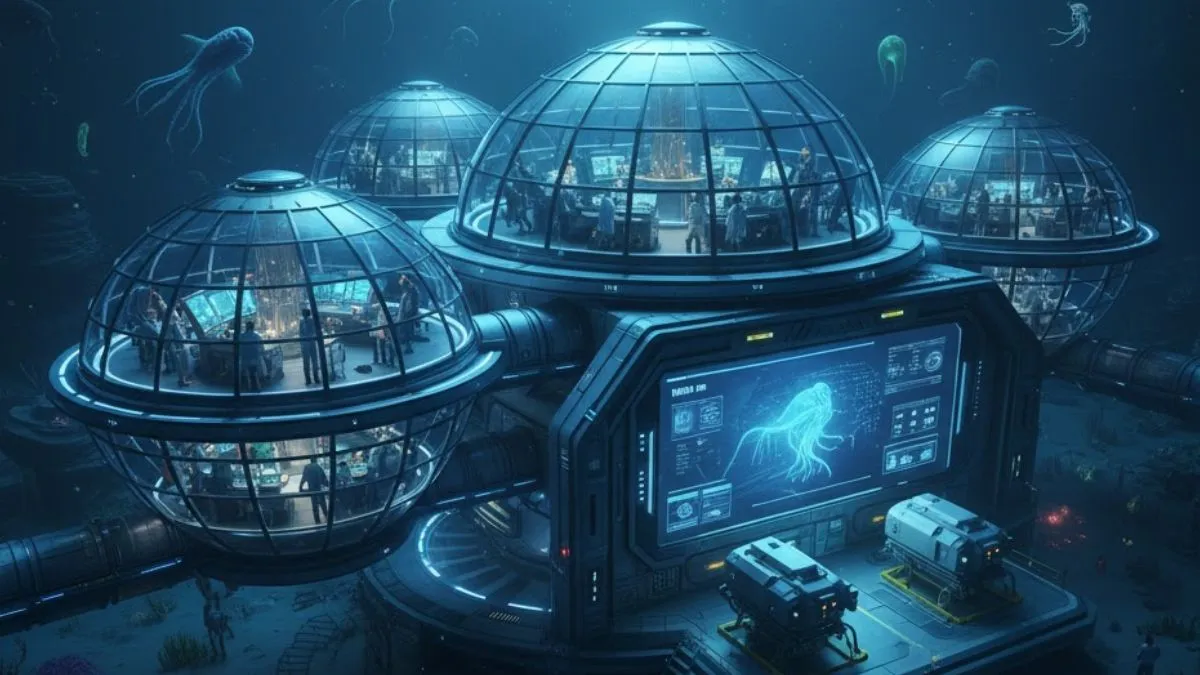
In a bold stride towards advancing deep-sea science, India has announced plans to construct the world’s deepest underwater research laboratory at a depth of 6,000 metres beneath the Indian Ocean. This cutting-edge facility will form a key part of India’s Vision 2047, marking the nation’s 100th year of independence with a global scientific milestone.
Project Overview: Visionary Ocean Exploration
The deep-sea habitat is envisioned as an oceanic version of the International Space Station (ISS). Initially, the mission will begin with a demonstrator module at 500 metres, designed to host three scientists underwater for over 24 hours. This will test life-support systems, pressure resistance, and logistical support mechanisms.
Once proven viable, this demonstrator will pave the way for the 6,000-metre full-scale habitat, which will be the deepest ever human-occupied research structure in marine history.
Unique Design Features and Technological Marvels
The deep-ocean lab will feature,
- Pressure-resistant titanium and composite structures to withstand the 600x atmospheric pressure found at 6,000 metres.
- 360-degree transparent observation panels to monitor marine life in real time.
- Oxygen regulation, temperature control, and independent lab compartments.
- Docking bays for research submersibles and supply vessels.
- Underwater communication systems using acoustic signals and fibre-optic links.
These innovations will allow long-term deployment and continuous scientific observation—transforming how deep-sea exploration is conducted.
Scientific Goals and Benefits
The deep-sea habitat aims to unlock secrets of the oceanic world that remain largely unexplored. Key research areas include,
- Marine biodiversity studies: Uncovering rare deep-sea organisms.
- Drug discovery: Exploring bioactive compounds from deep-sea microbes.
- Biotechnology: Harvesting enzymes and organisms suited for extreme environments.
- Geological research: Studying underwater tectonic and volcanic activity.
- Human performance: Understanding the impact of high-pressure environments on the human body.
This could place India at the forefront of marine bioprospecting and subsurface geology research.
India’s Global Edge in Deep-Sea Science
The only currently operational underwater research lab in the world, the Aquarius Reef Base (USA), operates at just 19 metres depth. India’s proposed 6,000-metre station would far surpass all existing facilities—setting new global benchmarks.
The lab also complements India’s broader “Samudrayaan Mission”, where crewed submersibles will explore the deep ocean as part of the Deep Ocean Mission under the Ministry of Earth Sciences.
Static Facts
- India to build: World’s deepest underwater lab (6,000m)
- Pilot module depth: 500 metres
- Target year for full deployment: By 2047
- Comparable concept: Underwater version of the International Space Station
- Main materials used: Titanium alloys, composite pressure hulls
- Existing global benchmark: Aquarius Reef Base (19m, USA)
- Project focus: Deep-sea biology, geology, drug discovery, high-pressure tech
- Part of: Vision 2047 and Deep Ocean Mission


 CAPF Bill 2026 Explained: How Government...
 INS Taragiri: Key Capabilities of India’...
 Sheshnaag-150 (India) vs ZALA Lancet-3 (...