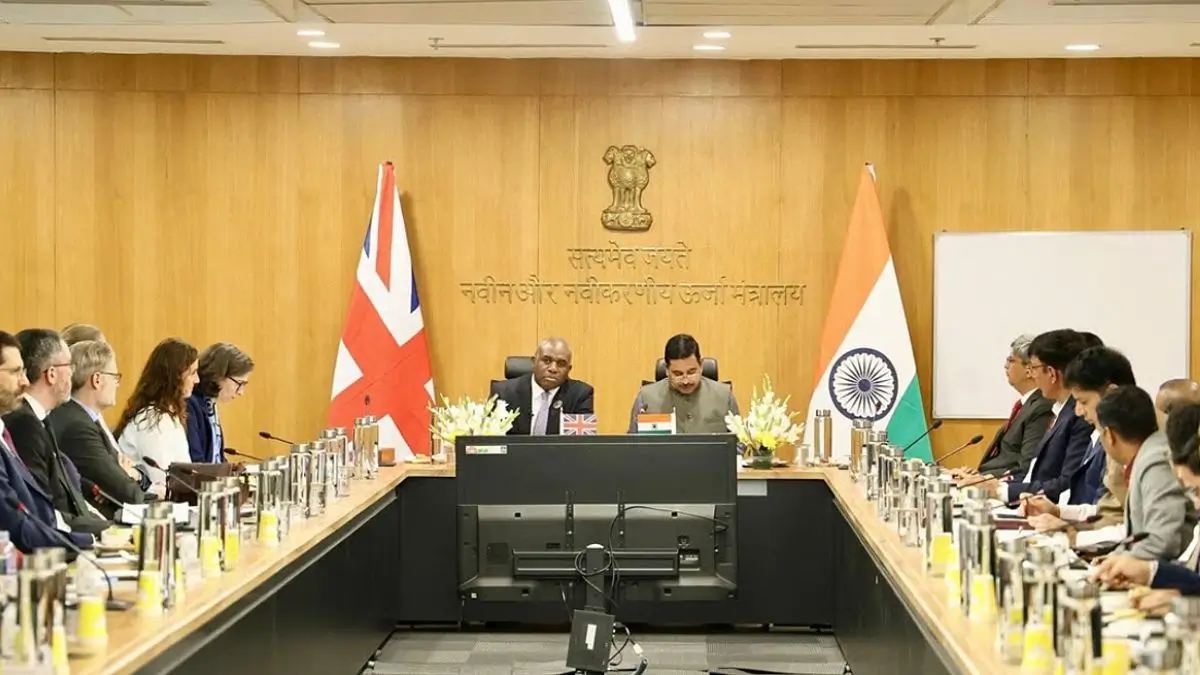
India and the United Kingdom have launched the India-UK Offshore Wind Taskforce to strengthen clean energy cooperation under Vision 2035. The initiative was unveiled on February 18 during the Fourth India-UK Energy Dialogue. Union Minister Pralhad Joshi described the platform as a “Trustforce” focused on delivering measurable milestones rather than symbolic partnerships. The taskforce aims to accelerate India’s offshore wind ecosystem, combining UK expertise with India’s large-scale renewable energy ambitions.
India-UK Offshore Wind Taskforce Launched Under Vision 2035
- The India-UK Offshore Wind Taskforce was launched by Pralhad Joshi alongside David Lammy.
- The initiative operates under Vision 2035 and the Fourth India-UK Energy Dialogue.
- The taskforce is designed to provide strategic leadership and coordination for India’s developing offshore wind ecosystem.
- The UK brings experience in scaling offshore wind projects and building supply chains, while India contributes market scale and rising clean energy demand.
Three Key Pillars of the Offshore Wind Taskforce
The India-UK Offshore Wind Taskforce will focus on three priority pillars,
- First, ecosystem planning and market design, including seabed leasing frameworks and revenue certainty mechanisms.
- Second, infrastructure and supply chains, covering port modernisation, domestic manufacturing and specialised marine vessels.
- Third, financing and risk mitigation, including blended finance models and mobilising long-term institutional capital.
These pillars aim to create a stable and bankable environment for offshore wind investments in India.
Offshore Wind in Gujarat and Tamil Nadu
- Promising offshore wind zones have been identified off the coasts of Gujarat and Tamil Nadu.
- Studies by the National Institute of Wind Energy have laid the groundwork for initial projects.
- To support early deployment, the government has approved a Viability Gap Funding (VGF) scheme of Rs 7,453 crore (around 710 million Pound).
- Offshore wind is considered complex due to high infrastructure costs, marine logistics, and grid integration challenges.
- The taskforce seeks to address these structural barriers systematically.
Link with National Green Hydrogen Mission
- The India-UK Offshore Wind Taskforce aligns with India’s National Green Hydrogen Mission.
- Offshore wind can supply high-quality renewable energy to coastal green hydrogen clusters.
- India currently leads the Hydrogen Breakthrough Goal under the Breakthrough Agenda.
- Green hydrogen prices have fallen to Rs 279 per kg, while green ammonia prices stand at Rs 49.75 per kg. Offshore wind can further reduce renewable power costs and strengthen India’s clean industrial ecosystem.
India’s Growing Renewable Energy Capacity
- India’s installed non-fossil fuel capacity has crossed 272 GW, including over 141 GW of solar and 55 GW of wind power.
- In the current financial year alone, more than 35 GW of solar and 4.61 GW of wind capacity have been added.
- Under Vision 2035, offshore wind is expected to become a strategic pillar in India’s next phase of energy transition, focusing on reliability, grid stability, and industrial competitiveness.
What Is Offshore Wind Energy?
- Offshore wind energy involves installing wind turbines in sea waters to harness stronger and more consistent wind speeds compared to onshore projects.
- It requires advanced marine engineering, port infrastructure, and high investment.
- Countries like the UK have successfully developed large-scale offshore wind farms.
- For India, offshore wind represents a new frontier in renewable energy expansion and energy security diversification.
Question
Q. The India-UK Offshore Wind Taskforce was launched under which framework?
A) Make in India
B) Vision 2035
C) National Solar Mission
D) SAGAR Initiative


 Costa Rica Launches Snake Identification...
 WTO 14th Ministerial Conference Conclude...
 Former Suriname President Chandrikapersa...