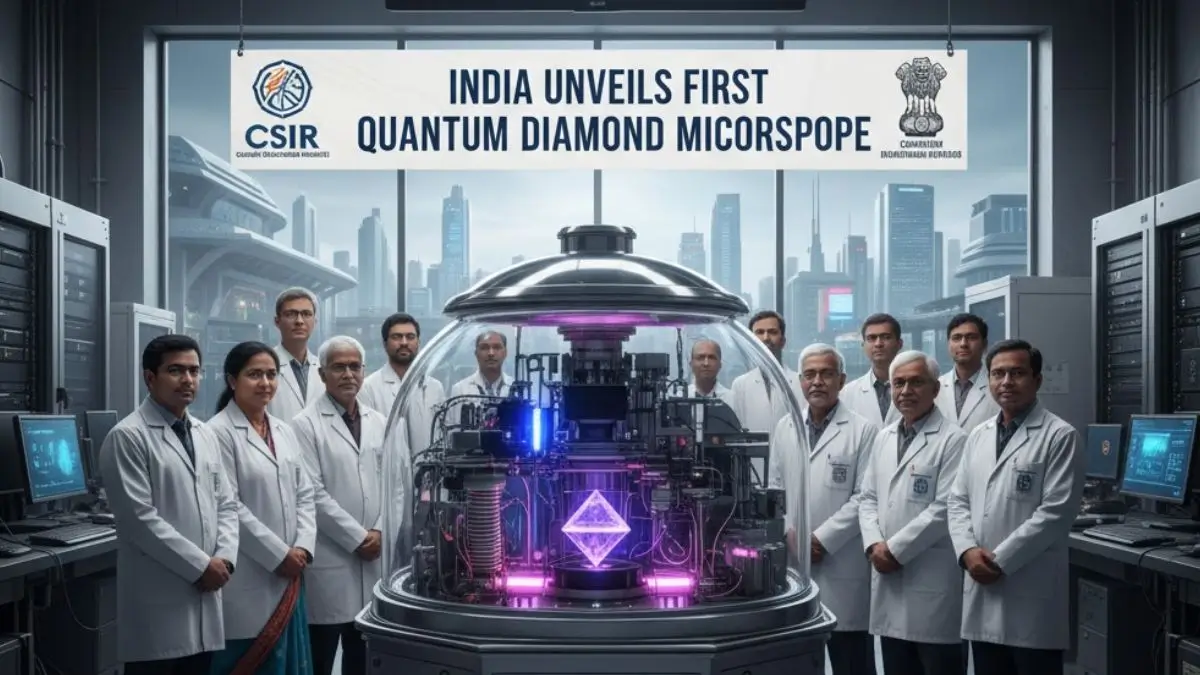
At the forefront of scientific innovation, India has achieved a significant milestone with the launch of its first indigenous Quantum Diamond Microscope (QDM), developed by the P-Quest Group at IIT Bombay. Announced at ESTIC 2025 (Emerging Science Technology and Innovation Conclave), this cutting-edge tool is set to transform areas like neuroscience, materials science, and semiconductor diagnostics.
What is a Quantum Diamond Microscope?
The Quantum Diamond Microscope is an advanced quantum sensing device that uses nitrogen-vacancy (NV) centers in diamond to detect minute magnetic fields with high precision.
How it Works,
- NV centers are atomic-scale defects in a diamond, where a nitrogen atom sits next to a missing carbon atom.
- These centers maintain quantum coherence at room temperature, making them ideal for sensitive measurements.
- Using a technique called Optically Detected Magnetic Resonance (ODMR), the NV centers emit fluorescence that changes in the presence of magnetic fields.
- This enables real-time 3D magnetic field imaging, similar to how a regular optical microscope visualizes light-based images.
The system is capable of capturing widefield nanoscale images of dynamic magnetic phenomena, making it invaluable in non-destructive testing and biological research.
Applications and Impact
Neuroscience and Brain Research
The QDM can map real-time magnetic activity in neurons and brain tissues, offering a non-invasive route to understanding brain signaling and disorders at unprecedented resolution.
Semiconductor and Chip Design
With the growth of 3D chip architectures, existing diagnostic tools fail to visualize complex current flows. The QDM provides layer-by-layer magnetic mapping of chips without dismantling them — crucial for autonomous systems, cryogenic processors, and next-gen electronics.
Battery and Materials Science
In battery diagnostics and materials research, QDM can trace ionic movement, phase transitions, and magnetic signatures within layered or encapsulated structures.
A Boost for National Quantum Mission
This breakthrough supports India’s National Quantum Mission (NQM), spearheaded by the Department of Science and Technology (DST). The mission aims to develop indigenous capabilities in quantum technologies across sensing, computing, cryptography, and materials.
Led by Professor Kasturi Saha, the P-Quest Group has also secured India’s first patent in this niche field of quantum magnetic imaging — marking a critical step toward quantum self-reliance.
Who Was Present at the Launch?
The QDM’s unveiling took place in the presence of key figures from India’s scientific leadership,
- Dr. Jitendra Singh, Union Minister for Science and Technology
- Prof. Ajay K. Sood, Principal Scientific Adviser to the Government
- Prof. Abhay Karandikar, Secretary, Department of Science and Technology
Their presence underlined the government’s support for high-impact, homegrown innovations in emerging fields.
Static Facts
- Launched: November 2025 at ESTIC
- Developed by: P-Quest Group, IIT Bombay
- Led by: Prof. Kasturi Saha
- Technology Base: Nitrogen-vacancy (NV) centers in diamond
- Function: 3D magnetic field imaging using ODMR
- Applications: Neuroscience, chip diagnostics, materials research
- India’s First Patent: In the domain of QDM magnetic imaging
- Part of: India’s National Quantum Mission


 India's First Quantum Computer to be Lau...
 India Strengthens Marine Research with B...
 AP Science City Signs 5-Year MoU with CS...