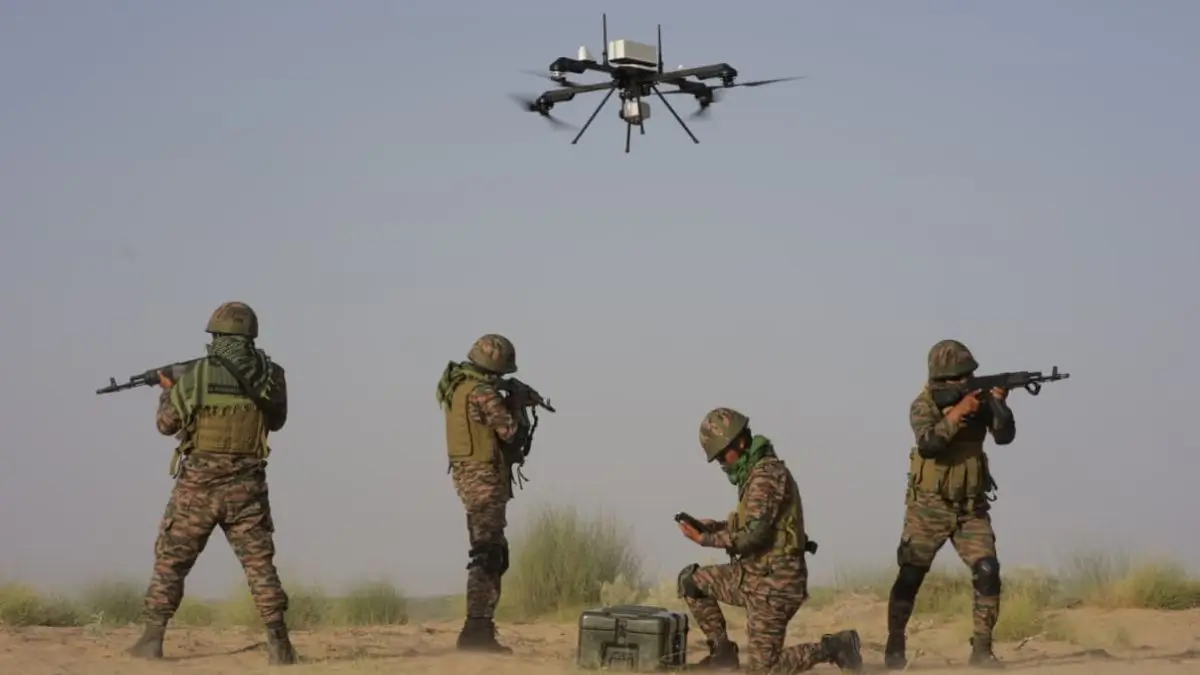
In a strategic leap toward embracing next-generation warfare, the Indian Army conducted ‘VAYU SAMANVAY-II’, a major drone and counter-drone exercise from 28–29 October 2025 in the forward desert areas under the Southern Command. This large-scale drill marked a significant advancement in India’s operational preparedness against aerial threats, reflecting the Army’s evolving emphasis on technology-driven, multi-domain combat.
Purpose and Significance of the Exercise
- VAYU SAMANVAY-II aimed to validate doctrinal principles surrounding the deployment and neutralization of drones in combat.
- The Indian Army tested its capabilities in a realistic, electronically contested environment, closely simulating future battlefields where electronic warfare, aerial surveillance, and AI-enabled command and control will play a decisive role.
Why It Matters
- Drones are now frontline tools in modern warfare — for surveillance, targeting, and delivery of payloads.
- Counter-drone technologies are equally critical to neutralize threats posed by hostile UAVs, especially in border and desert regions.
- Exercises like this allow India to rapidly adapt to the evolving threat landscape, while integrating indigenous technologies under live conditions.
Location and Terrain Advantage
The desert terrain and challenging weather conditions provided an ideal testing ground for both drone deployment and countermeasures. Operating in these extreme environments helps assess,
- Endurance and performance of drone systems
- Signal resilience in electronic warfare settings
- Ground force coordination in multi-domain operations
Technological Focus and Doctrinal Development
The exercise showcased the fusion of aerial and ground assets, testing,
- Unmanned Aerial Systems (UAS) and swarm drones
- Electromagnetic interference scenarios to simulate adversarial tech
- AI-based Command and Control (C2) centres for real-time decision-making
- Integration of indigenous drone and counter-drone systems
These components reflect the Army’s shift toward building a future-ready doctrine that embraces joint force capabilities and digitized warfare strategies.
Interoperability and Indigenous Innovation
VAYU SAMANVAY-II also emphasized joint interoperability between various Army arms, enhancing real-time communication and coordination. Troops were given the opportunity to,
- Use and assess Made-in-India drone systems
- Test counter-UAV jammers, spoofers, and detection radars
- Participate in simulated attack, defend, and neutralize scenarios using tech-aided tools
Static Facts
- Exercise Name: VAYU SAMANVAY-II
- Dates: 28–29 October 2025
- Location: Desert Sector, under Southern Command
- Objective: Test drone and counter-drone warfare readiness
- Environment: Realistic, electronic warfare simulated battlefield
- Led by: Lt. Gen. Dhiraj Seth, PVSM, AVSM
- Key Features: Integration of aerial and ground assets, indigenous tech, AI-enabled C2 systems


 INS Aridhaman Nuclear Submarine Joins In...
 INS Sunayna Reaches Male, Boosting Marit...
 BRO's Project Chetak Turns 47: How It St...