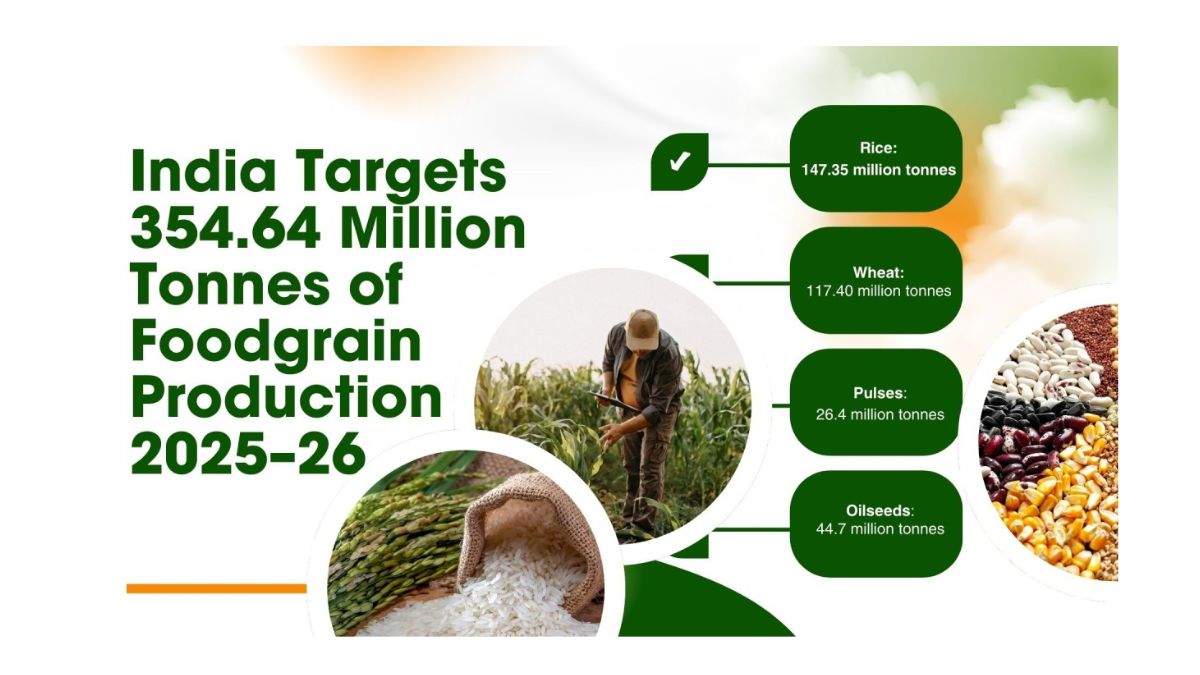
The year 2025 emerged as a watershed moment for India’s agricultural sector, reflecting the cumulative impact of policy continuity, public investment and institutional reforms undertaken over the past decade. Agriculture and allied activities continued to anchor the rural economy which is contributing nearly 16% to India’s GDP in FY 2024-25 and supporting the livelihoods of over 46% of the population. The year underscored that Indian agriculture is no longer confined to subsistence, but is steadily transitioning towards productivity, diversification, sustainability, and income security.
Record Foodgrain Production and Crop Performance
- India achieved its highest ever foodgrain production of 357.73 million tonnes in 2024-25, marking an 8% increase over the previous year and a historic rise of over 106 million tonnes compared to 2015–16.
- This milestone was driven by strong performance across major crops.
- Rice production reached 150.18 million tonnes, while wheat output stood at 117.95 million tonnes, both registering record levels.
- Pulses, oilseeds, maize, and millets also showed robust growth, supported by targeted crop missions, improved seed availability, and assured procurement mechanisms.
- The steady expansion of “Shree Anna” (millets) reaffirmed India’s global leadership in climate-resilient and nutrition-rich cereals, aligning agricultural growth with sustainability and food security goals.
Minimum Support Price and Income Assurance
- The Minimum Support Price (MSP) policy remained a cornerstone of farmer income stability in 2025.
- MSP for all mandated crops continued to ensure a minimum 50% return over the cost of production, reinforcing production incentives and planning confidence.
- Since 2014, MSP procurement has delivered unprecedented income support.
- Paddy procurement payments crossed ₹14.16 lakh crore, while wheat procurement exceeded ₹6.04 lakh crore, together surpassing ₹20 lakh crore.
- Procurement of pulses and oilseeds expanded sharply, especially for tur, urad, chana, and moong, correcting long-standing price volatility in these crops.
Direct Income Support and Agricultural Credit
- Direct benefit transfers under PM-Kisan Samman Nidhi continued to be a lifeline for farmers.
- By August 2025, nearly ₹3.90 lakh crore had been transferred through 20 instalments, benefiting over 11 crore farmers across the country.
- Institutional credit access also expanded significantly through the Kisan Credit Card programme.
- Cumulative agricultural credit crossed ₹10 lakh crore, reaching 7.71 crore farmers, with improved inclusion of small and marginal farmers, as well as livestock and fisheries stakeholders.
Risk Mitigation and Irrigation Expansion
- Crop risk protection under the Pradhan Mantri Fasal Bima Yojana continued to strengthen farmer confidence. Since 2016, claims worth ₹1.83 lakh crore have been paid, with enrolment rising sharply in 2024–25, especially among non-loanee farmers.
- Irrigation coverage expanded under the Pradhan Mantri Krishi Sinchai Yojana, with accelerated completion of long-pending projects and wider adoption of micro irrigation.
- Improved water-use efficiency enabled farmers to diversify towards high-value crops, enhancing income potential.
Agricultural Infrastructure and Village Level Services
- Infrastructure investment remained central to agricultural governance in 2025.
- The Agriculture Infrastructure Fund sanctioned over one lakh projects, strengthening storage, warehousing, cold chains, processing units, and Custom Hiring Centres. These interventions reduced post-harvest losses, curbed distress sales, and generated rural employment.
- Simultaneously, the rollout of PM Kisan Samriddhi Kendras transformed input delivery by integrating fertilizers, seeds, advisory services, and agri solutions at the village level, improving last-mile service access for farmers.
Market Reforms and Farmer Collectivisation
- Market transparency and price discovery improved through the expansion of the e-NAM platform. Increasing trade volumes, wider mandi integration, and enhanced farmer onboarding enabled better market access beyond local boundaries.
- The formation of 10,000 Farmer Producer Organisations (FPOs) emerged as a major structural reform.
- FPOs strengthened collective input procurement, marketing, and value addition, particularly benefiting smallholders, women farmers, and marginal producers.
Allied Sectors: Dairy, Fisheries and Horticulture
- Allied activities played a decisive role in income diversification. India retained its status as the world’s largest milk producer, accounting for nearly one fourth of global output, with milk production crossing 239.30 million tonnes.
- Growth was supported by the Rashtriya Gokul Mission and dairy infrastructure programmes.
- Fisheries production reached 195 lakh tonnes in 2024–25, driven by inland fisheries and enhanced budgetary support.
- Horticulture output continued its upward trend, while food processing exports crossed USD 49.4 billion by July 2025, reflecting growing value addition and global integration.
Sustainability, Climate Resilience and Energy Transition
- Sustainability remained integral to agricultural policy. Natural and organic farming expanded under dedicated missions, while the Soil Health Card scheme promoted balanced nutrient use through widespread soil testing.
- The ethanol blending programme achieved 19.05% blending by July 2025, generating foreign exchange savings, reducing crude oil imports, and providing additional income to sugarcane farmers.
- Renewable energy adoption under PM-KUSUM expanded solar pump coverage and decentralized solar power generation on farmlands.
Key Takeaways
- Agriculture contributed Nearly 16% to GDP and supported 46% of India’s population in FY 2024–25.
- Record foodgrain production: 357.73 million tonnes in 2024–25.
- MSP ensured 50% return over cost; paddy and wheat procurement exceeded ₹20 lakh crore since 2014.
- PM-Kisan transfers reached ₹3.90 lakh crore benefiting 11+ crore farmers.
- Agricultural credit crossed ₹10 lakh crore under KCC.
- PMFBY paid ₹1.83 lakh crore in claims since 2016.
- Allied sectors dairy, fisheries, horticulture drove income diversification.


 Loni Overtakes Delhi as Worlds Most Poll...
 Meet the Young Voice Representing India ...
 Supreme Court Rules on SC Status: Conver...