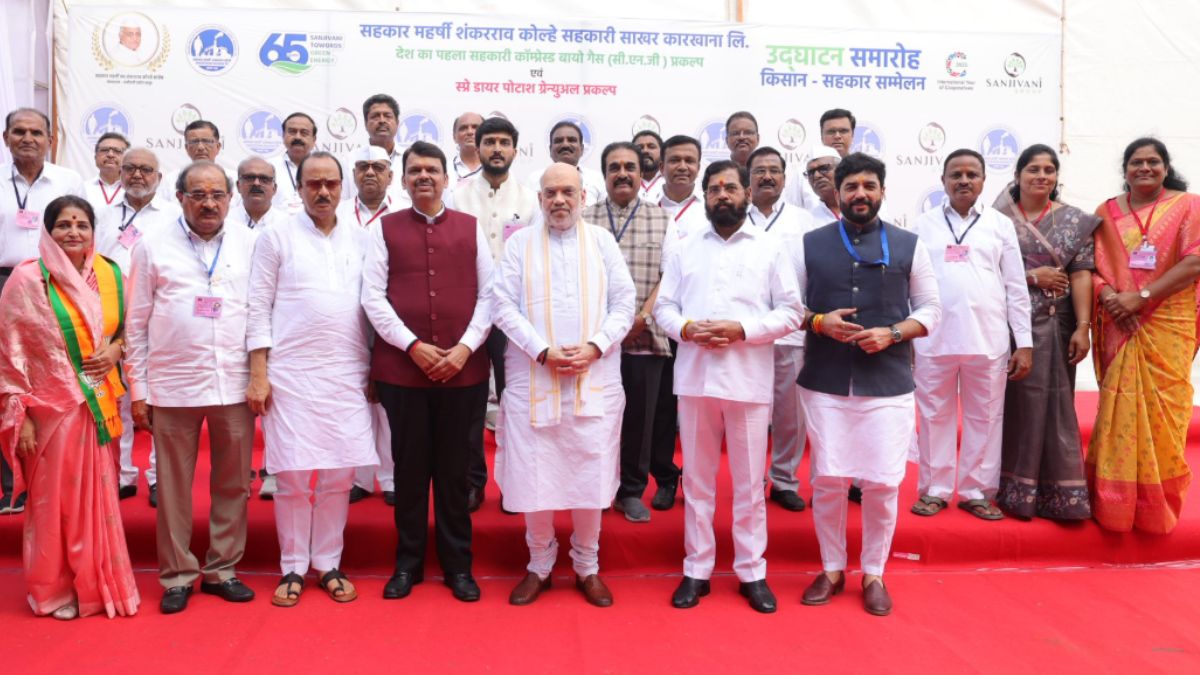
In a pathbreaking move, Union Home and Cooperation Minister Amit Shah inaugurated India’s first cooperative‑run compressed biogas (CBG) and spray dryer potash granule project at the Sahakar Maharshi Shankarrao Kolhe Cooperative Sugar Factory in Kopargaon, Maharashtra. This marks a pioneering effort to integrate energy, fertilizer, and agricultural waste utilization under a cooperative framework.
Project Details
- The new facility is designed to produce both CBG as a clean fuel substitute and potash granules for fertilizers using by‑products from sugar processing and organic waste.
- The cooperative model ensures farmers and local stakeholders have ownership and benefit share.
- The goal is to diversify beyond ethanol production and encourage circular economy practices within agro‑industries.
Significance
- The project is also backed by the National Cooperative Development Corporation (NCDC), which will provide financial support to replicate this model.
- Additionally, the government plans to strengthen cooperatives, women’s self‑help groups, and credit societies in the rural economy as part of the larger scheme.
- The government has enhanced Minimum Support Prices (MSP) for key crops and will establish 1,000 processing units to supply high‑quality seeds to farmers, furthering rural development.
Benefits & Opportunities
- Energy self‑reliance: CBG can replace fossil fuels in certain uses, reducing import dependency.
- Value addition: Waste from sugar processing and other biomass is converted into potash fertilizer, closing the loop.
- Farmer income boost: Local farmers supplying biomass can get additional revenue.
- Scalability: If successful, the model can be expanded across sugar cooperatives nationally.
- Eco‑friendly: Reduces waste, cuts emissions, and aligns with green energy goals.
Challenges & Considerations
- Ensuring technical reliability and capacity utilization in an integrated plant combining fuel and fertilizer outputs.
- Managing feedstock supply chain—consistent quality and quantity from agricultural waste.
- Guaranteeing fair benefit distribution among farmers, workers, and cooperative members.
- Sustaining operation costs, maintenance, and logistics, especially in less accessible regions.
- Addressing regulatory clearances, environmental norms, and monitoring emissions.
Important Takeaways
- First cooperative‑run CBG + potash granule project launched in India
- Location: Kopargaon, Maharashtra
- Operated by Sahakar Maharshi Shankarrao Kolhe Cooperative Sugar Factory
- Model to be replicated in 15 cooperative sugar factories
- Supported by NCDC
- Focus: Circular economy, energy diversification, rural income generation


 Amaravati Set to Become The Andhra Prade...
 How Many Seats Are There in Bihar Legisl...
 Nitish Kumar Resigns as Legislative Coun...