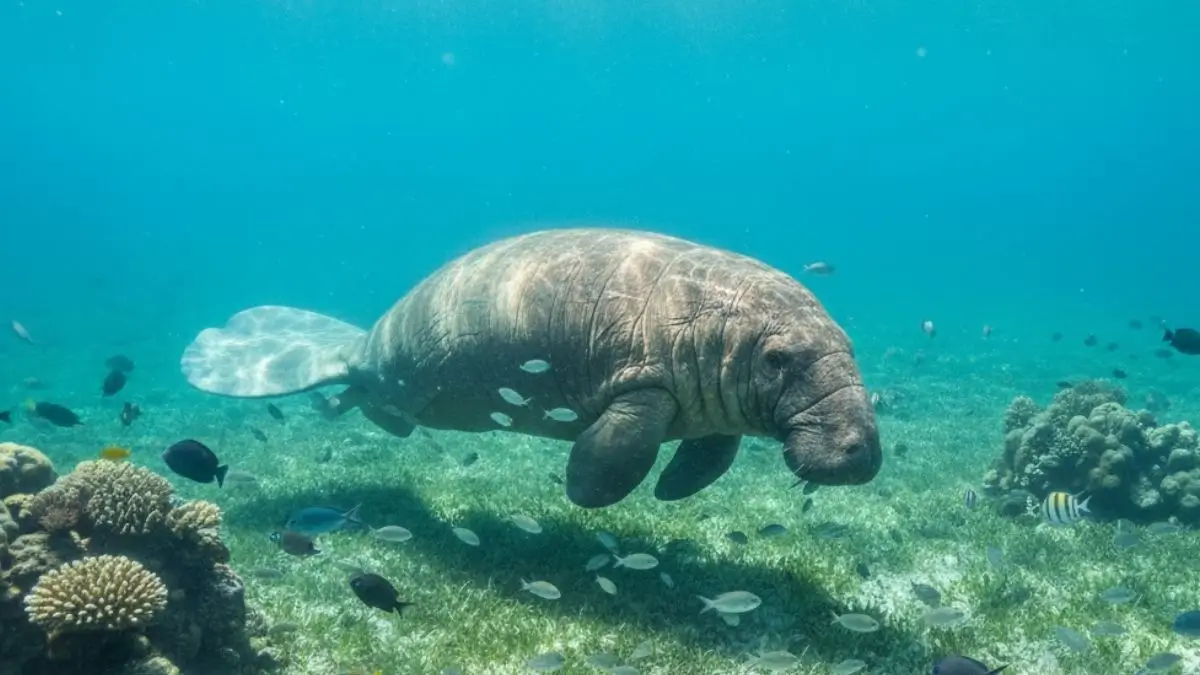
In a landmark for marine conservation, the International Union for Conservation of Nature (IUCN) officially recognized India’s first Dugong Conservation Reserve, located in Palk Bay, Tamil Nadu, during the 2025 IUCN World Conservation Congress. This recognition marks a crucial step in safeguarding one of India’s most endangered marine mammals — the dugong.
About the Dugong Conservation Reserve
- Established in September 2022 by the Tamil Nadu government under the Wildlife Protection Act, 1972, the Dugong Conservation Reserve spans an area of 448.34 sq. km. in the northern Palk Bay.
- The region hosts over 12,250 hectares of seagrass meadows, which are essential feeding grounds for dugongs, also known as “sea cows.”
- These meadows also act as carbon sinks and breeding zones for many marine species, enhancing coastal biodiversity and fish production.
Dugong: The Gentle Gardener of the Sea
Physical and Behavioral Traits
- Dugongs (Dugong dugon) are marine herbivores and close relatives of manatees.
- They possess a plump body, flipper-like forelimbs, and a fluked tail similar to dolphins. These mammals feed exclusively on seagrass, consuming 30–40 kg a day.
- Because of their feeding habits, dugongs are called “gardeners of the sea,” as their grazing activity helps maintain healthy seagrass ecosystems, which in turn support fish breeding and coastal health.
Habitat Range in India
Dugongs are typically found in warm, shallow, and calm coastal waters with rich seagrass beds. In India, they inhabit,
- Palk Bay
- Gulf of Mannar
- Gulf of Kutch
- Andaman and Nicobar Islands
Conservation Status and Threats
Despite their ecological significance, dugong populations are dwindling due to,
- Hunting for meat and oil
- Bycatch in commercial fishing nets
- Boat strikes
- Degradation of seagrass habitats due to pollution and coastal development
The species is listed as “Vulnerable” on the IUCN Red List and is protected under Schedule I of the Wildlife (Protection) Act, 1972, which offers the highest degree of protection in India.
Importance of the IUCN Recognition
The IUCN endorsement at the global conservation congress,
- Validates India’s commitment to marine biodiversity protection
- Brings international attention to the Palk Bay ecosystem
- Encourages further scientific collaboration and funding
- Sets a template for other marine conservation efforts across India
This move also supports India’s wider goals under the UN Decade of Ocean Science and contributes to SDG 14 – Life Below Water.
Key points to remember
- Location: Northern Palk Bay, Tamil Nadu
- Size: 448.34 sq. km
- Established: September 2022
- Recognized by IUCN: 2025
- Species protected: Dugong (Dugong dugon)
- Protection Status: IUCN Vulnerable, Schedule I under Wildlife Act


 E20 Petrol India 2026: Nationwide Rollou...
 NCERT Gets ‘Deemed University’ Status: W...
 India Ranks 3rd Globally in Renewable En...