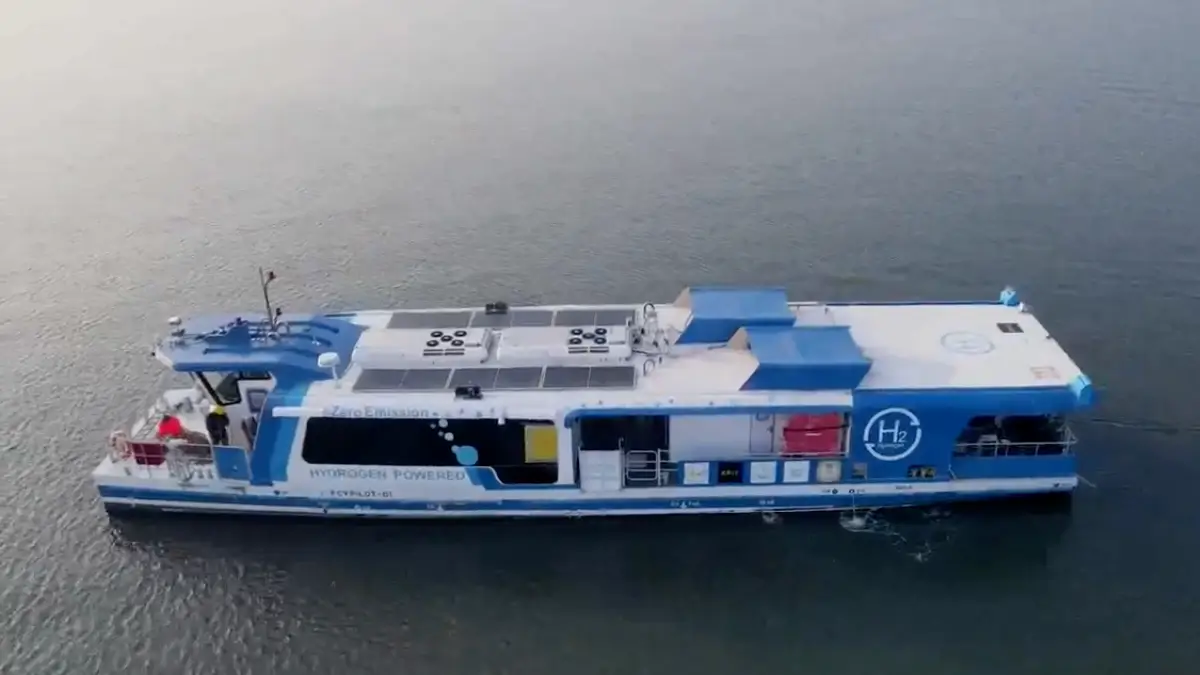
India has taken a historic step in green maritime mobility with the launch of its first fully indigenous hydrogen fuel cell passenger vessel, which began commercial operations at Namo Ghat, Varanasi. The vessel was flagged off by Union Minister Sarbananda Sonowal, marking a breakthrough in India’s transition toward clean, sustainable and self-reliant waterways.
This pioneering vessel is the first in the country to demonstrate hydrogen fuel cell propulsion, showcasing India’s capability to develop and deploy advanced green technologies in the maritime sector.
About the Vessel: Indigenous, Eco-Friendly and Technologically Advanced
Built by Cochin Shipyard Ltd. (CSL) and owned by the Inland Waterways Authority of India (IWAI), the vessel is powered by a Low Temperature Proton Exchange Membrane (PEM) fuel cell system, converting hydrogen into electricity with only water as the byproduct.
Key Features
- 24-meter catamaran design for maximum stability
- Passenger capacity: 50 (air-conditioned cabin)
- Service speed: 6.5 knots
- Operational duration: Up to 8 hours on a single hydrogen fill
- Hybrid system: Hydrogen fuel cell + batteries + solar power
- Zero pollution: No smoke, no noise, only water emissions
- Certified by: Indian Register of Shipping
This makes Varanasi one of the first cities in the world to deploy hydrogen-powered passenger transport.
Pilot Deployment and Safety Framework
To operationalise FCV Pilot-01, IWAI, CSL, and Inland and Coastal Shipping Ltd. have signed a tripartite agreement covering:
- Technical oversight
- Safety procedures
- Financial arrangements
- Monitoring and inspection mechanisms
These measures ensure the vessel operates safely under real-world commercial conditions while gathering valuable data for future scaling.
Benefits for Varanasi and Inland Water Transport
The hydrogen vessel is designed to improve the quality and efficiency of river-based mobility:
Passenger & Environmental Benefits
- Zero-emission travel along the Ganga
- Noise-free commute for pilgrims and passengers
- Reduced road congestion by shifting traffic to waterways
- Boost to tourism with modern, eco-conscious transport
This also strengthens Varanasi’s global identity as a city adopting futuristic sustainable technologies.
Maiden Commercial Run: Namo Ghat to Lalita Ghat
The vessel’s first commercial trip, covering a 5 km stretch from Namo Ghat to Lalita Ghat, was attended by:
- Union Minister Sarbananda Sonowal
- MoS Ravindra Jaiswal
- UP Ministers Dayashankar Singh & Dr. Daya Shankar Mishra
- Mayor of Varanasi Municipal Corporation
- Senior IAS officers and IWAI leadership
This ceremony showcased the vessel’s capability and marked its official entry into public service.
A Key Pillar of Maritime India Vision 2030 & Amrit Kaal Vision 2047
The hydrogen fuel cell vessel is part of IWAI’s long-term strategy to:
- Decarbonize inland water transport
- Introduce advanced hybrid & electric vessels
- Modernise river-based passenger transit
- Boost energy-efficient maritime operations
Guided by Maritime India Vision (MIV) 2030 and Maritime Amrit Kaal Vision (MAKV) 2047, India aims to build a future-ready, climate-resilient maritime ecosystem.


 India Approves New NDC Targets for 2031-...
 IRCTC Food Quality Row: Fine Imposed Aft...
 What is UDAN 2.0? Full Details of India’...