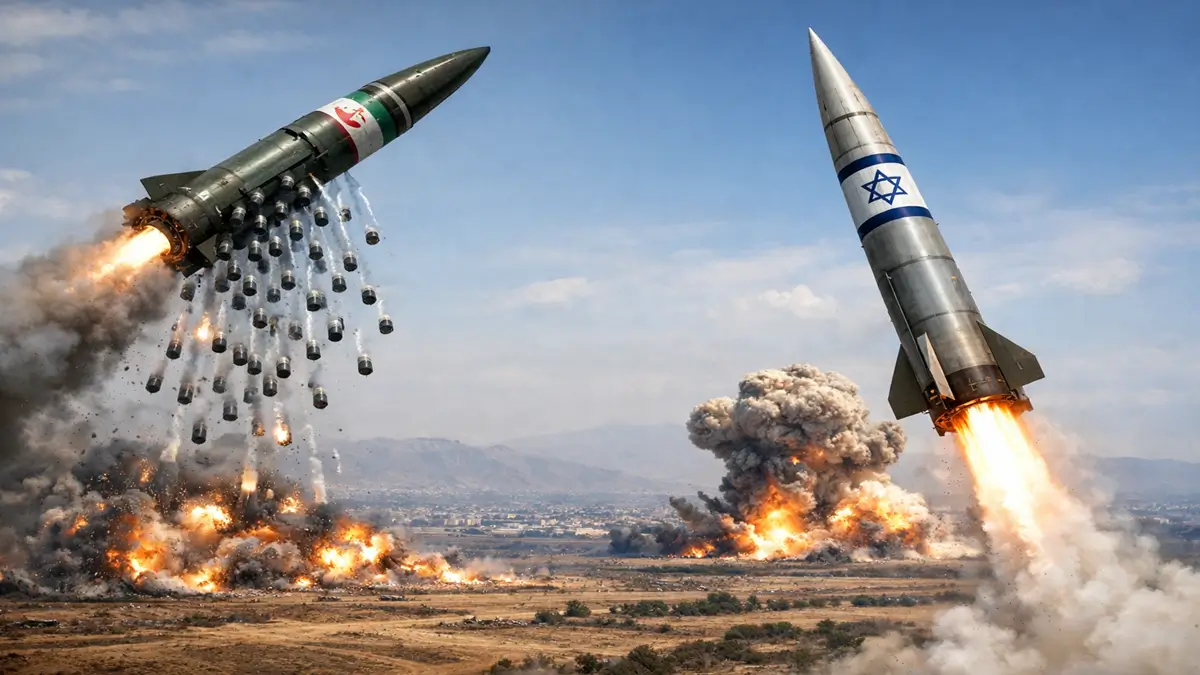
The missile rivalry between Iran and Israel is one of the most discussed military topics in global defense analysis. Iran has developed a large arsenal of ballistic missiles—some capable of carrying cluster munition warheads, while Israel possesses the Jericho missile family, which forms an important part of its strategic deterrence system.
Many people search online for comparisons such as “Iran missiles vs Israel Jericho missiles,” “Jericho-3 missile range,” or “which country has stronger missiles Iran or Israel.” This article explains the technology, range, and capabilities of these missile systems in simple terms.
1. What Are Iran’s Cluster Bomb Missiles?
Cluster bomb missiles are ballistic missiles equipped with a cluster munition warhead that releases multiple smaller explosives (submunitions) over a wide area. These weapons are designed to damage large targets such as military bases, airfields, or infrastructure.
Iran has developed several ballistic missiles that are believed to be capable of carrying cluster-type warheads, including variants of the Shahab, Qadr, Fateh, and Qiam missile systems.
Key Features
- Wide-area damage capability
- Multiple submunitions released in mid-air
- Designed to strike large military targets
- Medium-range ballistic missile systems
Examples of Iranian Missiles
- Shahab-3 – Range approximately 1,000–2,000 km
- Qadr missile – Range around 1,600–2,000 km
- Fateh series – Short to medium-range precision missiles
- Khorramshahr missile – Heavy payload ballistic missile
Iran possesses one of the largest missile arsenals in the Middle East, with hundreds to thousands of missiles developed over the past decades.
2. What Are Israel’s Jericho Missiles?
The Jericho missile family is Israel’s long-range ballistic missile system developed to provide strategic deterrence. These missiles are designed to deliver powerful warheads over long distances.
Major Jericho Variants
Jericho-1
- Range: about 500 km
- Early generation missile developed during the Cold War period.
Jericho-2
- Range: around 1,500 km
- Medium-range ballistic missile capable of reaching targets across the Middle East.
Jericho-3
- Estimated range: 4,800–6,500 km
- Considered an intercontinental-range missile, capable of striking targets far beyond the Middle East.
The Jericho-3 is believed to be the most advanced missile in Israel’s arsenal and is considered a key element of the country’s strategic deterrence capability.
3. Iran vs Israel Missile Comparison
| Feature | Iran Cluster-Capable Missiles | Israel Jericho Missiles |
|---|---|---|
| Missile Type | Medium-range ballistic missiles | Medium to intercontinental ballistic missiles |
| Range | ~700 km to 2,000 km | 500 km to 6,500 km |
| Warhead | Conventional or cluster munitions | Conventional or strategic warheads |
| Examples | Shahab-3, Qadr, Fateh, Khorramshahr | Jericho-1, Jericho-2, Jericho-3 |
| Launch Platform | Mobile launchers | Land-based strategic launch systems |
4. Which Missile System Is More Powerful?
The answer depends on several factors:
Range
- Israel’s Jericho-3 has a significantly longer range, reaching up to about 6,500 km.
- Most Iranian missiles have ranges of up to around 2,000 km.
Arsenal Size
-
Iran has developed a large number of ballistic missiles, focusing on quantity and regional reach.
Strategic Role
- Israel focuses on long-range strategic deterrence with advanced missile systems.
- Iran focuses on large numbers of medium-range missiles capable of targeting regional adversaries.
5. Strategic Importance in the Middle East
Missile technology plays a major role in the Iran–Israel strategic rivalry. Ballistic missiles are capable of delivering warheads over long distances at very high speeds.
Both countries view missile capability as a key deterrence tool, meaning the presence of powerful missile systems helps discourage potential attacks.


 Operation Urja Suraksha Explained: India...
 CAPF Bill 2026 Explained: How Government...
 INS Taragiri: Key Capabilities of India’...