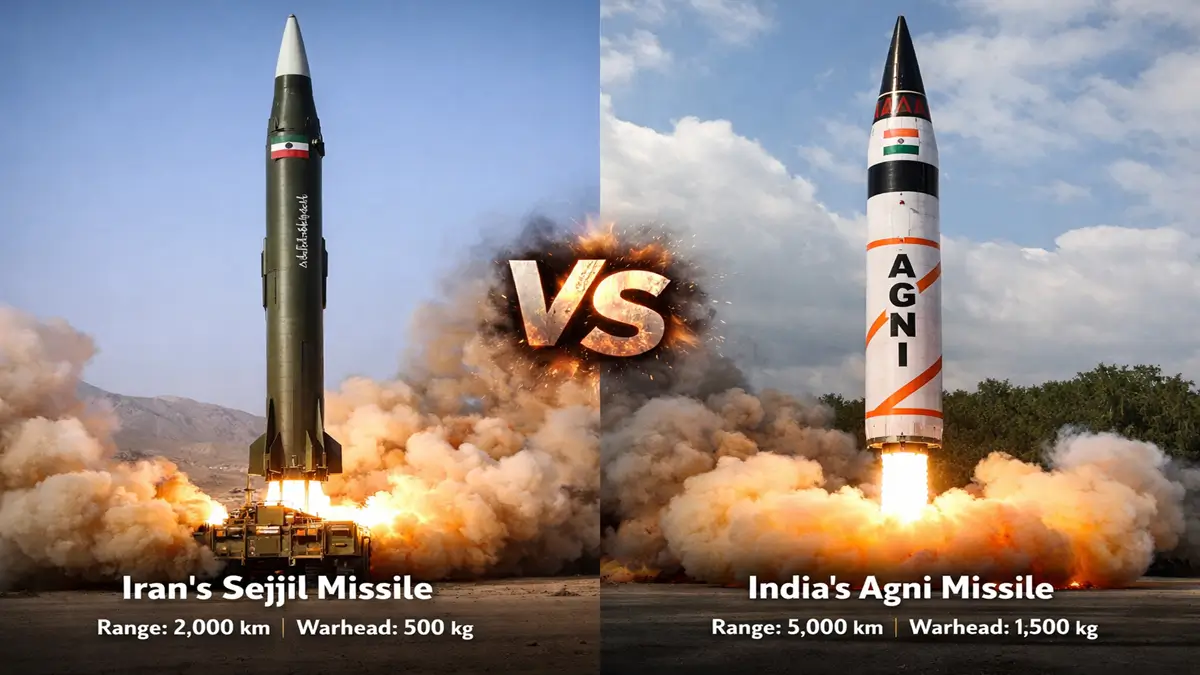
Ballistic missiles are among the most important strategic weapons in modern defense systems. Countries develop long-range missiles to strengthen deterrence and protect national security. Two such missiles that often attract global attention are Iran’s Sejjil missile and India’s Agni missile series. While both are powerful ballistic missiles, they differ significantly in range, technology, payload capacity, and strategic role.
This article compares the Sejjil missile of Iran with India’s Agni missile family, focusing on their range, power, and technological capabilities.
Overview of Iran’s Sejjil Missile
The Sejjil missile is one of Iran’s most advanced medium-range ballistic missiles. It was developed as part of Iran’s efforts to modernize its missile arsenal and replace older liquid-fuel systems.
Key Features
- Type: Medium-Range Ballistic Missile (MRBM)
- Range: Around 2,000–2,500 km
- Propulsion: Two-stage solid fuel rocket
- Payload Capacity: Around 700–1,000 kg
- Length: About 18 meters
- Launch Platform: Road-mobile launchers
One of the biggest advantages of the Sejjil missile is its solid-fuel technology, which allows faster launch preparation and makes the missile harder for enemies to detect before launch.
Strategically, the Sejjil missile allows Iran to strike targets across the Middle East and parts of Europe.
Read this also: Iran’s Cluster Bomb Missiles vs Israel’s Jericho Missiles
Overview of India’s Agni Missile Series
India’s Agni missile series is a family of long-range ballistic missiles developed by the Defence Research and Development Organisation (DRDO). The series includes multiple variants such as Agni-I, Agni-II, Agni-III, Agni-IV, and Agni-V.
Key Features
- Type: Short- to Intercontinental-range ballistic missiles
- Range: From 700 km (Agni-I) to 7,000–8,000 km (Agni-V)
- Propulsion: Multi-stage solid-fuel rockets
- Payload Capacity: Up to 1,500 kg or more
- Speed: Up to Mach 24 (Agni-V)
- Launch Platform: Road-mobile and canister-based launch systems
The Agni missile series is a key component of India’s nuclear deterrence strategy and helps maintain strategic balance in the region.
Range Comparison
| Missile | Country | Range | Category |
|---|---|---|---|
| Sejjil | Iran | 2,000–2,500 km | Medium-range ballistic missile |
| Agni-II | India | 2,000–3,500 km | Medium-range ballistic missile |
| Agni-III | India | 3,000–5,000 km | Intermediate-range ballistic missile |
| Agni-V | India | 5,000–8,000 km | Intercontinental ballistic missile |
Key Insight
Even the mid-range Agni-III and Agni-IV missiles exceed the Sejjil’s range, while Agni-V has more than double or triple the reach of Iran’s Sejjil.
Power and Payload Comparison
| Feature | Sejjil Missile (Iran) | Agni Missile (India) |
|---|---|---|
| Payload Capacity | ~700–1,000 kg | Up to ~1,500 kg |
| Fuel | Solid fuel | Solid fuel |
| Stages | Two-stage | Multi-stage |
| Max Speed | Mach 11–13 (estimated) | Up to Mach 24 |
| Range | 2,000–2,500 km | Up to 8,000 km |
Key Insight
India’s Agni missiles generally have greater payload capacity and longer range, giving them stronger strategic strike capability.
Strategic Role
Iran’s Sejjil Missile
- Designed primarily for regional deterrence.
- Capable of reaching Israel, Gulf countries, and parts of Europe.
- Focuses on quick launch capability using solid fuel.
India’s Agni Missile
- Developed as part of India’s nuclear deterrence strategy.
- Provides long-range deterrence against distant adversaries.
- Agni-V can reach targets across Asia and parts of Europe.
Which Missile Is More Powerful?
From a technological and strategic perspective:
- Range: Agni missiles (especially Agni-IV and Agni-V) are far superior.
- Payload: Agni missiles can carry heavier warheads.
- Speed & Technology: Agni-V is among the fastest ballistic missiles with advanced guidance systems.
However, the Sejjil missile is still a powerful regional weapon, designed mainly for Middle East strategic deterrence rather than global reach.


 Operation Urja Suraksha Explained: India...
 CAPF Bill 2026 Explained: How Government...
 INS Taragiri: Key Capabilities of India’...