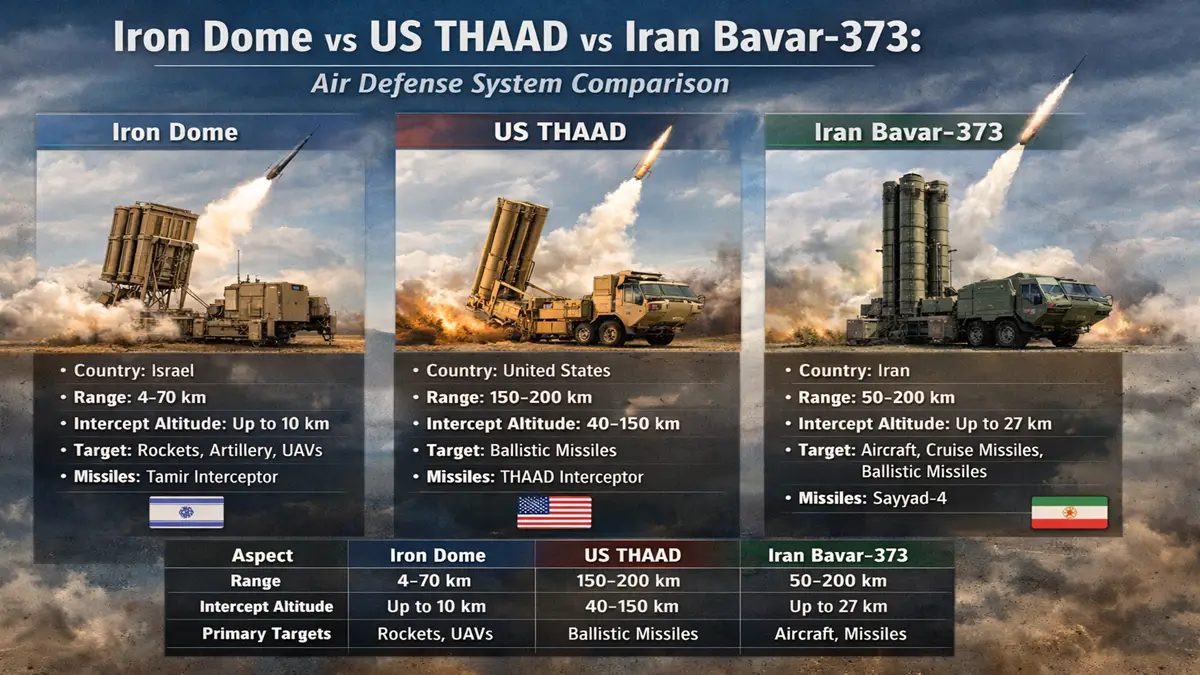
Modern warfare relies heavily on air and missile defense systems that can intercept rockets, drones, aircraft, and ballistic missiles before they reach their targets. Countries such as Israel, the United States, and Iran have developed advanced systems to protect their airspace.
Three of the most discussed systems are Iron Dome (Israel), THAAD (United States), and Bavar-373 (Iran). Each of these systems is designed for different types of threats and operates at different ranges and altitudes.
Iron Dome (Israel)
Iron Dome is a short-range air defense system developed by Israel to intercept rockets, artillery shells, and drones.
Key Features
- Developer: Rafael Advanced Defense Systems
- Operational since: 2011
- Interceptor missile: Tamir
- Range: Up to about 70 km
- Interception altitude: Around 10 km
- Primary purpose: Intercept short-range rockets, artillery shells, and drones
- Success rate: Reported above 90%
Iron Dome uses advanced radar to detect incoming rockets. The system calculates the rocket’s trajectory and determines whether it will hit a populated area. If it poses a threat, a Tamir interceptor missile is launched to destroy the rocket in mid-air.
THAAD – Terminal High Altitude Area Defense (USA)
THAAD is a high-altitude missile defense system developed by the United States to intercept ballistic missiles during their final phase of flight.
Key Features
- Developer: Lockheed Martin
- Operational since: 2008
- Engagement range: About 200 km
- Interception altitude: Up to 150 km
- Interceptor speed: More than Mach 8
- Technology: Hit-to-kill kinetic interceptor
Instead of using explosives, THAAD destroys incoming missiles through direct kinetic impact, meaning the interceptor collides with the target at extremely high speed.
The system is deployed in several strategic locations, including the United States, South Korea, and the United Arab Emirates.
Bavar-373 (Iran)
Bavar-373 is Iran’s indigenous long-range air defense system developed as an alternative to Russia’s S-300 missile defense system.
Key Features
- Developer: Iran’s Defense Ministry
- Operational since: 2019
- Interceptor missile: Sayyad-4
- Engagement range: Up to 200 km
- Interception altitude: Around 27–32 km
- Radar detection range: Around 300 km
Iran claims the system can track many aerial targets simultaneously and engage several threats using vertically launched missiles.
The Bavar-373 is designed to intercept fighter aircraft, drones, cruise missiles, and some ballistic missiles.
Iron Dome vs THAAD vs Bavar-373 (Comparison Table)
| Feature | Iron Dome (Israel) | THAAD (USA) | Bavar-373 (Iran) |
|---|---|---|---|
| Type | Short-range air defense | High-altitude ballistic missile defense | Long-range surface-to-air missile system |
| Primary Role | Intercept rockets and artillery | Destroy ballistic missiles | Counter aircraft and missile threats |
| Range | ~70 km | ~200 km | ~200 km |
| Interception Altitude | ~10 km | Up to 150 km | ~27–32 km |
| Interceptor | Tamir | Hit-to-kill interceptor | Sayyad-4 |
| Deployment | Israel | USA and allied regions | Iran |
Key Differences
1. Purpose
- Iron Dome: Designed mainly for short-range rocket threats.
- THAAD: Built to intercept ballistic missiles at high altitude.
- Bavar-373: Long-range system designed to counter aircraft and missile threats.
2. Interception Layer
- Iron Dome: Low-altitude and short-range defense.
- THAAD: High-altitude defense capable of intercepting missiles outside the atmosphere.
- Bavar-373: Medium-to-long-range air defense system.
3. Technology
- Iron Dome: Uses explosive interceptor missiles.
- THAAD: Uses kinetic hit-to-kill technology.
- Bavar-373: Uses radar-guided surface-to-air missiles.


 Operation Urja Suraksha Explained: India...
 CAPF Bill 2026 Explained: How Government...
 INS Taragiri: Key Capabilities of India’...