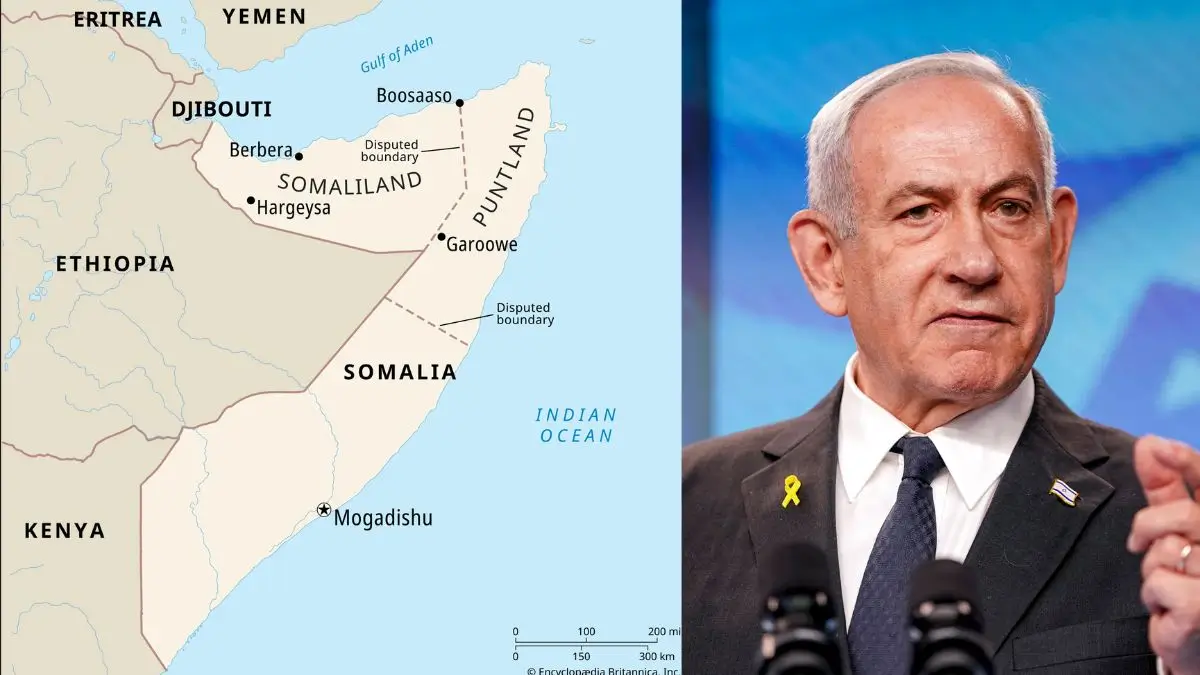
Israel has officially recognized Somaliland as an independent and sovereign state. This makes Israel the first country in the world to do so. The decision has major implications for Horn of Africa politics, regional stability, and international law.
Recognition of Somaliland
- Israel formally recognized the self-declared Republic of Somaliland.
- The recognition was announced after a joint declaration signed by Israeli leaders and Somaliland’s president.
- Somaliland has functioned independently since 1991, but had not been recognised by any country until now.
Key Leaders and Agreements Involved
The recognition was announced by Benjamin Netanyahu, who described the move as aligned with the spirit of the Abraham Accords.
Israel and Somaliland signed a mutual recognition declaration, committing to cooperation in,
- Agriculture
- Health
- Technology
- Economic development
Somaliland President Abdirahman Mohamed Abdullahi welcomed the move and expressed intent to join the Abraham Accords framework.
Background: Somaliland and Somalia
- Somaliland was a former British protectorate.
- It declared independence in 1991, after Somalia descended into civil war.
- Since then, Somaliland has maintained relative peace, stability, and its own institutions, including elections and security forces.
- However, the international community has continued to recognise Somaliland as part of Somalia, respecting Somalia’s territorial integrity.
Somalia’s Reaction
- Somalia strongly condemned Israel’s decision.
- The Somali government called it an “unlawful step” and a violation of its sovereignty.
- It stated it would pursue diplomatic, political, and legal measures under international law to defend its borders.
Somalia has historically opposed any move to recognise Somaliland and has actively lobbied other countries against it.
Regional and International Response
Several regional and international actors reacted negatively,
- African Union rejected the recognition and reaffirmed support for Somalia’s unity.
- Egypt, along with Turkey and Djibouti, warned that recognising breakaway regions threatens regional peace and security.
- These reactions highlight concerns that such recognition could encourage secessionist movements elsewhere in Africa.
Why Israel Took This Step
- Israel views the move as part of expanding its diplomatic footprint under the Abraham Accords framework.
The Horn of Africa is strategically important due to its proximity to,
- The Red Sea
- Major global trade routes
- Middle East Africa security dynamics
Recognition could also help Israel build new economic and security partnerships in Africa.
Significance of the Move
This recognition is significant because,
- It breaks a three-decade-long diplomatic deadlock for Somaliland
- It challenges the principle of territorial integrity vs self-determination
- It could reshape Horn of Africa geopolitics
- It tests the unity stance of the African Union
For Somaliland, it opens the door to international legitimacy, investments, and market access.
Key Takeaways
- Israel is the first country to recognise Somaliland
- Somaliland declared independence in 1991
- Somalia, Egypt, and the African Union oppose the move
- Linked to the Abraham Accords framework
- Raises questions on sovereignty vs self-determination
Question
Q. Which country became the first to formally recognise Somaliland as an independent state?
A. United States
B. United Kingdom
C. Israel
D. United Arab Emirates


 Iran’s Ceasefire Conditions After Trump’...
 WMO Warns Earth's Climate Is "Flashing R...
 Inside the Global Terrorism Index 2026: ...