
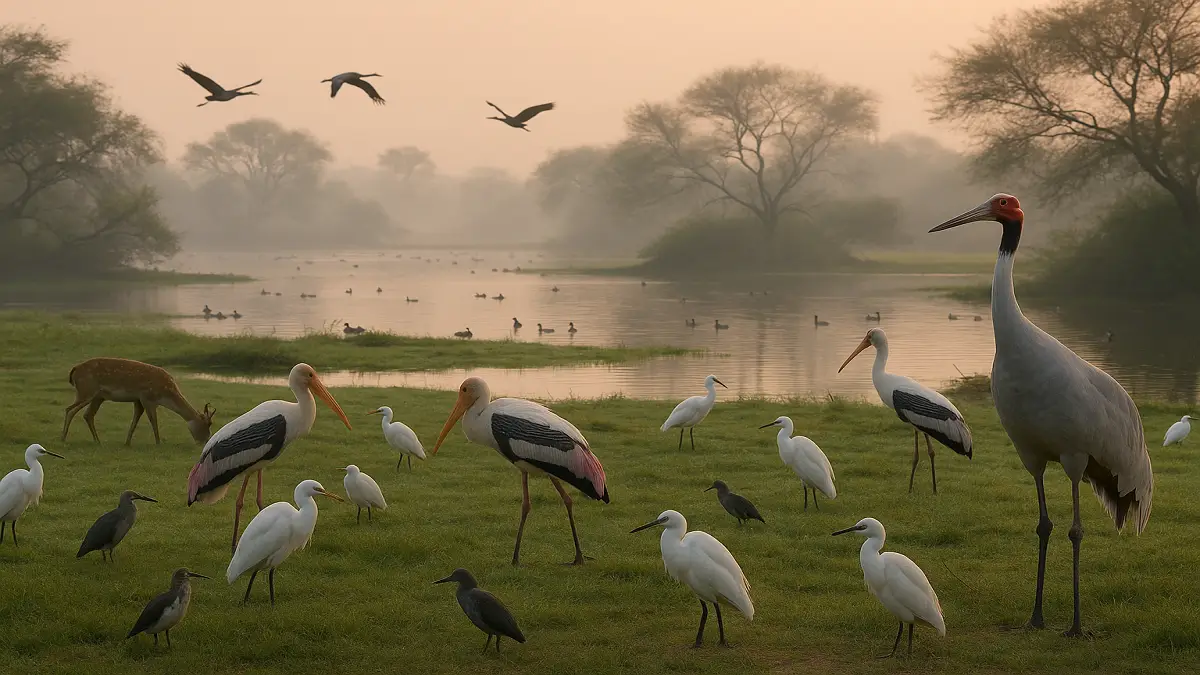
Following good monsoon rains, migratory birds like storks, pelicans, painted storks, and bar-headed geese have returned to Keoladeo National Park — signalling ecological revival in one of India’s most iconic wetlands. Known globally as a bird-watcher’s paradise, Keoladeo plays a key role in wetland conservation, winter migration, and ecological research.
About Keoladeo National Park
Keoladeo National Park is located in the Bharatpur district of Rajasthan, originally known as the Bharatpur Bird Sanctuary.
Historical Background
- Founded in the late 19th century as a hunting reserve by Maharaja Suraj Mal of Bharatpur.
- Declared a bird sanctuary in 1956.
- Upgraded to national park status in 1981.
- Renamed Keoladeo after an ancient Shiva temple located inside the park.
Area & Protection
- Covers 29 sq km.
- Unique among Indian parks — it is entirely enclosed by a 2-metre boundary wall to prevent encroachments.
Conservation Importance
Keoladeo is recognised globally because it:
- Is one of the world’s most important bird breeding and feeding habitats
- Is designated both a Ramsar Wetland Site and a UNESCO World Heritage Site
These honours highlight its role in global biodiversity conservation, wetland protection, and migratory bird survival.
Geography and Vegetation
Keoladeo has a diverse mixture of wetland systems:
- Woodlands
- Swamps
- Wet grasslands
Its vegetation is mostly dry deciduous, consisting of:
- Medium-sized trees
- Shrubs and scrub varieties
Common Plant Species
Some frequently spotted trees include:
- Kadam
- Jamun
- Babul
- Kandi
- Ber
- Kair
- Piloo
This mosaic ecosystem sustains varied herbivores, reptiles, and bird life.
Fauna Richness
Keoladeo’s biodiversity is not limited to birds.
Mammals
- Deer
- Sambars
- Blackbucks
- Jackals
- Fishing cats
Reptiles
- Pythons
- Monitor lizards
- Snakes and amphibians
Migratory Pathway Significance
Keoladeo lies along the Central Asian migratory flyway, one of the world’s major bird migration routes.
This makes it a crucial staging and wintering ground.
Bird Population & Migration
- Home to over 360 species of resident and migratory birds.
- Peak migration season: October to March.
- Visitors arrive from Afghanistan, Turkmenistan, China, and Siberia.
Important Winter Migrant Species
- Gadwalls
- Shovellers
- Common teals
- Tufted ducks
- Pintails
- White spoonbills
- Asian open-billed storks
- Oriental ibises
- Rare Siberian cranes (once a major attraction)
Keoladeo as an Ecological Classroom
The park is an unparalleled site for:
Wildlife photography
Ecotourism
Research and breeding studies
International bird watching tourism
Its wetland dynamics help scientists study migration patterns, climate impact, and wetland ecology.


 Who were the Seven Sisters of Petroleum?...
 What is the State Flower of Florida? Che...
 Which is the Largest Desert in Asia? Che...











