
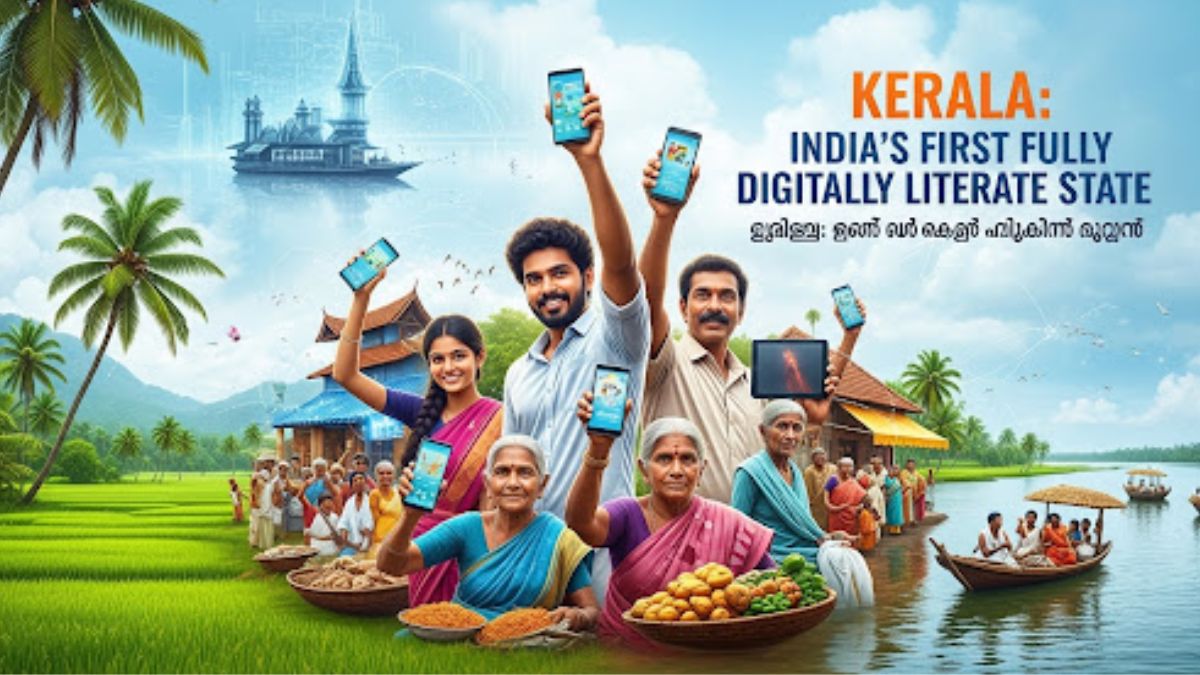
In a landmark announcement, Kerala Chief Minister declared the state as India’s first fully digitally literate state, achieving a significant milestone under the Digi Kerala project. This recognition marks not only the completion of Phase I of the initiative but also Kerala’s leadership in bridging the digital divide through grassroots participation and inclusive training.
Mass Mobilisation and Inclusive Outreach
Kerala’s digital literacy drive was built on community-centric implementation, ensuring maximum coverage and inclusiveness,
- Survey outreach: Reached 1.5 crore individuals across 83.46 lakh families.
- Targeted identification: Found 21.88 lakh digitally illiterate individuals.
- Training success: Trained and evaluated 21.87 lakh people, achieving a 99.98% success rate.
What makes this effort remarkable is the inclusive approach. Even a 104-year-old participant, M.A. Abdullah Moulavi Baqavi, completed training—symbolizing the program’s accessibility for all age groups.
Training Through Grassroots Governance
The program was delivered through local self-governments, leveraging Kerala’s tradition of decentralisation and participatory governance. This bottom-up model ensured that training was contextually relevant, community-led, and widely accepted.
Why This Achievement Matters
1. Bridging the Digital Divide
Digital illiteracy restricts access to key services. With this initiative,
- Citizens can now access e-governance portals, welfare schemes like Ayushman Bharat, PM-Kisan, and Jan Dhan Yojana.
- Financial inclusion becomes more feasible with digital banking and online payments.
2. Empowering Digital Democracy
A digitally literate public is empowered to,
- File RTIs, register grievances online, and participate in civic activities.
- Monitor government schemes and demand accountability—strengthening transparency in governance.
3. Model for Other States under Digital India
- Kerala’s approach differs from traditional tech-driven models. Instead of focusing only on infrastructure, it emphasizes people-first digital education, making it replicable across other Indian states.
- Prioritises skills over gadgets.
- Demonstrates cost-effective, decentralised implementation.
- Aligns with Digital India’s core values of empowerment and inclusion.
4. Socio-Economic Empowerment
The program contributes to,
- Women’s empowerment via digital participation in self-help groups and online business.
- Livelihood support for small traders and artisans using digital platforms.
- Inclusion of the elderly and marginalised in the digital mainstream.
5. Crisis Resilience and Governance Continuity
Digitally literate citizens are better equipped to adapt during pandemics, floods, or other disruptions,
- Enable remote learning, telemedicine, and online service access.
- Reduce dependence on intermediaries for essential services.


 ECINet KYC Feature Explained: How Voters...
 BIRAC-BioNEST Incubation Centre Inaugura...
 E20 Petrol India 2026: Nationwide Rollou...











