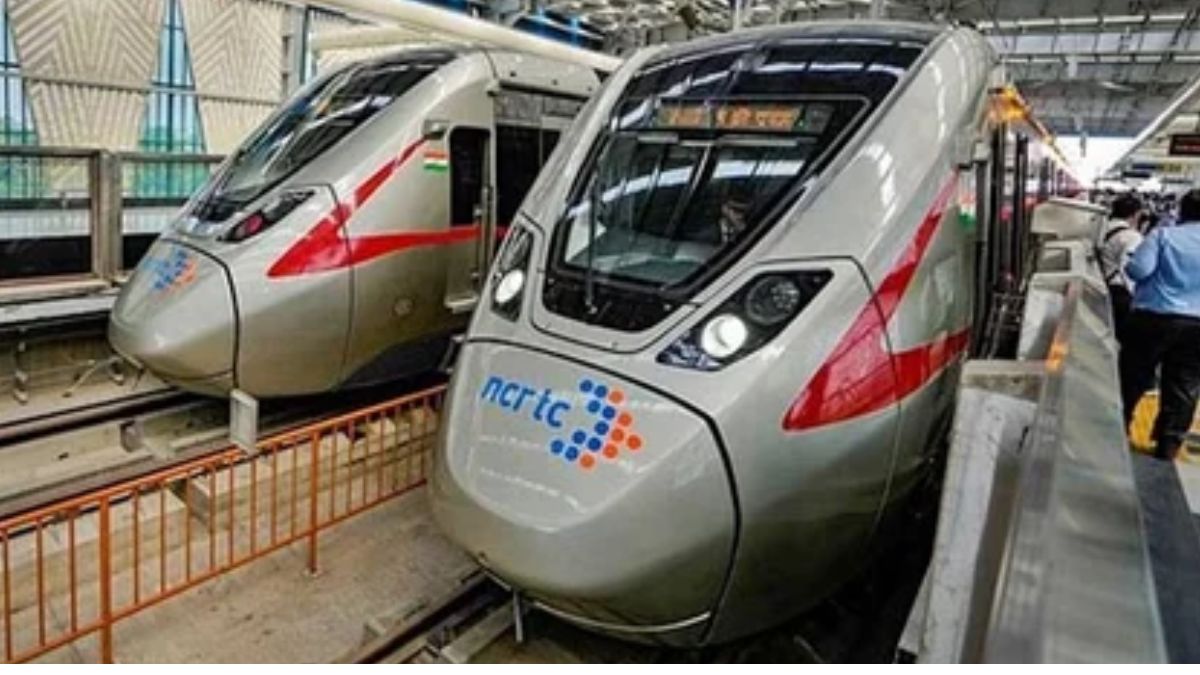
India has officially entered the era of rapid regional transit with Namo Bharat, the nation’s fastest train, clocking a top speed of 160 km/h. Operating on the Delhi-Meerut Regional Rapid Transit System (RRTS), this high-speed marvel connects two key urban centers in under 60 minutes, redefining daily commuting in northern India.
This development not only sets a new speed benchmark but also symbolizes a major leap in India’s transportation infrastructure and intercity connectivity.
Namo Bharat: Breaking Speed Records
Until recently, the title of India’s fastest trains was shared by Gatimaan Express and Vande Bharat, both capable of reaching 160 km/h. However, following a SEBI speed restriction in June 2024, these trains were capped at 130 km/h on most routes. In contrast, Namo Bharat continues to operate at 160 km/h on dedicated corridors designed for high-speed travel, officially making it India’s fastest operational train.
This speed is achieved on longer intervals between stations, thanks to modern infrastructure and advanced safety systems like Automatic Train Protection (ATP), Automatic Train Control (ATC), and Automatic Train Operations (ATO).
The Delhi-Meerut RRTS Corridor: A Corridor Built for the Future
The operational stretch of the RRTS currently spans 55 km, from New Ashok Nagar in Delhi to Meerut South in Uttar Pradesh. Eventually, the entire 82.15 km corridor, featuring 16 stations, will run from Sarai Kale Khan in Delhi to Modipuram in Meerut.
Despite the station stops, the system is designed to maintain an end-to-end travel time of under 60 minutes, showcasing the efficiency of modern rail engineering.
The route is served by 36 six-car trainsets, operating at 15-minute intervals. These trains are designed in Hyderabad and manufactured at Alstom’s Savli facility in Gujarat, emphasizing India’s growing capability in domestic rail manufacturing.
Namo Bharat: More Than Just a Train
Unlike traditional Indian trains, Namo Bharat does not require seat reservations or fixed timetables. Nor is it a metro. Instead, it functions as a hybrid rapid transit system tailored for medium-distance intercity travel, combining the high speed of express trains with the frequency of metros.
Launched on 21 October 2023, the first 17-km Priority Section alone has served over 1.5 crore riders, highlighting its impact and popularity.
This model bridges the gap between long-distance rail travel and local metro services, especially for suburban commuters in the Delhi-NCR region.
Integration with Meerut Metro: Seamless Urban Mobility
A unique feature of the RRTS is its integration with the Meerut Metro, which runs on the same infrastructure. The 23-km metro line, with 13 stations, offers easy interchange for passengers between local city routes and high-speed regional services.
This multi-modal integration enhances connectivity within Meerut and streamlines transit options for commuters traveling into Delhi or other parts of NCR.
Backed by a National and State Partnership
The Namo Bharat RRTS project is a joint initiative of the Government of India (50%) and the state governments of Delhi, Uttar Pradesh, Haryana, and Rajasthan (12.5% each). It is the first of its kind in India—a dedicated regional rapid transit system meant to reduce road congestion, lower pollution, and promote faster urban-rural integration.
With future corridors planned for Delhi–Panipat and Delhi–Alwar, the Namo Bharat model may become the backbone of intercity mobility in northern India.
Key Takeaways
- Namo Bharat is India’s fastest train, operating at 160 km/h on the Delhi–Meerut RRTS corridor.
- It outpaces Gatimaan Express and Vande Bharat, which are now restricted to 130 km/h.
- The full 82.15 km corridor will feature 16 stations from Sarai Kale Khan to Modipuram.
- Trains are manufactured by Alstom in Gujarat and integrate advanced safety systems like ATP, ATC, and ATO.
- The service is reservation-free and integrated with the Meerut Metro for seamless urban-regional connectivity.
- The RRTS is a joint venture between the Centre and four state governments, marking a first-of-its-kind transit model in India.


 Menaka Guruswamy Takes Oath, Becomes Ind...
 India Adds Highest Ever Wind Power Capac...
 Western Dedicated Freight Corridor Compl...