
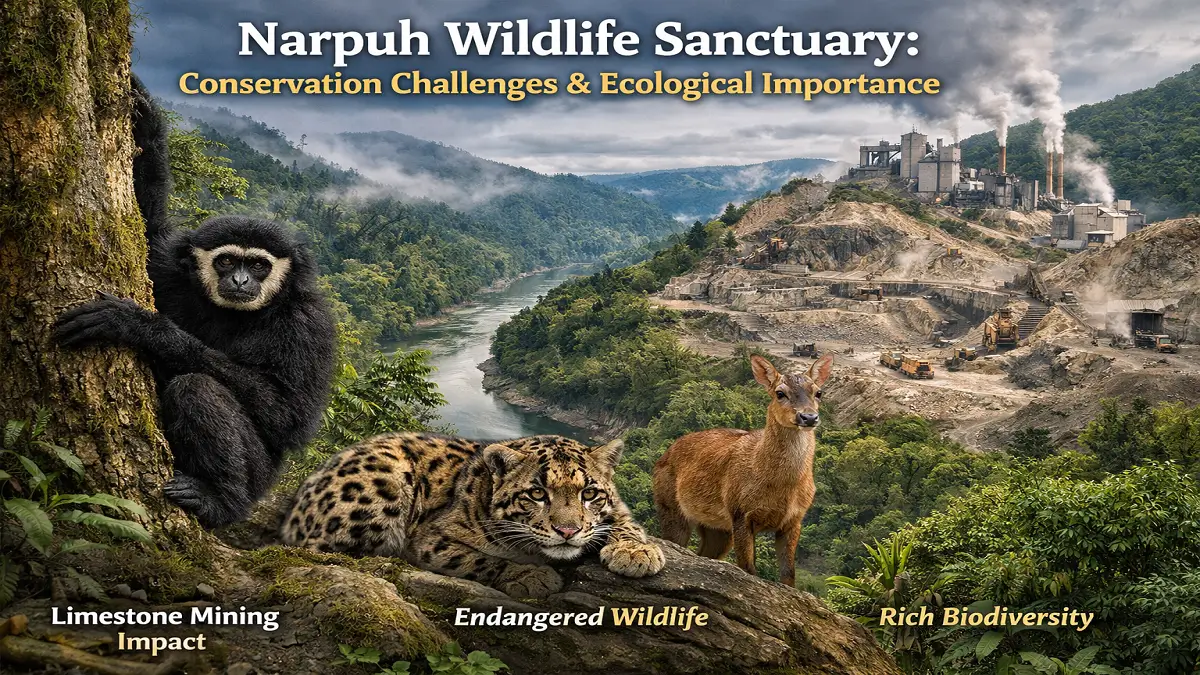
Recently, scientists and conservation experts have raised serious concerns about the growing threats to Narpuh Wildlife Sanctuary, particularly due to limestone mining activities and nearby cement factories. These developments pose long-term risks to the fragile ecosystem of the sanctuary, which is one of the most ecologically rich regions of Meghalaya.
About Narpuh Wildlife Sanctuary
Location and Establishment
Narpuh Wildlife Sanctuary is located in the East Jaintia Hills district near Jowai, Meghalaya. It was officially declared a wildlife sanctuary in 2014, making it the only protected area in the Jaintia Hills region.
The sanctuary holds strategic ecological importance due to its location:
- It is surrounded by Reserve Forests on all sides
- Except for its southwestern boundary, which shares a border with the State of Assam
This geographical positioning makes Narpuh a crucial ecological corridor between Meghalaya and Assam.
Geographical Features and Rivers
Lukha River
The northern boundary of the sanctuary is defined by the Lukha River, which acts as a natural physical barrier. Rivers like Lukha play a vital role in:
- Maintaining local biodiversity
- Supporting aquatic life
- Regulating microclimatic conditions
Climate and Rainfall
One of the defining features of Narpuh Wildlife Sanctuary is its extreme rainfall pattern. The region receives more than 6,000 mm of annual rainfall, primarily from the southwest monsoon.
Impact of Climate
- Creates ideal conditions for dense forest growth
- Supports a wide range of endangered and endemic species
- Helps maintain evergreen and semi-evergreen vegetation
This high rainfall makes the sanctuary one of the wettest forest ecosystems in India.
Vegetation of Narpuh Wildlife Sanctuary
Narpuh is home to some of the tallest evergreen and semi-evergreen forests remaining in Meghalaya. These forests are vital carbon sinks and help in climate regulation.
Important Flora Species
Some notable plant species found in the sanctuary include:
- Castanopsis indica
- Castanopsis tribuloides
- Dysoxylum species
- Elaeocarpus species
- Engelhardtia spicata
- Syzygium species
These plant species support both wildlife and local communities and are critical for maintaining forest health.
Fauna: Rich Wildlife Diversity
The sanctuary hosts a remarkable variety of wildlife, including several endangered and vulnerable species.
Key Animal Species
- Hoolock Gibbon (India’s only ape)
- Serow
- Slow Loris
- Sloth Bear
- Large Indian Civet
- Leopard Cat
- Clouded Leopard
- Barking Deer
The presence of apex predators like the Clouded Leopard indicates a healthy and balanced ecosystem.
Latest Conservation Challenges
Threat from Limestone Mining
The East Jaintia Hills region is rich in limestone deposits, leading to:
- Unregulated mining
- Habitat fragmentation
- Loss of forest cover
Impact of Cement Factories
Cement plants near the sanctuary contribute to:
- Air and water pollution
- Disturbance to wildlife movement
- Long-term ecological degradation
Scientists warn that if these activities continue unchecked, they could irreversibly damage the sanctuary’s biodiversity.
Why Narpuh Wildlife Sanctuary Matters
From an exam and policy perspective, Narpuh Wildlife Sanctuary is important because:
- It is a biodiversity hotspot
- Plays a role in climate regulation
- Acts as a habitat for endangered species
- Highlights the conflict between development and conservation


 Which Place is known as the Glass Capita...
 Who is known as the Father of Census of ...
 Which Continent is known as the White Co...











