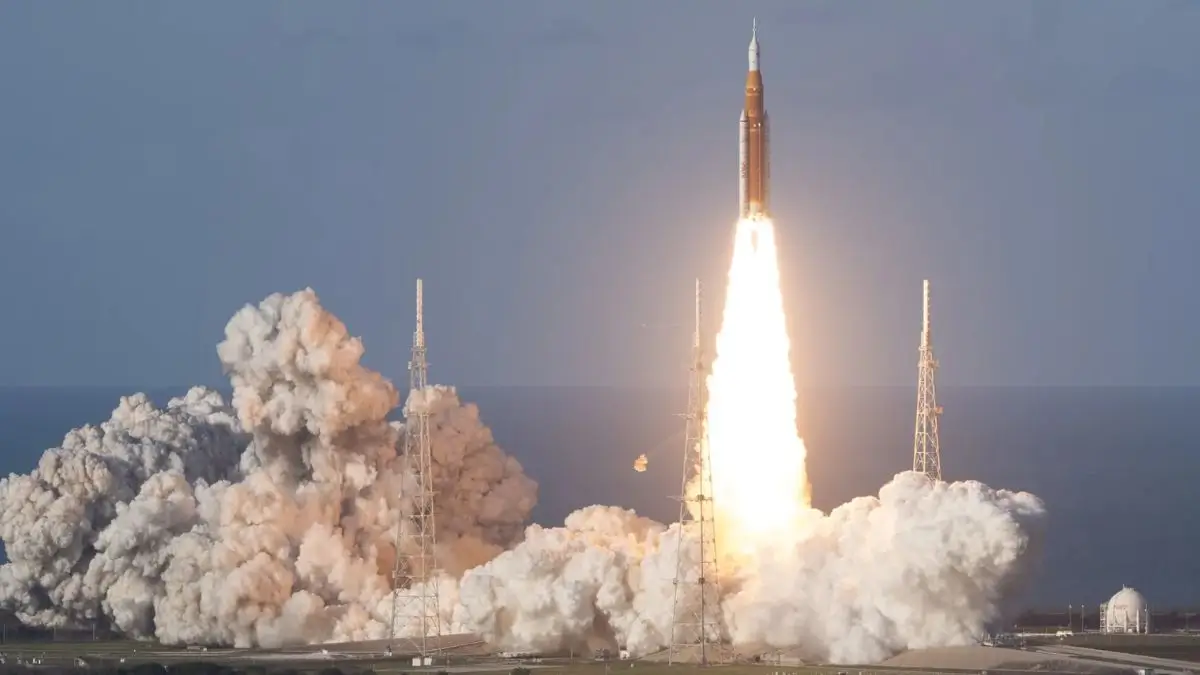
The historic moment for the space exploration NASA has successfully launched the Artemis II mission on the April 1, 2026. This is marking the first crewed journey towards the Moon since after 1972. NASA’s powerful Space Launch System rocket had lifted the four astronauts into space for the 10-day mission around the Moon and will take it back to earth. This mission is not just about landing but it is about testing systems which could soon return the humans to the lunar surface.
Artemis II Launch Beginning of New Era
The Artemis II mission was launched from the Kennedy Space Center at 6:35 p.m. ET and it draw the attention towards thousands of spectators.
The mission representing the,
- The revival of human lunar exploration
- And major step towards the future Moon landings
- Also to continuation of the legacy of the Apollo missions
As compare to Apollo 8 this mission will orbit the Moon without the landing and will be ensuring that spacecraft systems are safe for the future missions.
Meet the Artemis II Crew Astronauts
This mission carries the four astronauts aboard on the Orion spacecraft and each of astronaut has their big achievement.
- Reid Wiseman – Commander
- Victor Glover – First Black astronaut to travel to deep space
- Christina Koch – First woman will to journey into deep space
- Jeremy Hansen – First non-American on a Moon mission
This diverse crew highlights the shift toward the inclusive space exploration.
Mission Details: 10 Day Journey Around the Moon
The Artemis II mission is designed for the deep-space test flight.
Key Mission Timeline
April 1, 2026: Launch of the mission
April 1-2: Testing the systems in Earth orbit
April 6: Lunar flyby
April 10: Return to the Earth
The spacecraft will travel over the 695,000 over the mission performance.
Unique Trajectory and Record-Breaking Distance
Unlike the previous missions the Artemis II will follows a free-return trajectory.
It means that,
- The spacecraft will uses the Moon’s gravity to return to Earth
- It can safely return to the earth back even if propulsion fails
The mission will reach about the 252,799 miles from Earth and it will making the farthest distance humans have ever traveled and also surpassing the Apollo-13.
How the Launch Unfolded & Key Technical Milestones
Artemis II launch has involved the several precise and critical stages by using the Space Launch System (SLS) rocket and Orion spacecraft.
Lift-off and Initial Thrust
- The launch was took place at Kennedy Space Center
- Twin boosters have generated over the 75% of total thrust
- Total thrust has reached 8.8 million pounds
Booster Separation
- The separation was occurred within the first few minutes of the launch
- Also the reduced weight and allowed the smoother ascent
Core Stage Separation
- With this it has marked the end of the first propulsion phase
- Also transitioned to upper-stage operations
Solar Array Deployment
- Orion also deployed the solar array wings (SAWs)
- These provide continuous power for the life support, communication and also for navigation systems.
- Each step of the mission is crucial to ensuring mission safety and long-duration space travel capability.
Why Artemis II Matters for the Future of Space Exploration
Artemis II is not just the symbolic mission but it is the critical test for future deep-space exploration.
The mission will,
- Validate the life-support systems for the long-duration space travel
- Also the test navigation and communication systems in deep space
- Will ensure the safety of the astronauts for future lunar landings
It will also lays the ground work for the Artemis III in which it aims to land humans on the Moon Surface and which is including the first woman.


 India's First Quantum Computer to be Lau...
 India Strengthens Marine Research with B...
 AP Science City Signs 5-Year MoU with CS...