
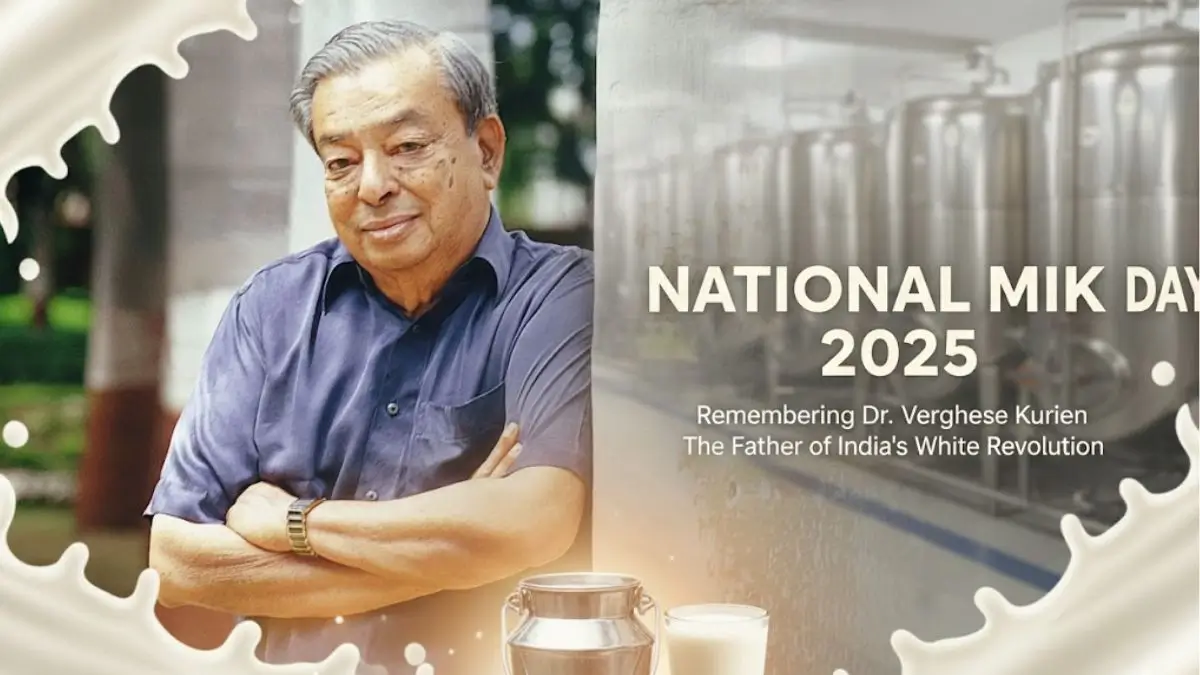
National Milk Day, celebrated annually on November 26, commemorates the birth anniversary of Dr. Verghese Kurien, hailed as the Father of the White Revolution in India. The 2025 celebration not only honours his vision and legacy but also reflects the nation’s immense strides in transforming from a milk-deficient country to the world’s largest milk producer, contributing nearly 25% of global milk output. Milk continues to play a vital role in India’s nutrition and economy, supporting over 8 crore farmers, and providing high-quality proteins, calcium, and essential nutrients across all age groups.
A Historical Journey: From Import Dependence to Global Leadership
In the 1950s and 1960s, India faced acute milk shortages, despite having the world’s largest cattle population. The turning point came with the creation of the National Dairy Development Board (NDDB) in 1965 and the launch of Operation Flood in 1970, modeled on the success of the Anand cooperative.
Under Kurien’s leadership, India developed a vast network of village-level milk societies, revolutionizing dairy production and distribution. This cooperative model helped connect rural producers to urban markets, ensuring fair prices, reduced middlemen exploitation, and steady income for millions.
India’s Dairy Surge in the Last Decade
From 2014–15 to 2023–24, India’s milk production rose by 63.56%, reaching 239.3 million tonnes, while per capita availability surged from 124g to 471g/day.
The country’s bovine population has played a critical role, with 303.76 million cattle, and a 27.39% increase in productivity, the fastest globally. Milk production from indigenous breeds has also grown from 29 to 50 million tonnes, thanks to focused schemes like,
- Rashtriya Gokul Mission
- Livestock Health and Disease Control Programme
- Integration of Ethnoveterinary Medicine (EVM) with Ayurveda
Rashtriya Gokul Mission: Enhancing Indigenous Breeds
Launched in 2014 and revamped in March 2025, the Rashtriya Gokul Mission focuses on,
- Conservation and genetic improvement of indigenous cattle and buffalo
- Expansion of Artificial Insemination (AI) services
- Establishment of IVF labs and Breed Multiplication Farms
- With a total outlay of ₹3,400 crore, the mission has benefited 92 million animals and 56 million farmers. In 2024–25 alone, 565.55 lakh inseminations were conducted.
The National AI Programme (NAIP) has reached over 5.5 crore farmers, using sex-sorted semen and producing more female calves to boost milk output. Over 38,700 MAITRIs (Multipurpose AI Technicians) now deliver doorstep services to rural farmers.
National Programme for Dairy Development (NPDD): Boosting Infrastructure
Since 2014–15, the NPDD has built and upgraded critical dairy infrastructure. The scheme was restructured in 2021, and now includes,
- Component A: Enhancing milk testing, chilling, and procurement for cooperatives and FPOs
- Component B: Expanding organised markets and improving processing capacities
Achievements so far include,
- Formation of 31,908 dairy cooperatives
- 120.68 lakh kg/day increase in milk procurement
- Establishment of 6,000 bulk milk coolers and 61,677 village milk testing labs
- Inauguration of large-scale plants in Mehsana, Indore, Bhilwara, and Karimnagar
The Sabar Dairy Plant in Rohtak, Haryana, inaugurated in October 2025, is now India’s largest curd and buttermilk production facility, with daily capacities of 150 MT curd and 3 lakh litres of buttermilk.
Empowering Women Through Dairy
Women constitute 70% of India’s dairy workforce and 35% of cooperative members. Over 48,000 women-led cooperatives and 16 all-women Milk Producer Organisations (MPOs) highlight their growing influence.
The Shreeja Milk Producer Organisation in Andhra Pradesh, which received the International Dairy Federation’s Dairy Innovation Award, stands out as a model of gender-driven cooperative success.
Policy Boosts: GST Reforms for Dairy
At the 56th GST Council Meeting (September 3, 2025), major tax reductions were announced,
- 0% GST on UHT milk and paneer
- 5% GST on butter, ghee, dairy beverages (down from 12%)
- Ice cream tax reduced from 18% to 5%
- Milk cans and dairy inputs now taxed at 5%
These reforms are expected to benefit over 8 crore rural households, reduce costs, and make Indian dairy products more competitive globally.
White Revolution 2.0: Scaling Cooperatives and Sustainability
Launched in December 2024, White Revolution 2.0 aims to,
- Set up 75,000 new dairy cooperatives
- Expand milk procurement to 1,007 lakh kg/day
- Establish three Multi-State Cooperative Societies for:
- Feed and input supply
- Biofertilizer and natural farming
- Environmentally managed carcass utilization
With a five-year rollout plan (2024–29), this initiative is expected to strengthen farmer incomes, support circular economies, and drive India’s global dairy leadership.
Data and Projections: India’s Dairy Future
According to APEDA’s September 2025 Dashboard, India is poised to,
- Contribute 32% to global milk supply in 2025–26
- Achieve 242 million tonnes of milk production
- Increase processing capacity to 100 million litres/day by 2028–29
- Eradicate FMD and Brucellosis through national vaccination campaigns
These milestones reflect a robust policy ecosystem, improved genetic and health parameters, and rising private and cooperative investments.
Gopal Ratna Awards 2025: Honouring Dairy Champions
The National Gopal Ratna Awards will be presented on November 26, recognizing excellence in,
- Indigenous breed dairy farming
- Artificial insemination services
- Dairy cooperative leadership
Each category offers cash prizes of ₹5 lakh, ₹3 lakh, and ₹2 lakh for first, second, and third places, along with special awards for North-Eastern and Himalayan States.
Static Facts
- Date Celebrated: November 26 (Birth anniversary of Dr. Verghese Kurien)
- India’s Milk Production (2023–24): 239.3 million tonnes
- Per Capita Availability: 471 grams/day
- Women in Dairy Workforce: 70%
- Rashtriya Gokul Mission Total Outlay: ₹3,400 crore (2021–26)
- Artificial Inseminations in 2024–25: 565.55 lakh
- NAIP Coverage: 14.12 crore inseminations, 5.5 crore farmers
- NPDD Component A & B Focus: Infrastructure + market access
- Sabar Dairy Rohtak Plant Cost: ₹350 crore


 National Safe Motherhood Day 2026: Why M...
 Jyotirao Phule Jayanti 2026: India Begin...
 World Homoeopathy Day 2026: Advancing Ho...











