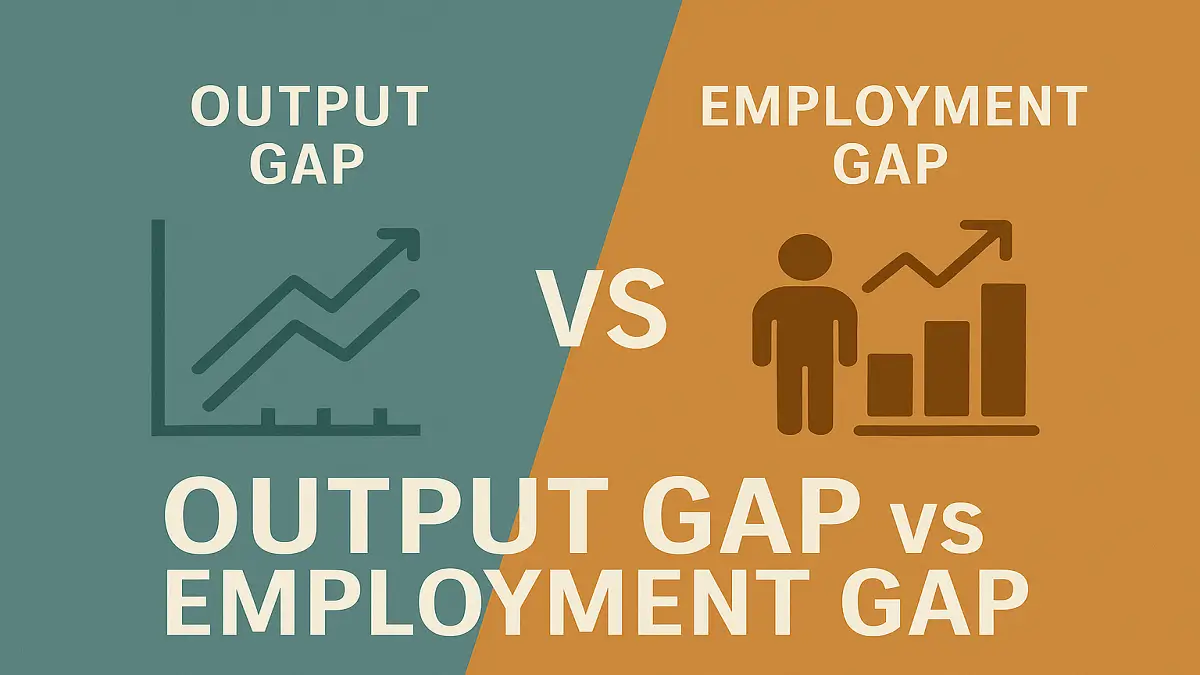
Economists use different indicators to understand how well an economy is performing. Two such important indicators are the Output Gap and the Employment Gap. These concepts appear frequently in competitive exams, especially in economy sections.
Both gaps indicate how far the economy is from its ideal performance, but they measure different aspects. This article explains both terms clearly, with examples and exam-focused insights.
What is the Output Gap?
The Output Gap measures the difference between the actual output of the economy and its potential output.
-
Actual Output: What the economy is currently producing
-
Potential Output: What the economy can produce if all resources (labor, capital, technology) are fully utilized
Formula
Output Gap = Actual Output – Potential Output
Types of Output Gap
-
Positive Output Gap (Overheating Economy)
-
Actual output > Potential output
-
Inflation rises
-
High demand and production
-
-
Negative Output Gap (Recessionary Gap)
-
Actual output < Potential output
-
Unemployment rises
-
Low demand and production
-
Simple Example
If an economy can produce goods worth ₹100 crore but currently produces only ₹90 crore:
Output Gap = 90 – 100 = –10 crore (Negative Output Gap)
What is the Employment Gap?
The Employment Gap measures the difference between the actual employment level and the full employment level.
-
Actual Employment: How many people are currently employed
-
Full Employment: Employment level with minimal unemployment (usually includes frictional unemployment)
Formula
Employment Gap = Actual Employment – Full Employment
Types of Employment Gap
-
Positive Employment Gap
-
More people employed than expected
-
Rare situation, usually temporary
-
-
Negative Employment Gap
-
Fewer people employed
-
Indicates unemployment problems
-
Simple Example
If full employment requires 50 million workers but only 47 million are employed:
Employment Gap = 47 – 50 = –3 million (Negative Employment Gap)Output Gap vs Employment Gap: Key Differences


 RBI's This Domain Wins Global Recognitio...
 Why HDFC Bank Chairman Atanu Chakraborty...
 RBI Injects ₹48,014 Crore into Banking S...