
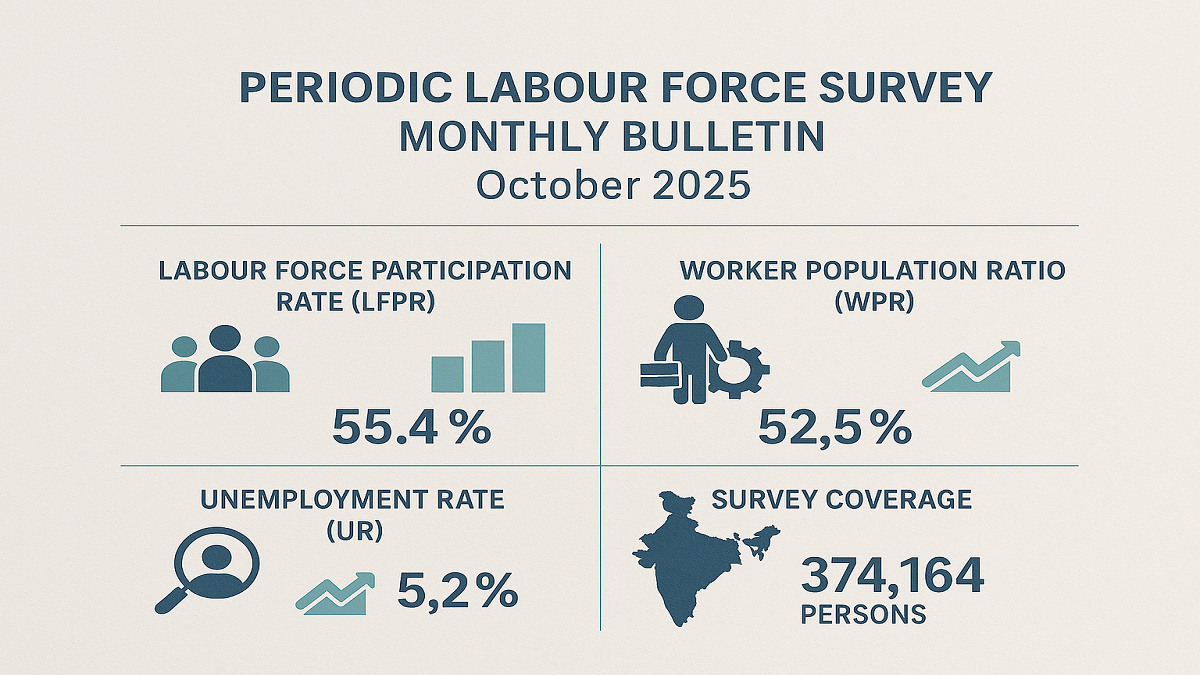
The Periodic Labour Force Survey (PLFS) is one of India’s most important tools for understanding employment, unemployment, and labour market trends. Conducted by the National Statistical Office (NSO) under the Ministry of Statistics and Programme Implementation (MoSPI), the survey tracks how people participate in economic activities.
Since January 2025, the PLFS has adopted a new methodology to provide monthly and quarterly labour market estimates using the Current Weekly Status (CWS) approach.
The October 2025 Monthly Bulletin is the seventh report in this updated series and covers key indicators such as:
-
Labour Force Participation Rate (LFPR)
-
Worker Population Ratio (WPR)
-
Unemployment Rate (UR)
This report focuses on people aged 15 years and above, both in rural and urban areas.
Labour Force Participation Rate (LFPR) Shows Steady Growth
What is LFPR?
LFPR indicates the percentage of people who are either working or actively looking for work. It reflects how many individuals are participating in economic activities.
Key Findings for October 2025
The overall LFPR increased to 55.4%, reaching its highest level in six months. This improvement continues the positive trend seen over the past four months.
- LFPR in June 2025: 54.2%
- LFPR in October 2025: 55.4%
Rural LFPR Leads the Growth
Rural areas showed a stronger improvement:
- Rural LFPR in June 2025: 56.1%
- Rural LFPR in October 2025: 57.8%
This indicates that more people in villages are participating in work-related activities.
Female Labour Force Participation Continues to Rise
One of the most encouraging findings in the October bulletin is the consistent rise in female participation in the labour force.
Overall Female LFPR
- June 2025: 32.0%
- October 2025: 34.2%
This is the highest recorded since May 2025, showing that more women—especially in rural areas—are entering the workforce or actively seeking work.
Rural Female LFPR
The growth is mainly driven by rural women, reflecting expanded opportunities and active workforce involvement.
Worker Population Ratio (WPR) Improves Steadily
What is WPR?
WPR measures the percentage of people who are actually working among the total population aged 15 years and above.
Overall WPR Trends
The overall WPR touched 52.5% in October 2025, continuing its rise from June 2025.
- June 2025: 51.2% (approx.)
- October 2025: 52.5%
This shows that not only are more people participating in the labour force, but a higher number of them now have jobs.
Rise in Female WPR
Female employment also showed a positive pattern:
- Female WPR in June 2025: 30.2%
- Female WPR in October 2025: 32.4%
Again, rural areas contributed significantly to this improvement.
Rural Female WPR
- June 2025: 33.6%
- October 2025: 36.9%
This suggests that female participation in rural workforce activities—such as agriculture, self-employment, and informal sector work—has increased steadily for four months in a row.
Unemployment Rate Remains Stable at 5.2%
What is UR?
The Unemployment Rate (UR) reflects the percentage of people who are willing to work and are actively looking for jobs but cannot find employment.
Overall UR
The national unemployment rate remained unchanged at 5.2%, the same as in September 2025.
Rural and Urban Trends
- Rural UR decreased slightly from 4.6% to 4.4%
- Urban UR increased marginally from 6.8% to 7.0%
These opposite movements balanced each other, keeping the overall unemployment rate stable.
Female Unemployment Rate Falls Slightly
- Female UR in September 2025: 5.5%
- Female UR in October 2025: 5.4%
The drop was mainly due to a decline in rural female unemployment, which went down from 4.3% to 4.0%.
This indicates better work opportunities or increased participation in rural regions among women.
Male Unemployment Stays Nearly Constant
Male unemployment remained steady at 5.1%.
- Rural male UR fell slightly from 4.7% to 4.6%
- Urban male UR rose from 6.0% to 6.1%
This resulted in overall stability for the male unemployment rate.
Survey Coverage
The October 2025 estimates are based on data collected from:
- 3,74,164 persons in total
- 2,14,254 persons in rural areas
- 1,59,910 persons in urban areas
This large sample ensures reliable and comprehensive national-level employment insights.


 Who were the Seven Sisters of Petroleum?...
 What is the State Flower of Florida? Che...
 Which is the Largest Desert in Asia? Che...











