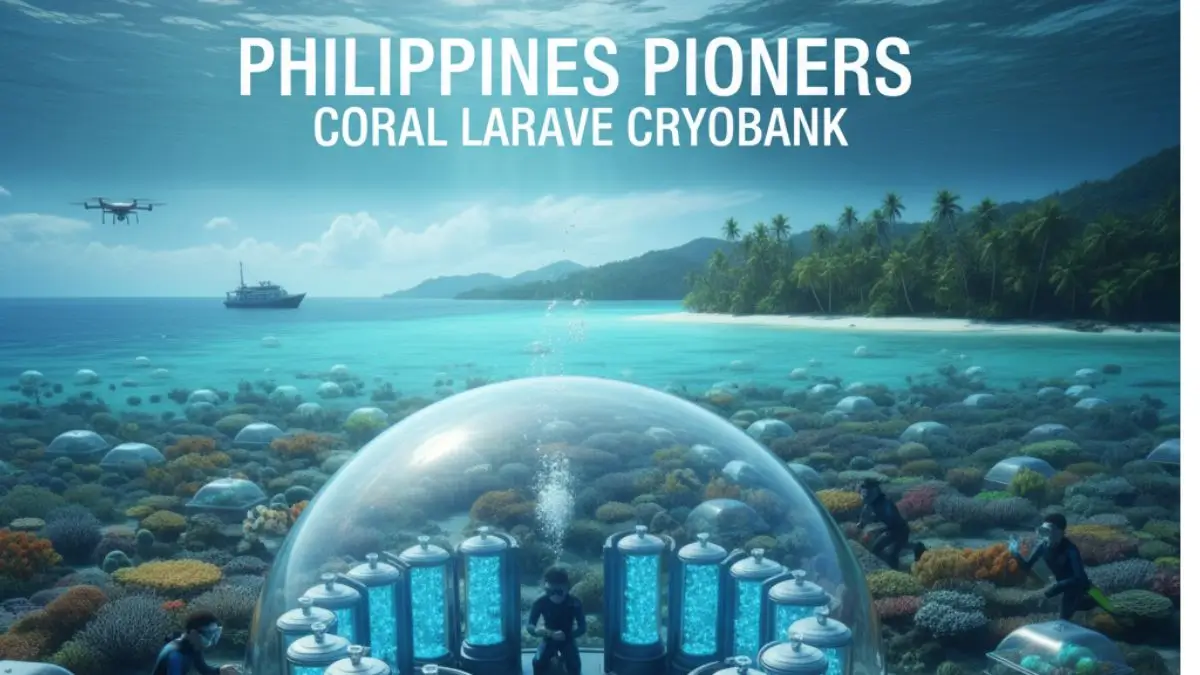
In a pioneering step for marine conservation, the Philippines has launched Southeast Asia’s first Coral Larvae Cryobank, aiming to preserve coral genetic diversity and protect its vital reef ecosystems. This initiative comes at a time when global coral populations are under severe threat from climate change, bleaching events, and human activities.
What Is the Coral Cryobank Initiative?
- The Coral Larvae Cryobank is part of a multinational collaboration between scientific institutions from the Philippines, Taiwan, Indonesia, Malaysia, and Thailand.
- Its primary goal is to freeze and store coral larvae using advanced cryopreservation techniques to ensure their survival and potential reintroduction in the future.
- This approach is designed to protect biodiversity, facilitate coral reef restoration, and build resilience against ongoing and future marine ecosystem stressors.
Cryopreservation: How It Works
Cryopreservation is the process of preserving living cells or tissues at ultra-low temperatures, typically –196°C, using liquid nitrogen. This halts all biological activity, essentially “pausing” life.
For corals.
- Larvae are treated with cryoprotectants like glycerol, ethylene glycol, or DMSO.
- The process uses vitrification, where water inside cells is replaced and rapidly cooled to form a glass-like state, avoiding ice crystal damage.
- Once preserved, the coral larvae can be stored indefinitely and revived for reef repopulation and research when needed.
The Coral Triangle: Amazon of the Seas
The cryobank is a critical conservation tool for the Coral Triangle, often dubbed the “Amazon of the Seas.” Spanning nearly 6 million square kilometers, this region includes parts of,
- Indonesia
- Malaysia
- The Philippines
- Papua New Guinea
- Solomon Islands
- Timor-Leste
This region holds,
- Over 75% of the world’s coral species
- Nearly a third of global reef fish species
- Expansive mangrove forests and
- Six out of seven marine turtle species
The Coral Triangle is vital for global marine biodiversity, regional food security, and coastal economies.
Why This Matters: Threats to Coral Ecosystems
Coral reefs are in crisis worldwide. The Status of Coral Reefs of the World 2020 report notes that 14% of corals were lost between 2009 and 2018, primarily due to,
- Climate change-induced coral bleaching
- Rising sea temperatures
- Pollution and destructive fishing practices
- Unregulated coastal development and tourism
Without intervention, coral decline could severely impact marine life, fisheries, and coastal livelihoods.
What Are Corals and Why Are They Important?
- Corals are marine invertebrates that form large colonies called polyps.
- These polyps secrete calcium carbonate to build protective exoskeletons, forming coral reefs.
- Reefs are essential for 25% of marine life, providing breeding, feeding, and shelter zones.
Types of Coral Reefs
- Fringing Reefs – Close to shorelines
- Barrier Reefs – Found farther offshore, separated by lagoons
- Atolls – Circular reefs surrounding sunken volcanic islands
Coral Bleaching
- Occurs when corals, stressed by high temperatures or pollution, expel the symbiotic algae (zooxanthellae) living in their tissues.
- This turns them white and often leads to death if conditions don’t improve.
Static Facts
- Country: Philippines
- Launch Year: 2025
- Technique Used: Cryopreservation via vitrification
- Cryobank Purpose: Preserve coral larvae and genetic diversity
- Temperature: ~–196°C using liquid nitrogen
- Coral Triangle Region Includes: Indonesia, Malaysia, Philippines, PNG, Solomon Islands, Timor-Leste
- Coral Loss (2009–2018): 14% globally


 WTO 14th Ministerial Conference Conclude...
 Former Suriname President Chandrikapersa...
 No Social Media for Kids Under 16: Indon...