
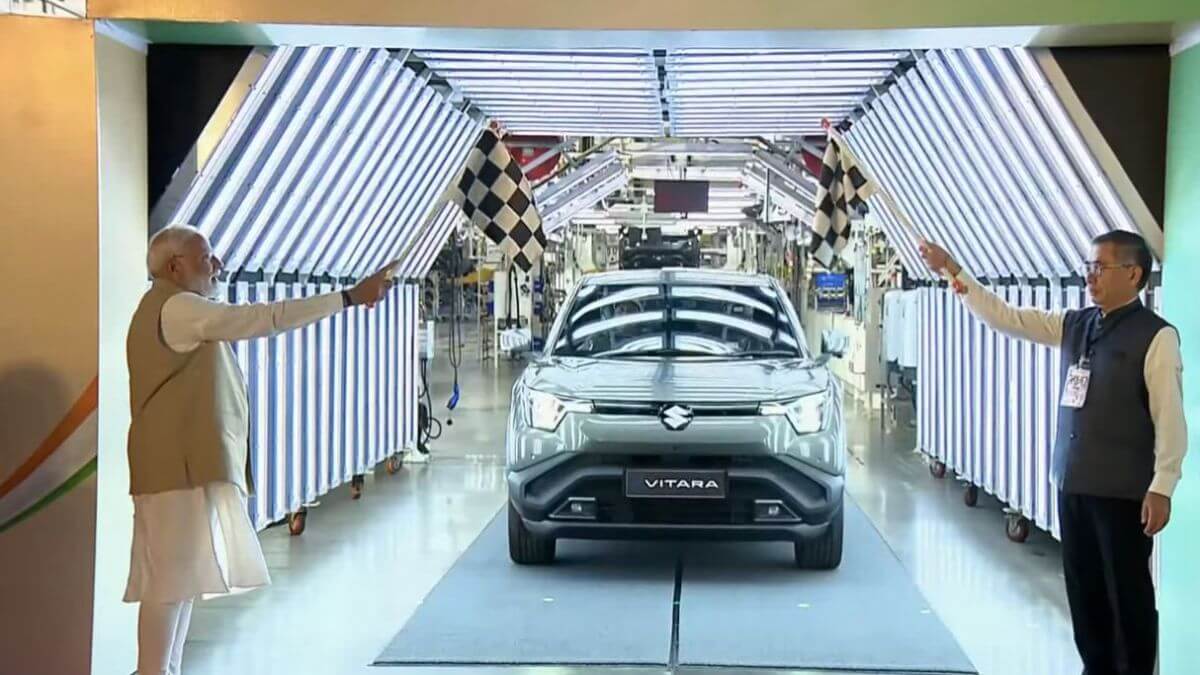
In a significant boost to India’s clean energy mission, Prime Minister Narendra Modi inaugurated a series of green mobility initiatives in Hansalpur, Gujarat, marking a pivotal moment in the country’s shift toward sustainable transport. The event was highlighted by the launch of Maruti Suzuki’s “e VITARA”, a Made-in-India Battery Electric Vehicle (BEV) set to be exported to over 100 countries, alongside the initiation of domestic hybrid battery electrode manufacturing.
India’s Leap into Global Green Mobility
Launch of e-VITARA: Made in India, Made for the World
The unveiling of the e VITARA represents not only technological innovation but a declaration of India’s manufacturing strength. This BEV, developed by Maruti Suzuki, will cater to global markets including Europe and Japan. The move positions India as a central hub for electric vehicle exports, reinforcing the message of “Make in India, Make for the World.”
Establishing Local Battery Electrode Production
Accompanying the launch, India also kickstarted the local production of hybrid battery electrodes at the TDS Lithium-Ion Battery plant in Gujarat. A collaboration between Toshiba, Denso, and Suzuki, this facility will produce critical components domestically, reducing reliance on imports and ensuring that over 80% of the battery value is manufactured in India. This step strengthens the foundation for Aatmanirbhar Bharat in clean energy tech.
Transforming India into a Manufacturing Powerhouse
Policy Support and Infrastructure Expansion
The Prime Minister emphasized that over the past decade, India has created an enabling environment for manufacturing through initiatives like the Production Linked Incentive (PLI) scheme, industrial corridors, and logistics parks. These reforms are designed to make Indian industry globally competitive.
Semiconductor and Mineral Strategy
Looking forward, India is set to establish six semiconductor plants, further cementing its position in the tech manufacturing sector. Modi also introduced the National Critical Mineral Mission, aiming to conduct 1,200 mineral exploration campaigns to secure key resources such as rare earths, vital for the automotive and electronics industries.
India-Japan Partnership: A Strategic Collaboration
From Maruti to Modern Industry
Japan’s trust and cultural alignment with India as key to the long-term success of joint ventures like Maruti Suzuki. The beginnings of this industrial journey with the Vibrant Gujarat Summit and Japan’s role as a strategic partner. The focus has now evolved from car manufacturing to include advanced sectors like battery tech and semiconductors.
People-to-People and Talent Exchange
India is also fostering people-to-people connections with Japan, promoting language education, youth exchange programmes, and skill-sharing initiatives. Modi encouraged companies like Maruti Suzuki to play a proactive role in deepening these ties.


 Gujarat HC Bans AI in Courtroom Decision...
 Blackbucks Make a Comeback in Chhattisga...
 Nitish Kumar to Take Rajya Sabha Oath on...











