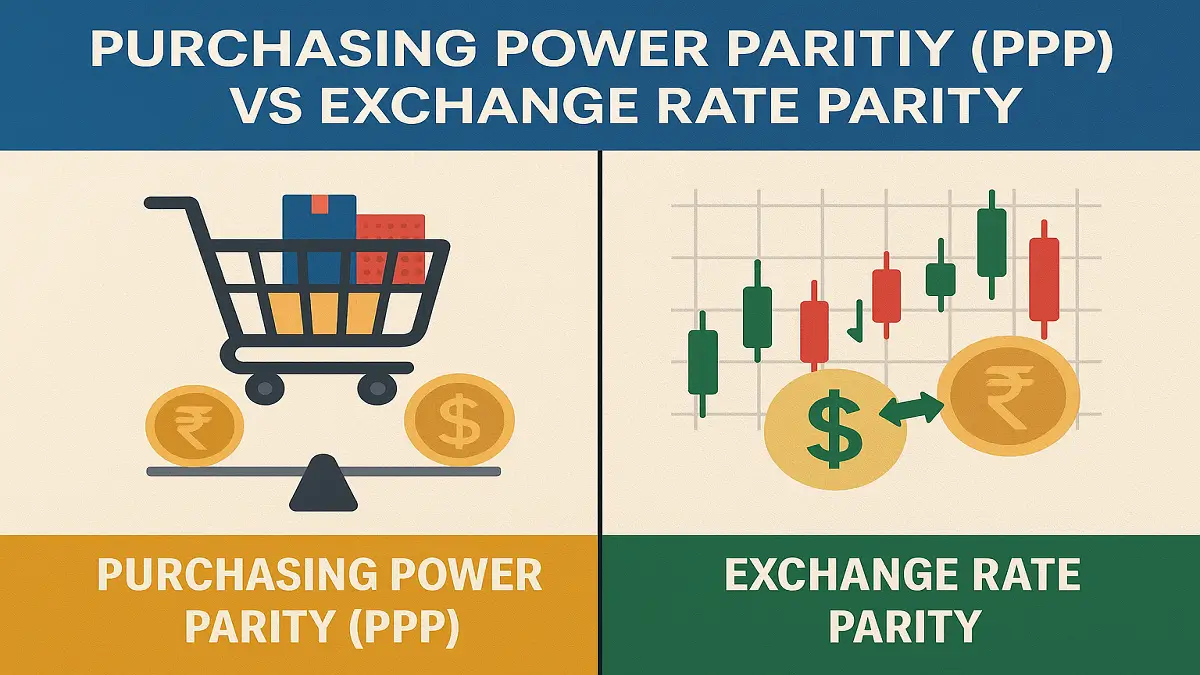
Currencies around the world differ in value, and understanding why they rise or fall is essential for students, traders, policymakers, and exam aspirants. Two important concepts used to compare currencies are:
- Purchasing Power Parity (PPP)
- Exchange Rate Parity
Both terms deal with how the value of one currency relates to another, but they do so from different perspectives. This article explains both concepts in simple language, highlights their differences, and provides examples to help learners grasp them easily.
What is Purchasing Power Parity (PPP)?
Purchasing Power Parity (PPP) is an economic theory that states:
“Two currencies are in equilibrium when a basket of goods costs the same in both countries after converting the currency.”
PPP compares currencies based on their purchasing power, not market fluctuations.
Key Idea of PPP
-
If a product costs ₹500 in India and the same product costs $10 in the USA, then the PPP exchange rate is:
₹500 = $10 → 1 USD = ₹50 (PPP rate) -
If the actual market exchange rate is ₹85 per USD, it means:
The rupee is undervalued, or
The dollar is overvalued
Types of PPP
- Absolute PPP: Same basket of goods should cost the same after exchange rate adjustment.
- Relative PPP: Focuses on inflation differences between countries.
Famous Example: The Big Mac Index
The Economist uses the price of a McDonald’s Big Mac to compare PPP between countries.
PPP is widely used by:
- World Bank
- IMF
- Economists
- Government reports
PPP gives a realistic comparison of living standards and income across nations.
What is Exchange Rate Parity?
Exchange Rate Parity refers to the actual exchange rate determined by market forces, such as:
- Demand and supply of currencies
- Interest rates
- Inflation
- Trade flows
- Foreign investment
- Speculation
It reflects how much one currency is worth in the forex market right now.
Example: If 1 USD = ₹85 today, this is the exchange rate parity or nominal exchange rate.
Types of Exchange Rate Parity
- Interest Rate Parity (IRP): Difference in interest rates between two countries determines forward exchange rates.
- Covered Interest Parity (CIP)
- Uncovered Interest Parity (UIP)
Factors influencing exchange rate parity
- RBI or central bank interventions
- Commodity prices (oil, gold)
- Global events
- Market speculation
- Capital flows
Unlike PPP, exchange rate parity fluctuates daily.
PPP vs Exchange Rate Parity: Key Differences
Here is a simple and clear comparison:
| Feature | PPP (Purchasing Power Parity) | Exchange Rate Parity |
|---|---|---|
| Meaning | Compares currencies based on purchasing power | Market exchange rate set by forex market |
| Basis | Price of goods & services | Demand, supply, interest rates, flows |
| Changes | Very slow, long-term | Changes daily, highly volatile |
| Use | Comparing GDP, living standards | Currency trading, imports, exports |
| Influence of inflation | Highly dependent | One of many factors |
| Stability | Stable | Frequently fluctuates |
| Example | Big Mac Index | 1 USD = ₹85 |
| Used by | World Bank, IMF | Forex traders, central banks |
Simple Example to Understand Both
Let’s say:
- A product in India costs ₹600
- The same product in the USA costs $10
- PPP exchange rate = 600/10 = ₹60 per USD
But if the actual exchange rate is ₹85 per USD, this is the exchange rate parity.
So here:
- PPP says: Rupee should be ₹60
- Market says: Rupee is ₹85
This gap shows undervaluation or overvaluation.
Which One Is More Accurate?
- PPP gives long-term fairness between currencies.
- Exchange Rate Parity reflects real-time market conditions.
Both are useful but serve different purposes.


 India’s GST Collections Hit ₹1.78 Lakh C...
 India Approves IBC Amendment Bill 2026 t...
 India’s Industrial Output Grows 5.2% in ...