
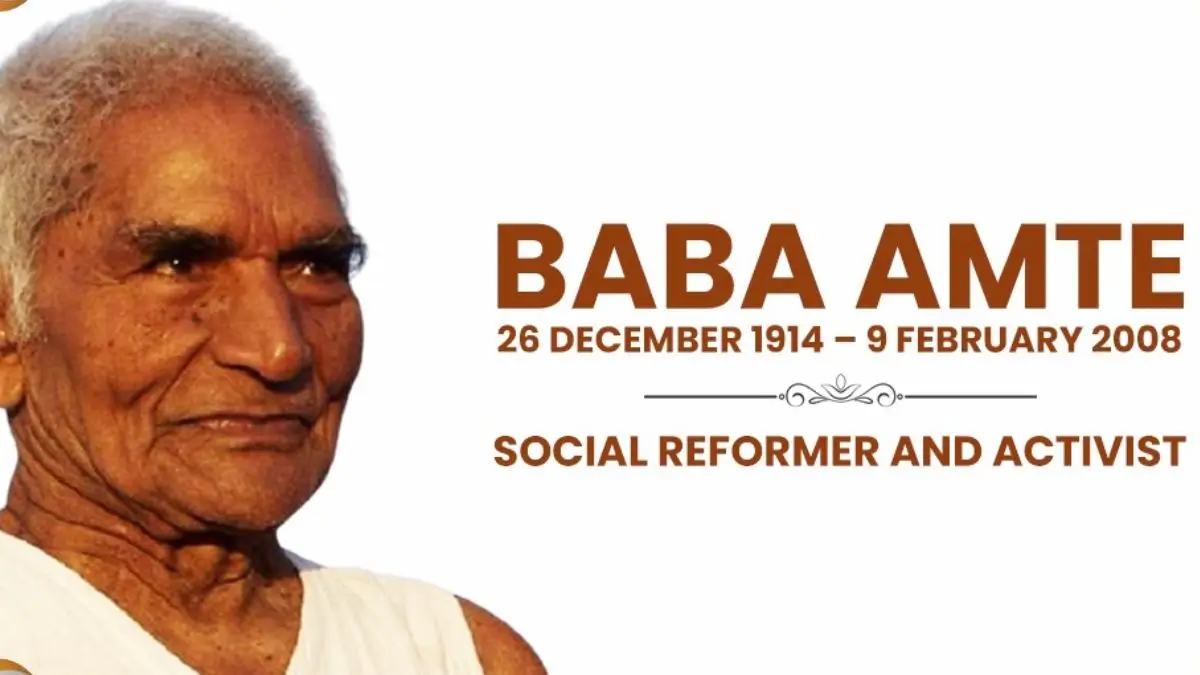
India remembers one of its greatest social reformers on February 9, 2026, the 18th death anniversary of Baba Amte. The news brings focus back to his lifelong service for the poor, the sick, and the displaced. Baba Amte dedicated his life to dignity, equality, and justice, especially for leprosy patients and tribal communities. His work continues to inspire social movements, public service, and civil society across the country even years after his passing.
Baba Amte Death Anniversary 2026
- The Baba Amte death anniversary 2026 is being observed on February 9, marking 18 years since the passing of Baba Amte in 2008.
- The day is remembered nationwide to honour his contribution to leprosy rehabilitation, social justice, and environmental movements.
- Educational institutions, social organisations, and civil society groups recall his ideals of compassion, service, and human dignity.
Who Was Baba Amte? Early Life and Ideals
- Baba Amte, born as Murlidhar Devidas Amte on December 26, 1914, in Maharashtra, came from a well-off family.
- Trained as a lawyer, he initially worked during the freedom struggle by defending leaders jailed during the Quit India Movement.
- However, his life changed after meeting leprosy patients who were treated with extreme social stigma.
- This encounter pushed him to abandon a comfortable life and dedicate himself fully to the upliftment of the most neglected sections of society.
Baba Amte and Leprosy Rehabilitation Movement
- Baba Amte is best known for his work in leprosy rehabilitation.
- He founded Anandwan (Forest of Joy) in Maharashtra, an ashram that provided medical care, education, and employment to people affected by leprosy.
- At a time when leprosy patients were ostracised, Baba Amte treated them with dignity and equality.
- Anandwan became a self-sufficient community and a global model for humane rehabilitation, changing how society viewed leprosy forever.
Baba Amte and Narmada Bachao Andolan
- In the later years of his life, Baba Amte became a key face of the Narmada Bachao Andolan.
- He joined the movement to oppose large dams like the Sardar Sarovar Dam, which displaced thousands of tribal families.
- Living on the banks of the Narmada River for nearly seven years, he highlighted issues of forced displacement, ecological damage, and lack of rehabilitation.
- His involvement gave moral strength and national attention to the movement.
Role of Baba Amte in Environmental and Tribal Rights
- Baba Amte strongly believed that development must be people-centric and environmentally sustainable.
- During the Narmada movement, he raised concerns about tribal rights, river ecology, and long-term environmental damage.
- He stressed that progress should not come at the cost of human suffering.
- His peaceful protests and grassroots approach reshaped India’s debate on development versus displacement, making him a pioneer of environmental justice in India.
Awards and National Recognition of Baba Amte
- For his exceptional contribution to society, Baba Amte received many prestigious awards.
- These include the Padma Shri, Padma Vibhushan, Ramon Magsaysay Award, Gandhi Peace Prize, and the UN Prize for Human Rights.
- These honours recognised his service to humanity, social reform, and environmental activism.
Question
Q. Baba Amte is most closely associated with which rehabilitation centre?
A. Sevagram
B. Anandwan
C. Sabarmati Ashram
D. Auroville


 National Safe Motherhood Day 2026: Why M...
 Jyotirao Phule Jayanti 2026: India Begin...
 World Homoeopathy Day 2026: Advancing Ho...











