
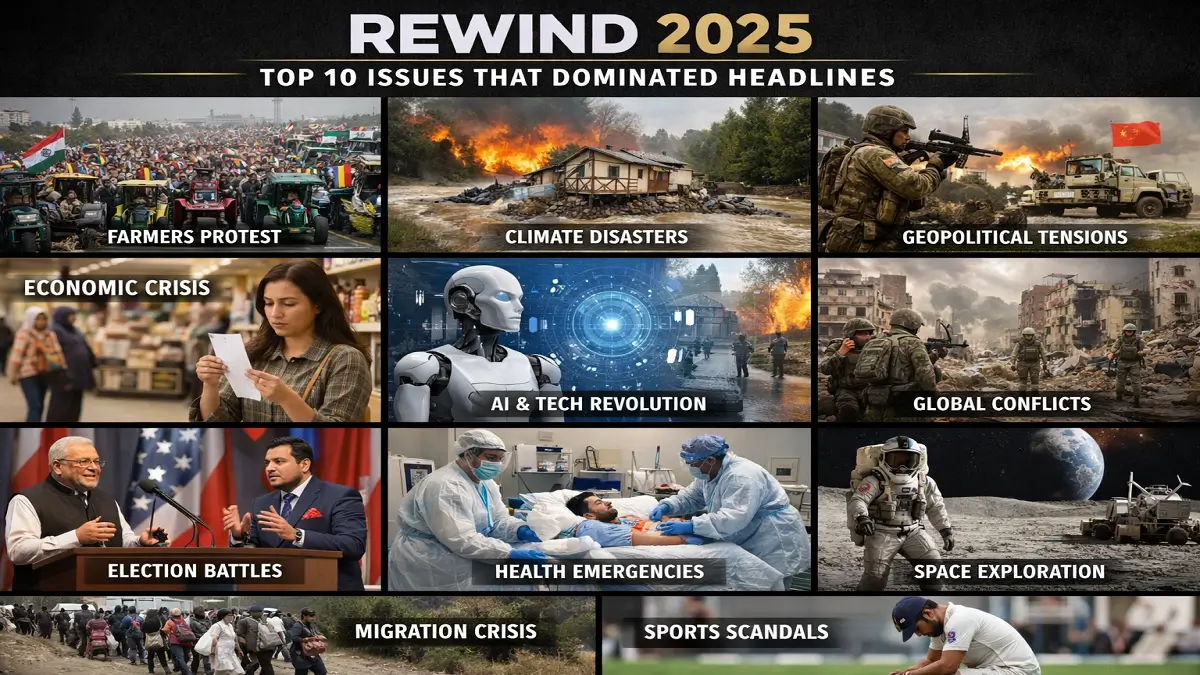
From national politics and international affairs to history, economy, and technology, 2025 was a year of landmark events. Several developments not only shaped public discourse but also became highly relevant for competitive examinations. Below are the top ten issues that captured attention throughout the year.
1. Fifty Years of the National Emergency (1975–1977)
The year 2025 marked fifty years of the National Emergency imposed on June 25, 1975, by the government of Prime Minister Indira Gandhi under Article 352 of the Indian Constitution.
The Emergency period was characterised by suspension of fundamental rights, press censorship, mass arrests, postponement of elections, and rule by executive decree. In Indian political history, the term “Emergency” specifically refers to the period from June 25, 1975, to March 21, 1977.
This episode remains crucial for understanding constitutional safeguards, democratic institutions, and the balance of power in India.
2. Axiom-4 Mission: India’s Human Spaceflight Milestone
The Axiom-4 mission marked a significant achievement in India’s expanding role in human spaceflight. Indian Air Force Group Captain Shubhanshu Shukla, along with three international astronauts, spent eighteen days aboard the International Space Station and orbited the Earth 288 times.
The mission concluded with a splashdown in the Pacific Ocean on July 15, 2025, after a twenty-hour return journey. The experiments conducted during the mission strengthened India’s contribution to global space research and international collaboration.
3. Nepal’s Gen Z Protest and Political Upheaval
In September 2025, Nepal witnessed a major political upheaval driven by Gen Z-led, largely leaderless protests against social media restrictions and corruption. The demonstrations escalated across Kathmandu and other cities.
As a result, Prime Minister Khadga Prasad Sharma Oli resigned on September 9. The President accepted his resignation and dissolved Parliament. Former Supreme Court Justice Sushila S. Karki was sworn in as Interim Prime Minister on September 12.
The episode is significant for understanding youth-led movements and political transitions in South Asia.
4. Ranveer Allahbadia Controversy and Obscenity Laws
A controversial remark by content creator Ranveer Allahbadia during an episode of a digital comedy show sparked a nationwide debate on obscenity laws. FIRs were filed in multiple states, and the incident revived discussion around legal standards governing freedom of expression.
The controversy brought renewed attention to the Hicklin Test, formulated in English law in 1868, which defines obscenity based on its potential to corrupt susceptible minds. In India, this test was applied in the landmark Ranjit D. Udeshi versus State of Maharashtra case in 1964.
5. Donald Trump’s Reciprocal Tariffs Announcement
In April 2025, US President Donald Trump announced reciprocal tariffs against major trading partners, describing the move as America’s “Liberation Day.” A base tariff of ten percent was imposed on all imports, followed by country-specific duties.
After global criticism, a ninety-day pause was announced, and the tariffs later came into effect on August 27, 2025. The move had significant implications for global trade, supply chains, and World Trade Organization norms.
6. The Ghibli Trend and AI Ethics Debate
With the upgrade of ChatGPT’s image generation capabilities in March 2025, users began recreating images in the distinctive animation style of Japan’s Studio Ghibli. The trend quickly went viral across social media platforms.
However, it also raised serious concerns regarding copyright infringement, ethical use of artificial intelligence, and the future of creative professions. The debate gained momentum after resurfacing remarks by Hayao Miyazaki, who had earlier criticised AI-generated art as lacking human emotion.
Studio Ghibli was founded in 1985 by Hayao Miyazaki, Isao Takahata, and Toshio Suzuki and is known for its hand-drawn animation style.
7. Chola Dynasty and Rajendra Chola I
In July 2025, Prime Minister Narendra Modi visited Gangaikonda Cholapuram in Tamil Nadu to commemorate one thousand years of Rajendra Chola I’s maritime expedition to Southeast Asia.
The visit included the unveiling of a commemorative coin and the inauguration of an exhibition on Chola naval power. Rajendra Chola I expanded the empire inherited from his father Rajaraja Chola I and played a key role in establishing India’s maritime influence.
The Chola dynasty is regarded as one of the longest-ruling dynasties in world history.
8. India Becomes the Fourth Largest Economy
According to the International Monetary Fund’s World Economic Outlook released in April 2025, India emerged as the world’s fourth-largest economy, alongside Japan.
The IMF also projected India to remain the fastest-growing major economy over the next two years, highlighting its strong macroeconomic fundamentals and long-term growth potential.
9. From Caste to Caste Census
On April 30, 2025, the Cabinet Committee on Political Affairs approved the inclusion of caste data in the upcoming population census. The announcement was made by Union Minister Ashwini Vaishnaw.
Census enumeration is a Union subject under the Constitution. Historically, India’s first non-synchronous census was conducted in 1872, while the first synchronous census took place in 1881 under W.C. Plowden. The decision revived long-standing debates on social justice, governance, and policy formulation.
10. Implementation of India’s Four Labour Codes
After more than five years since parliamentary approval, the government moved ahead with implementing the four labour codes from November 21, 2025.
The four codes include the Code on Wages (2019), Industrial Relations Code (2020), Code on Social Security (2020), and Occupational Safety, Health and Working Conditions Code (2020). Together, they replaced twenty-nine central labour laws with the aim of simplifying compliance, ensuring uniform wage structures, and expanding social security coverage.


 Which Place is known as the Onion Hub of...
 Who were the Seven Sisters of Petroleum?...
 What is the State Flower of Florida? Che...











