
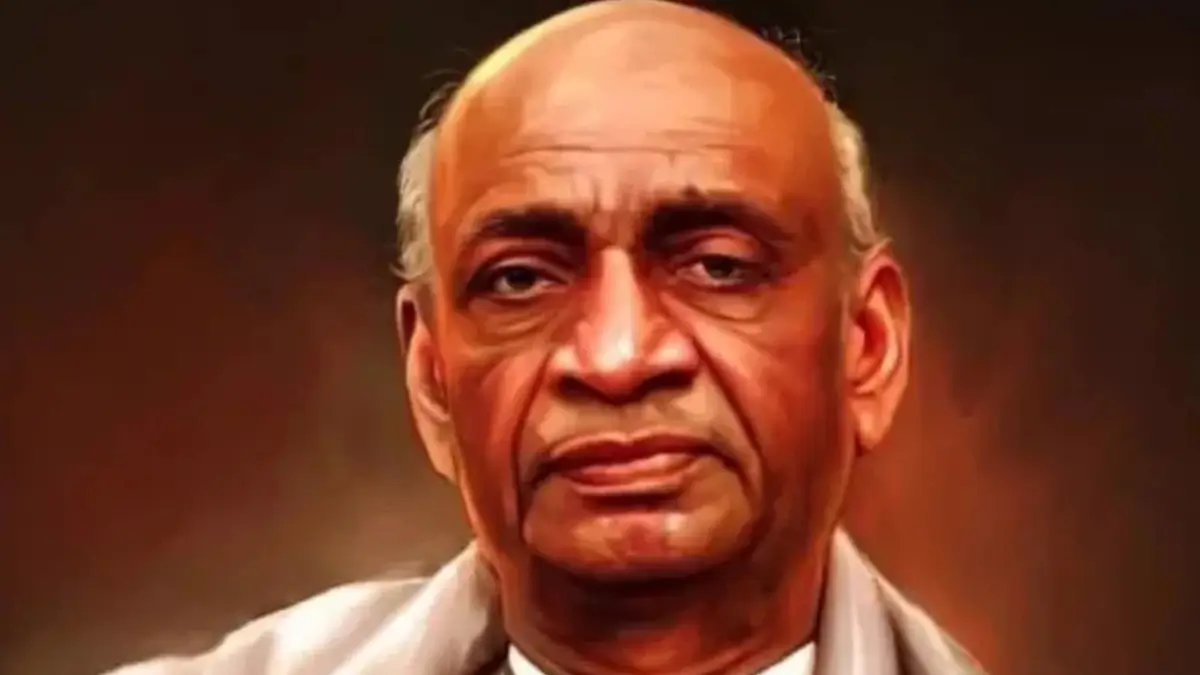
Sardar Vallabhbhai Patel, fondly remembered as the Iron Man of India, was one of the most influential leaders of India’s freedom movement. As the first Deputy Prime Minister and Home Minister of independent India, he played a historic role in uniting more than 560 princely states into one strong nation. His determination, leadership, and vision made him a true architect of modern India.
Early Life and Education of Sardar Vallabhbhai Patel
Sardar Vallabhbhai Patel was born on 31 October 1875 in Nadiad, Gujarat, to Jhaverbhai Patel and Ladba Patel. Known for his courage and simplicity since childhood, he studied in local schools before becoming a lawyer. Despite financial struggles, Patel worked hard, saved money, and went to London to study law at the Middle Temple, where he topped his class.
Role in India’s Freedom Struggle
After returning from England, Patel joined Mahatma Gandhi’s movement and became a strong supporter of non-violent resistance (Satyagraha). He led several successful movements, including:
- Kheda Satyagraha (1918): Helped farmers who couldn’t pay taxes due to famine.
- Bardoli Satyagraha (1928): Protested against unfair land taxes. After this victory, people affectionately began calling him “Sardar,” meaning leader or chief.
- Quit India Movement (1942): Inspired thousands with his powerful speeches against British rule.
Patel’s courage and organizational skills made him one of the strongest pillars of the Indian National Congress.
The Iron Man and India’s Unification
After India gained independence in 1947, Sardar Patel became the Deputy Prime Minister and Home Minister. He faced the enormous task of uniting over 565 princely states. Through his diplomacy, firmness, and vision, almost all states joined the Union of India, except a few like Hyderabad, Junagadh, and Kashmir, which were later integrated.
This remarkable achievement earned him the title of the Iron Man of India — symbolizing strength, unity, and determination.
Patel’s Role in Building Modern India
Sardar Patel also laid the foundation of India’s civil services, which he called the “Steel Frame of India.” He believed that an honest and efficient administrative system was essential to keep India united and strong.
He also worked for:
- Rehabilitation of refugees after Partition.
- Restoration of peace during communal unrest.
- Reconstruction of the Somnath Temple in Gujarat.
His leadership ensured stability and order in the newly independent nation.
The Statue of Unity
To honor Sardar Patel’s legacy, the Government of India built the Statue of Unity in Gujarat, near the Narmada Dam. Inaugurated on 31 October 2018, the statue stands 182 meters (597 feet) tall, making it the world’s tallest statue. It represents national unity, strength, and pride — ideals Patel dedicated his life to.
Rashtriya Ekta Diwas
In 2014, the Indian government declared 31 October, Sardar Patel’s birthday, as Rashtriya Ekta Diwas or National Unity Day. The day is celebrated every year to remind citizens of Patel’s great contribution in uniting India and promoting national integration.
Death and Legacy of Sardar Vallabhbhai Patel
Sardar Patel passed away on 15 December 1950 in Mumbai. In 1991, he was posthumously awarded the Bharat Ratna, India’s highest civilian honor. His life continues to inspire generations, and he is remembered as a true patriot, a great administrator, and the unifier of India.


 Which is the Most Consumed Beverage in t...
 Which is the Only Continent with No Tree...
 Which River is known as the National Riv...











