
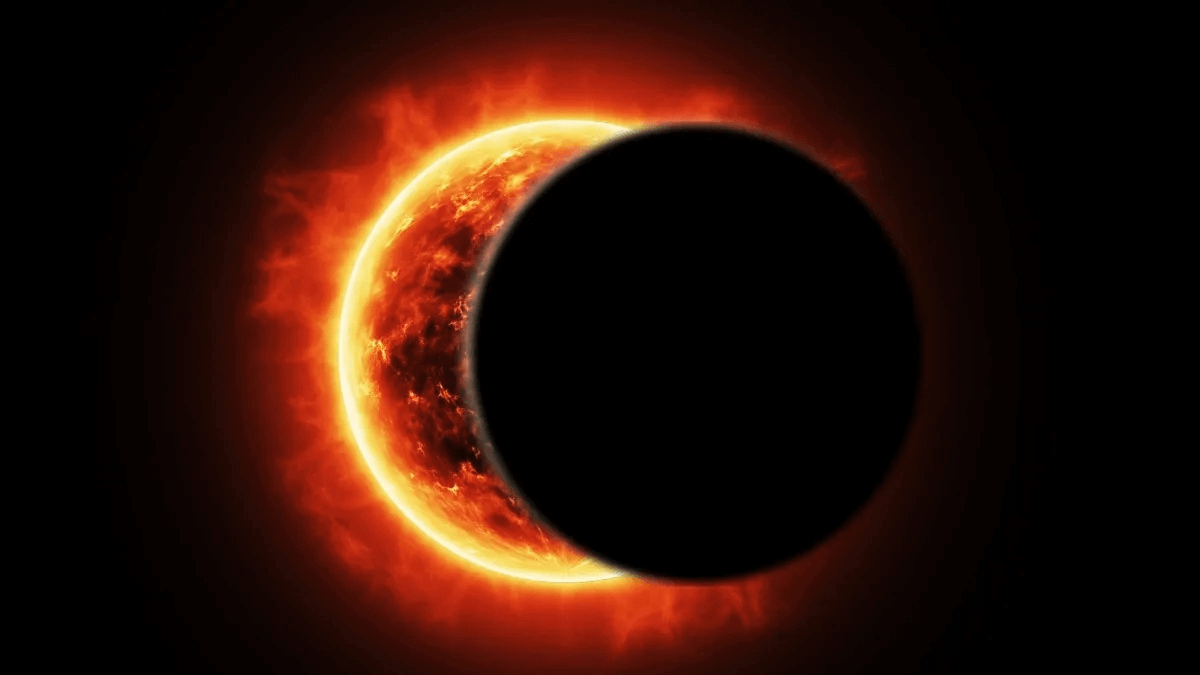
Solar eclipses have always fascinated people because they are rare and beautiful celestial events. In September 2025, a partial solar eclipse (Surya Grahan) will occur, where the Moon will cover part of the Sun. Let’s explore the date, timing, visibility, and key facts about this upcoming eclipse.
Solar Eclipse in September 2025, Date
On Sunday, September 21, 2025, the world will witness a partial solar eclipse. This means that the Sun will not be fully hidden; instead, the Moon will block only a portion of it.
Because of time zone differences, some regions like New Zealand will see the eclipse continuing into the early hours of Monday, September 22, 2025.
Will the Eclipse be Visible in India?
Sadly, India will not be able to see this eclipse. The timings fall between 11:00 PM and 3:23 AM IST, which is during the night. Since a solar eclipse can only be seen in daylight, viewers in India will miss this event.
Key Date and Time (UTC)
Here are the important timings of the eclipse in Universal Time (UTC):
- Eclipse begins: 17:29 UTC (10:59 PM IST, Sept 21)
- Maximum eclipse: 19:41 UTC (1:11 AM IST, Sept 22)
- Eclipse ends: 21:53 UTC (3:23 AM IST, Sept 22)
The total duration of the eclipse will be around four hours.
Countries Where the Eclipse Will Be Visible
The September 2025 Surya Grahan will mainly be visible in the Southern Hemisphere. Some of the regions that will witness it include:
- Australia and New Zealand – during their early morning hours
- Pacific Islands – such as Fiji, Samoa, Tonga, and Cook Islands
- French Polynesia and New Caledonia
- Parts of Antarctica – with the longest viewing duration
Countries in North and South America, Europe, Africa, and most of Asia (including India) will not see the eclipse
Why is This Special?
- This eclipse is partial, so the Sun will not disappear completely. The maximum coverage in some areas (like southern New Zealand) will be around 72–85%.
- The sky will dim slightly, but it will not turn completely dark like in a total eclipse.
- It is a reminder of how precisely the Earth, Moon, and Sun move in space to create such rare alignments.
Safety During the Eclipse
It’s very important not to look at the Sun directly during an eclipse. Even if the Sun is partly covered, it can damage the eyes. Use special solar glasses or indirect viewing methods like pinhole projectors to watch safely.


 Who were the Seven Sisters of Petroleum?...
 What is the State Flower of Florida? Che...
 Which is the Largest Desert in Asia? Che...











