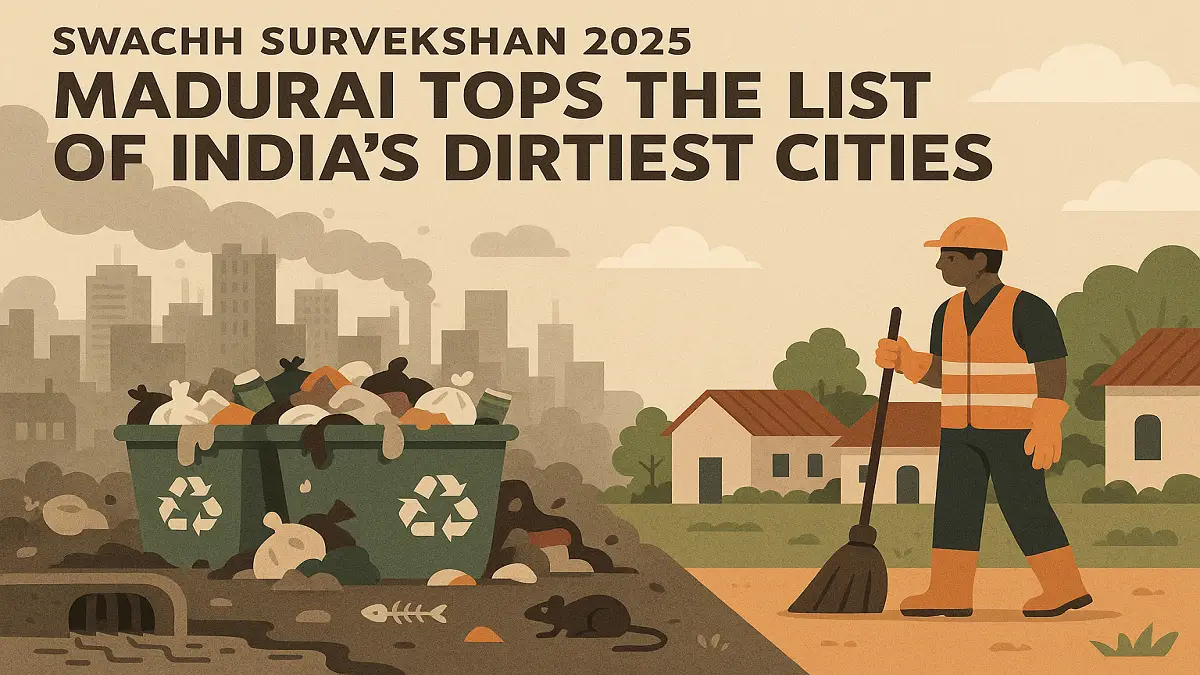
The Swachh Survekshan 2025 report, released under the Swachh Bharat Mission, has once again exposed the deep divide in India’s urban cleanliness efforts. While some smaller cities have made impressive strides in maintaining hygiene, several of India’s major metropolitan areas have failed to keep up. This year, Madurai has topped the list as the dirtiest city in India 2025, followed closely by Ludhiana, Chennai, Ranchi, and Bengaluru.
Background: Understanding Swachh Survekshan
The Swachh Survekshan is an annual cleanliness survey conducted by the Ministry of Housing and Urban Affairs (MoHUA) under the Swachh Bharat Mission (Urban).
It evaluates Indian cities based on parameters like:
- Solid waste management
- Citizen feedback
- Sanitation and hygiene levels
- Innovation and best practices
The survey covers over 4,000 urban local bodies, ranking them to encourage competition and continuous improvement.
Top 10 Dirtiest Cities in India 2025
According to the official Swachh Survekshan 2025 results, the following cities performed the worst in the cleanliness rankings:
| Rank | City | Score |
|---|---|---|
| 1 | Madurai | 4823 |
| 2 | Ludhiana | 5272 |
| 3 | Chennai | 6822 |
| 4 | Ranchi | 6835 |
| 5 | Bengaluru | 6842 |
| 6 | Dhanbad | 7196 |
| 7 | Faridabad | 7329 |
| 8 | Greater Mumbai | 7419 |
| 9 | Srinagar | 7488 |
| 10 | Delhi | 7920 |
Major Highlights from the 2025 Report
1. Big Metros Underperform
Despite being economic powerhouses, cities like Bengaluru, Chennai, and Delhi performed poorly. Rapid urbanization, weak waste segregation, and poor public discipline have contributed to their declining hygiene scores.
2. Smaller Cities Show the Way
Smaller towns such as Indore, Surat, and Navi Mumbai continue to dominate the clean city rankings. Their success proves that effective civic management and community participation matter more than financial resources.
3. Bengaluru’s Decline
Once known as the “Garden City,” Bengaluru now struggles with unregulated waste disposal, overflowing landfills, and clogged drains, ranking fifth among the dirtiest cities. Its rapid IT-led expansion has severely strained civic infrastructure.
4. Chennai and Delhi Face Similar Challenges
Both Chennai and Delhi have been criticized for poor waste segregation, frequent waterlogging, and inefficient sanitation systems, reflecting gaps in long-term urban planning.
5. Environmental Concerns
Pollution, untreated sewage, and improper solid waste management continue to affect air and water quality in these cities, posing serious public health and environmental risks.
Contrast: The Cleanest Cities Continue to Inspire
On the other hand, Indore, Surat, and Navi Mumbai were once again recognized in the “Super Swachh League” for their consistent efforts toward urban cleanliness. Their models emphasize door-to-door garbage collection, recycling, and citizen awareness, setting a benchmark for others.
Reasons Behind Poor Rankings
- Unplanned Urban Growth – Rapid expansion without adequate waste management infrastructure.
- Lack of Civic Awareness – Limited citizen participation in cleanliness drives.
- Inadequate Segregation – Mixing of biodegradable and non-biodegradable waste.
- Weak Enforcement – Poor monitoring and implementation of sanitation bylaws.
- Neglected Drains and Landfills – Overflowing waste sites and untreated sewage discharge.
Government Measures and the Way Forward
The Ministry of Housing and Urban Affairs has urged all low-ranked cities to:
- Improve waste segregation at source
- Develop modern waste treatment plants
- Strengthen municipal monitoring systems
- Launch awareness campaigns promoting citizen responsibility
The upcoming Swachh Bharat Mission 2.0 also aims to integrate smart technology for better waste tracking and disposal efficiency.


 UV Index Explained: The Hidden Health Ri...
 QS World University Rankings 2026: India...
 Best Airlines in the World 2026: Best Fu...