
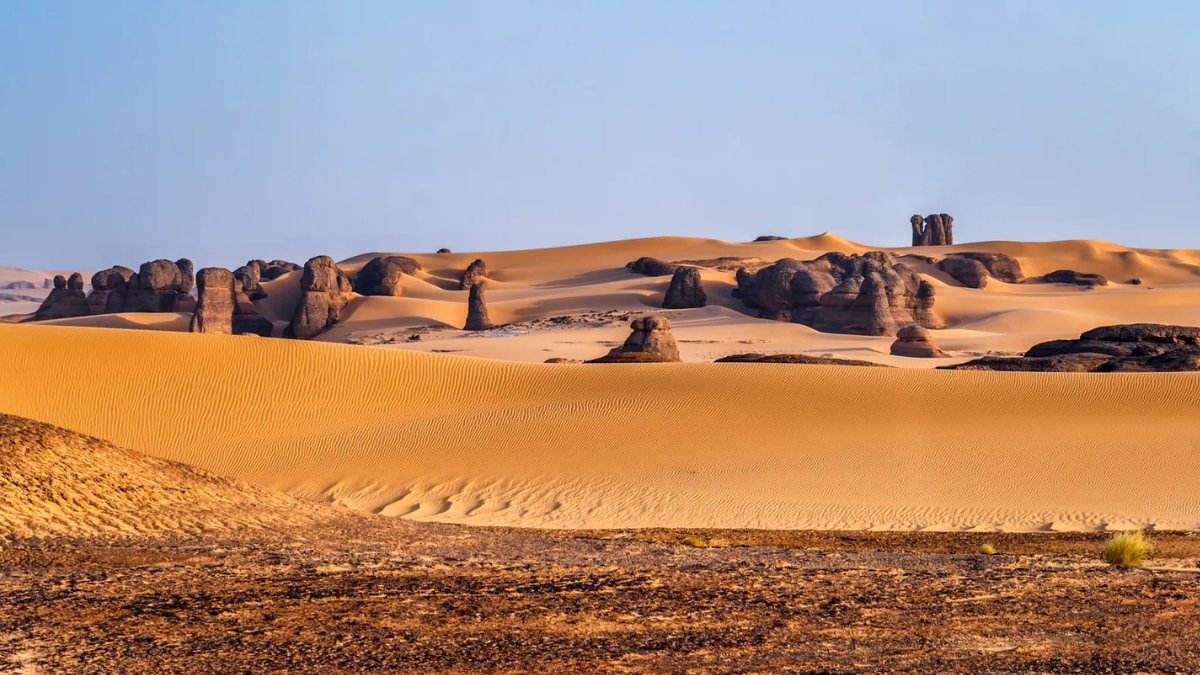
Deserts cover vast parts of the Earth, shaping climates, ecosystems, and cultures. Some countries today are almost entirely made up of desert landscapes, while others include major arid zones. In this article, we explore the top 10 countries that have the largest desert areas by 2025, showing how nature’s wide, dry expanses define these nations.
Top-10 Countries with the Most Desert Area by 2025
Algeria, with the approximately desert area of 1,500,000 + square kilometers, holds the title of the country with the most desert area, followed by Saudi Arabia, Libya and Australia.
Here is the list of top-10 countries with the most desert area in 2025:
| Rank | Country | Approx. Desert Area ( sq. km) |
| 1. | Algeria | 1,500,000+ |
| 2. | Saudi Arabia | 1,300,000+ |
| 3. | Libya | 1,200,000+ |
| 4. | Australia | 1,000,000+ |
| 5. | Sudan | 800,000+ |
| 6. | China | 700,000+ |
| 7. | Niger | 700,000+ |
| 8. | 9Mongolia | 500,000+ |
| 9. | United States | 500,000+ |
| 10. | Iran | 300,000+ |
Algeria, Country with the Most Desert Area
Algeria has the biggest desert area in the world, with more than 80% of its land covered by the Sahara Desert. This includes huge sand dunes, rocky plateaus, and seasonal salt flats. Cities like Tamanrasset and oases such as the M’zab Valley have been home to people for centuries. Even with extreme heat and very little rainfall, desert communities here have learned to survive using traditional ways and by settling near water sources.
Saudi Arabia
Almost all of Saudi Arabia is desert, including the Arabian Desert and the famous Rub’ al Khali, or “Empty Quarter,” the world’s largest continuous sand desert. It is known for vast dune fields, rocky hills, and wide gravel plains. The desert has shaped Bedouin traditions for centuries. Today, these open spaces are also being used for solar and wind energy projects, showing how the land can support both cultural heritage and modern development.
Libya
About 90% of Libya is part of the Sahara Desert, with the Libyan Desert being one of the driest places on Earth. Some areas may not see rain for decades. Despite this, ancient rock art in the Acacus Mountains shows that people once thrived here. The desert landscape includes sand seas, rocky plateaus, and salt flats. Even today, small communities survive in oases scattered across this dry but historically rich region of North Africa.
Australia
Australia’s deserts, including the Great Victoria, Simpson, and Gibson, cover around 18% of the country. These areas are part of the “Outback,” famous for its red soil, scattered shrubs, and wide-open spaces. Unlike the Sahara, Australia’s deserts are not endless sand dunes but dry plains with unique wildlife like lizards, kangaroos, and emus. After rare rains, colorful wildflowers bloom, turning the desert into a brief but stunning natural display that attracts visitors and scientists alike.
Sudan
Sudan’s northern region is mostly desert, with the Bayuda and Nubian Deserts making up a big part of its land. The landscape includes gravel plains, volcanic hills, and dry riverbeds known as wadis. Life here depends heavily on the Nile River, which allows farming in certain areas. Historically, these deserts were crossed by trade caravans, linking Africa to the Middle East. Today, they remain important for cultural heritage and mineral resources despite harsh living conditions.
China
China’s deserts include the Taklamakan in Xinjiang and the Gobi in the north. The Taklamakan is one of the driest and most dangerous sand deserts in the world. The Gobi, shared with Mongolia, is a cold desert with rocky plains and freezing winters. Together, they cover over 700,000 square kilometers. These deserts are important for wildlife, history, and trade routes, especially as part of the ancient Silk Road, which once connected China to the West.
Niger
Nearly two-thirds of Niger is desert, with the Ténéré Desert in the east being one of the most iconic parts of the Sahara. Known for its wind-sculpted rock formations and vast sand dunes, it is a challenging environment with little vegetation. Despite the tough climate, nomadic groups and small settlements exist here. Historically, the desert was part of important caravan trade routes, connecting West Africa to North Africa and the Mediterranean region.
Mongolia
The southern third of Mongolia is dominated by the Gobi Desert, a cold desert with rocky landscapes, dry grasslands, and harsh winters. Covering over 500,000 square kilometers, it is home to rare animals like snow leopards and wild Bactrian camels. The Gobi also holds fossil-rich areas, revealing dinosaur remains. Despite its harsh climate, nomadic herders have lived here for centuries, moving with their livestock to find grazing areas and water sources.
United States
The United States has four main desert regions: the Great Basin, Mojave, Sonoran, and Chihuahuan Deserts. Together, they cover more than 500,000 square kilometers, mostly in southwestern states like Arizona, Nevada, and California. These deserts vary widely, from cactus-covered landscapes to high, cold plateaus. They are home to unique plants like Joshua trees and animals like roadrunners. Despite being dry, these areas attract millions of visitors each year for their beauty and biodiversity.
Iran
Iran’s main deserts are the Dasht-e Kavir (Great Salt Desert) and the Dasht-e Lut, known for some of the hottest temperatures ever recorded on Earth. Together, they cover about 300,000 square kilometers. The land is a mix of salt flats, bare rock, and tall sand dunes shaped by the wind. While life is limited, certain hardy plants and desert villages still exist, using ancient irrigation systems to survive in this extreme environment.


 Which Place is known as the Glass Capita...
 Who is known as the Father of Census of ...
 Which Continent is known as the White Co...











