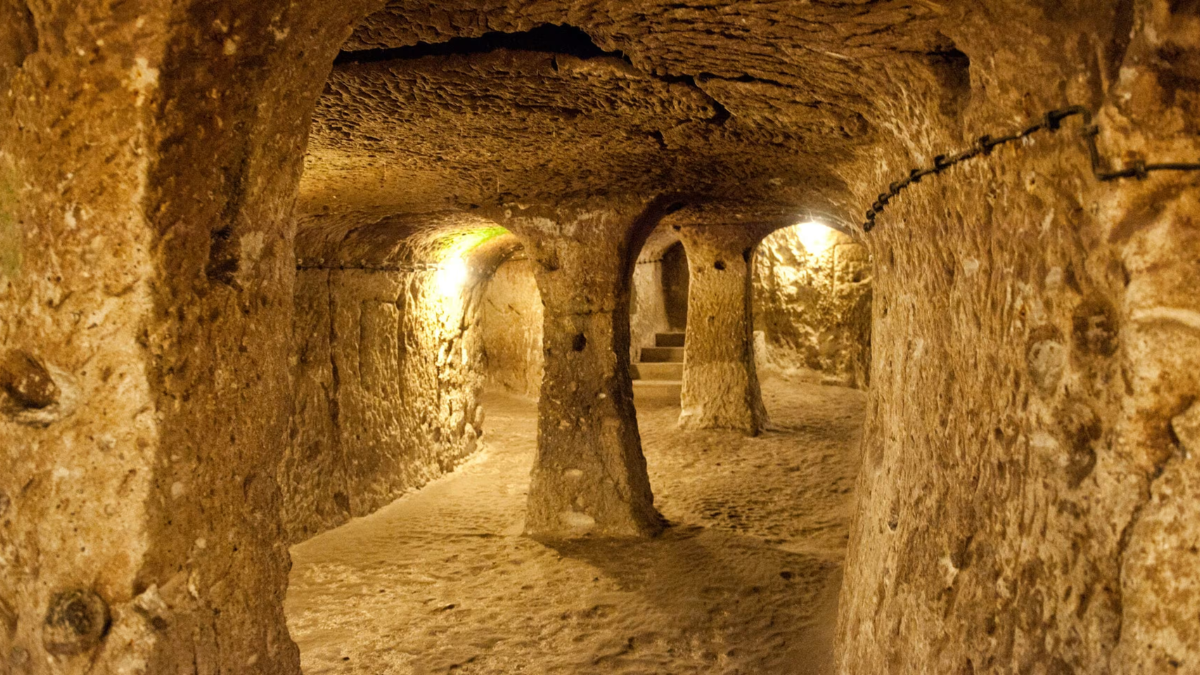
Most people imagine cities filled with tall buildings and busy roads, but some of the world’s most fascinating cities are hidden underground. These underground cities were built for different reasons—some to escape enemies, others to survive extreme weather, and a few for modern convenience. They show how humans can adapt and create unique living spaces even below the earth’s surface.
Top-7 Cities that are Built Entirely Underground
Across the world, there are cities not built above the ground but hidden beneath it. These underground cities were created for safety, survival, or modern convenience. From ancient refuges to modern complexes, they reveal how humans adapt and build amazing spaces below the earth’s surface.
Here are the names of top-7 cities that are entirely built underground:
- Derinkuyu
- Nushabad
- Naours
- Orvieto
- Dixia Cheng
- SubTropolis
- Crystal City
Derinkuyu, Cappadocia, Turkey
One of the most famous underground cities is Derinkuyu in Turkey. Built thousands of years ago, this massive network goes almost 60 meters deep and could protect nearly 20,000 people. It had stables, kitchens, wine presses, chapels, and ventilation systems. For centuries, people used it as a safe place to hide during invasions and wars.
Nushabad, Iran
Near Kashan in Iran lies Nushabad, a hidden city built several levels underground. It was designed to protect residents during enemy attacks and from the region’s extreme climate. With narrow tunnels, storage rooms, water reservoirs, and quick escape routes, Nushabad is a remarkable example of ancient Persian engineering.
Naours, France
In northern France, the underground city of Naours was created inside an old chalk quarry. With around 300 rooms and 28 galleries, it could house nearly 3,000 people. First used in the Middle Ages as a wartime refuge, it was later used again during World War II. The city even had wells, chapels, and proper ventilation to support long stays.
Orvieto, Italy
The Italian town of Orvieto sits on volcanic rock, beneath which lies a vast network of 1,200 tunnels and rooms. Built originally by the ancient Etruscans, these underground spaces were used to store food and wine. During World War II, they served as bomb shelters. Today, many parts of Orvieto’s underground tunnels are open for tourists.
Dixia Cheng, Beijing, China
In the 1960s, China built Dixia Cheng, also known as the “Underground City,” during the Cold War. Covering about 85 square kilometers, it was intended as a nuclear fallout shelter for up to a million people. The city included schools, hospitals, restaurants, and storage areas. Although never actually used, it remains one of the largest underground defense projects in the world.
SubTropolis, Kansas City, USA
Unlike the ancient cities, SubTropolis in the United States is a modern underground business hub. Built inside an old limestone mine, it spans more than 5 million square feet. Today, it hosts offices, warehouses, manufacturing units, and even data centers. Its natural underground setting provides cool temperatures and high security, making it a unique business location.
Crystal City, Arlington, Virginia, USA
Just outside Washington, D.C., lies Crystal City, a modern underground network connecting offices, hotels, homes, shops, and restaurants. The system of tunnels links millions of square feet of space, protecting people from extreme weather. It is a shining example of how underground spaces can be used not just for survival, but for modern city living.


 Which Beverage is known as the Queen of ...
 Which City of the World is known as the ...
 Which is the Largest LPG Producing City ...