
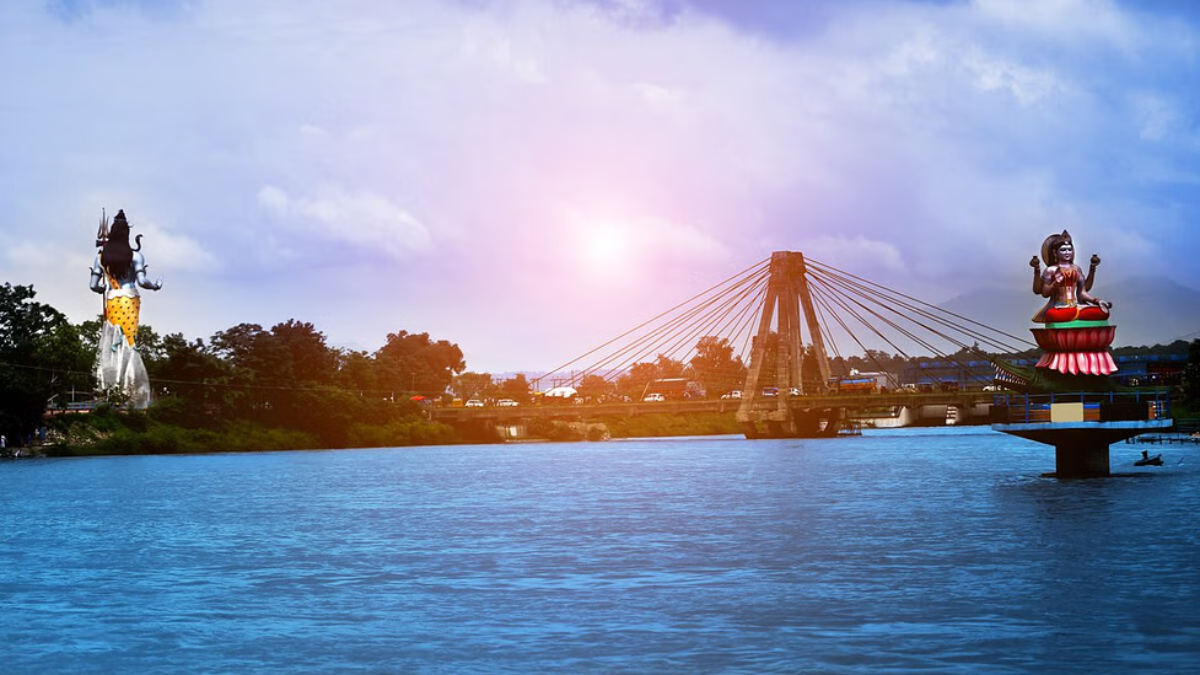
India is a land where rivers are more than just water sources; they are seen as symbols of life, purity, and spirituality. Since ancient times, rivers have played a central role in culture, rituals, and traditions. Many of them are even worshipped as goddesses, and among these, seven rivers hold a very special place, often called the seven sacred rivers of India.
Top-5 Most Sacred Rivers of India
India is home to many holy rivers, but the top five sacred rivers are the Ganga, Yamuna, Godavari, Narmada, and Kaveri. These rivers are worshipped as goddesses, support millions of lives, and hold deep cultural, spiritual, and historical significance across the country.
Here are the names of top-7 most sacred rivers of India:
- Ganga River
- Yamuna River
- Sindhu River
- Narmada River
- Godavari River
- Krishna River
- Kaveri River
Ganga River
The Ganga is the most sacred river in India, worshipped as Goddess Ganga. It begins from the Gangotri glacier in Uttarakhand and flows for over 2,500 km, finally joining the Bay of Bengal. The river passes through major states like Uttar Pradesh, Bihar, and West Bengal. It provides irrigation, drinking water, and supports millions of people. For Hindus, taking a holy dip in the Ganga is believed to wash away sins and bring spiritual purity, making it the holiest river.
Yamuna River
The Yamuna originates from the Yamunotri glacier in Uttarakhand and travels about 1,376 km before merging with the Ganga at Prayagraj. It flows through Delhi, Haryana, and Uttar Pradesh. The river is vital for irrigation in fertile farming areas, especially western Uttar Pradesh. Historically, cities like Delhi and Agra flourished along its banks. Spiritually, the Yamuna is closely associated with Lord Krishna, as many of his stories are set on its banks. It is also considered the daughter of the Sun God.
Sindhu River
The Sindhu, also known as the Indus River, begins in Tibet, flows through Ladakh in India, and then passes into Pakistan before emptying into the Arabian Sea. Its total length is around 3,000 km. The Indus Valley Civilization, one of the world’s oldest urban cultures, developed on its banks. In Vedic texts, the Sindhu is praised as a mighty and sacred river. It continues to be important for irrigation and farming in the north-western regions, holding both historical and religious significance.
Narmada
The Narmada River rises from Amarkantak in Madhya Pradesh and flows westward into the Arabian Sea, which makes it unique among Indian rivers. Covering around 1,312 km, it passes through Madhya Pradesh, Maharashtra, and Gujarat. The Narmada is crucial for irrigation, drinking water, and hydroelectric projects like the Sardar Sarovar Dam. Spiritually, it is believed that simply meditating on the banks of the Narmada can cleanse sins. Pilgrims also undertake the Narmada Parikrama, walking around the river as a sacred journey.
Godavari River
The Godavari River, often called the Dakshin Ganga (Ganga of the South), starts from Trimbakeshwar in Maharashtra and flows about 1,465 km into the Bay of Bengal. It passes through Maharashtra, Telangana, Chhattisgarh, and Andhra Pradesh. Known as one of India’s most fertile river basins, it supports crops like rice, sugarcane, and cotton. The river also holds great religious importance, especially during the Godavari Pushkaram festival held every 12 years. Legends connect the Godavari with Sage Gautama, making it spiritually significant.
Krishna
The Krishna River begins in the Mahabaleshwar hills of Maharashtra and flows for about 1,400 km before entering the Bay of Bengal. It passes through Maharashtra, Karnataka, Telangana, and Andhra Pradesh. The river supports agriculture by providing irrigation and has many dams built on it, such as Nagarjuna Sagar and Almatti, which are crucial for farming and power generation. The Krishna is also worshipped as a goddess in southern India and is linked with several legends, making it both sacred and vital.
Kaveri River
The Kaveri River rises from the Brahmagiri Hills in Karnataka and flows about 800 km, passing through Karnataka and Tamil Nadu before joining the Bay of Bengal. Its delta is called the “Rice Bowl of South India” because of its fertile plains that support paddy cultivation. The Kaveri is worshipped as Goddess Kaveriamma in South India and is believed to serve mankind with divine blessings. It is vital for agriculture, drinking water, and culture, making it one of India’s most revered rivers.


 Which is the Most Consumed Beverage in t...
 Which is the Only Continent with No Tree...
 Which River is known as the National Riv...











