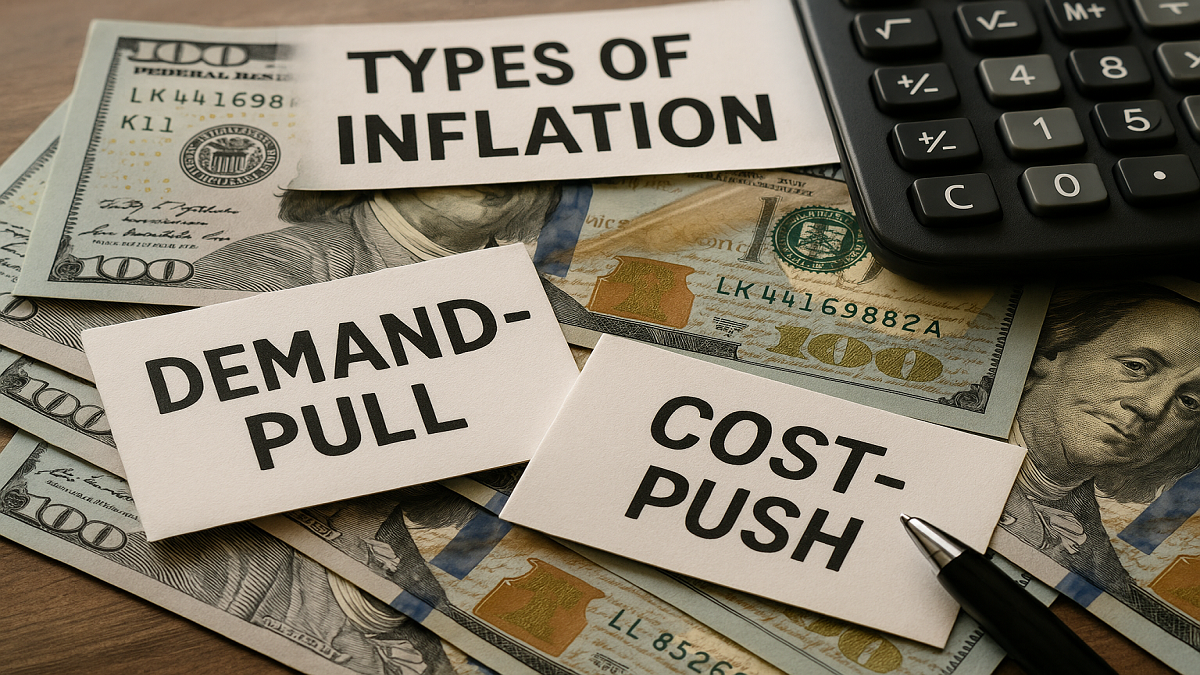
Inflation refers to the sustained rise in the general price level of goods and services in an economy over a period of time. It reduces the purchasing power of money and affects consumers, businesses, and the government alike.
Inflation can occur due to different causes, and economists generally classify it into Demand-Pull Inflation and Cost-Push Inflation. Apart from these, there are other types based on speed, scope, and control.
1. Demand-Pull Inflation
- Definition: Inflation caused when aggregate demand (AD) exceeds aggregate supply (AS) in the economy.
- Reason: Too much money chasing too few goods.
- Example: Rise in consumer demand during festival seasons or after an increase in government spending.
2. Cost-Push Inflation
- Definition: Inflation caused by an increase in production costs like wages, raw materials, or fuel.
- Reason: Producers pass higher costs onto consumers in the form of higher prices.
- Example: A rise in international crude oil prices increases transportation costs, leading to higher prices of goods.
3. Built-in Inflation (Wage-Price Spiral)
- Definition: When workers demand higher wages to cope with rising prices, and businesses raise prices further to cover higher wage costs.
- Reason: A cycle of higher wages → higher prices → demand for higher wages.
- Example: Inflation during strong labor union activity.
4. Hyperinflation
- Definition: Extremely rapid and uncontrollable rise in prices (often >50% per month).
- Reason: Excessive money supply, usually due to government printing money without backing.
- Example: Germany in the 1920s, Zimbabwe in the 2000s.
5. Creeping, Walking, and Galloping Inflation
- Creeping Inflation: Very slow rise in prices (less than 3% per year). Considered normal for growth.
- Walking Inflation: Moderate inflation (3–10% per year), may start affecting purchasing power.
- Galloping Inflation: Very high inflation (>10% per year), disrupts economy.
6. Stagflation
- Definition: A situation where inflation persists along with economic stagnation (low growth + high unemployment).
- Reason: Supply shocks + weak demand.
- Example: 1970s oil crisis in the USA.
7. Deflation (Opposite of Inflation)
- Definition: Persistent fall in prices of goods and services.
- Reason: Reduced demand, economic slowdown.
- Example: Great Depression of the 1930s.
Quick Comparison Table
| Type of Inflation | Cause | Example |
|---|---|---|
| Demand-Pull | Excess demand | Festival demand, govt. spending |
| Cost-Push | Higher production costs | Oil price rise |
| Built-in (Wage-Price Spiral) | Higher wages → higher prices | Strong union wage hikes |
| Hyperinflation | Excessive money supply | Zimbabwe (2000s) |
| Creeping | Slow rise (<3%) | Normal growth |
| Walking | Moderate (3–10%) | Developing economies |
| Galloping | Very high (>10%) | Developing countries with weak control |
| Stagflation | Inflation + unemployment | 1970s oil crisis |
| Deflation | Falling prices | Great Depression |


 What is National Investigation Agency? C...
 Which State is the Largest Petroleum Pro...
 Largest Crude Oil Supplier Countries to ...