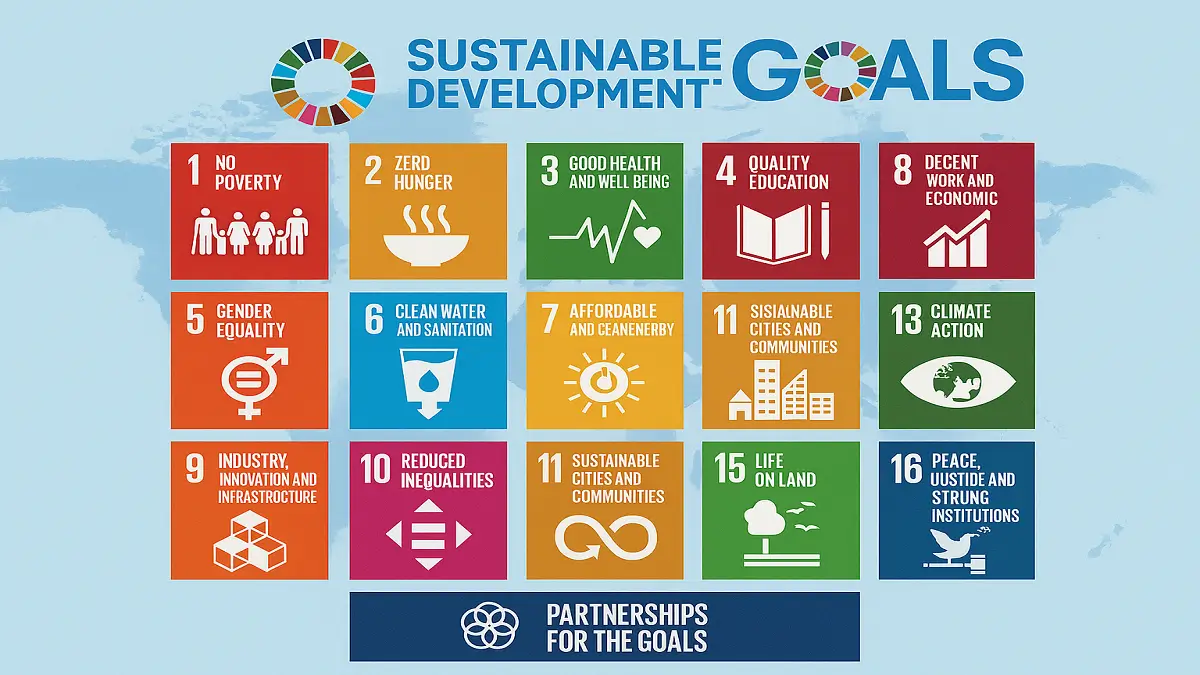
The Sustainable Development Goals, or SDGs, were adopted in September 2015 by all 193 United Nations member states as part of the 2030 Agenda for Sustainable Development. They replaced the earlier Millennium Development Goals (MDGs) and were designed to address broader challenges facing humanity — from poverty and inequality to climate change and peace.
The SDGs are not just goals for governments. They serve as a universal call to action for individuals, businesses, and civil societies to work together toward a fairer and more sustainable future. With 17 goals and 169 specific targets, the SDGs aim to create measurable progress by 2030, ensuring that “no one is left behind.”
Full List of 17 Sustainable Development Goals
Each of the 17 Sustainable Development Goals focuses on a specific global issue, yet they’re deeply interconnected. Together, they form the backbone of global development planning. Let’s look at them one by one —
- Goal 1: No Poverty – End poverty in all its forms everywhere. Despite progress, over 700 million people worldwide still live in extreme poverty.
- Goal 2: Zero Hunger – End hunger and promote sustainable agriculture. About 9% of the world’s population faces food insecurity.
- Goal 3: Good Health and Well-Being – Ensure healthy lives and promote well-being for all ages. It aims to reduce maternal mortality, end epidemics, and expand healthcare access.
- Goal 4: Quality Education – Guarantee inclusive and equitable education for everyone. Education remains key to breaking the cycle of poverty.
- Goal 5: Gender Equality – Achieve equality and empower all women and girls, ensuring their participation in all aspects of life.
- Goal 6: Clean Water and Sanitation – Ensure availability and sustainable management of water and sanitation for all.
- Goal 7: Affordable and Clean Energy – Make energy accessible, reliable, and sustainable. This includes a shift to renewable energy sources.
- Goal 8: Decent Work and Economic Growth – Promote inclusive economic growth, productive employment, and decent work opportunities.
- Goal 9: Industry, Innovation, and Infrastructure – Build resilient infrastructure and encourage innovation-driven, sustainable industries.
- Goal 10: Reduced Inequalities – Reduce inequality within and among countries through fair policies and equal access to opportunities.
- Goal 11: Sustainable Cities and Communities – Make cities inclusive, safe, and resilient as urbanization accelerates worldwide.
- Goal 12: Responsible Consumption and Production – Ensure sustainable consumption and production patterns to reduce waste and pollution.
- Goal 13: Climate Action – Take urgent measures to combat climate change and its impacts, from rising temperatures to extreme weather.
- Goal 14: Life Below Water – Conserve and sustainably use the oceans, seas, and marine resources.
- Goal 15: Life on Land – Protect and restore terrestrial ecosystems, manage forests sustainably, and combat biodiversity loss.
- Goal 16: Peace, Justice, and Strong Institutions – Promote peaceful, inclusive societies with equal access to justice.
- Goal 17: Partnerships for the Goals – Strengthen global partnerships to support and achieve the SDGs through cooperation and resources.
How are countries working to achieve the SDGs?
Every UN member country, including India, has developed national strategies to align with the SDGs. Governments are encouraged to integrate these goals into their policies, budgets, and development programs. The United Nations tracks progress annually through the Sustainable Development Report, which ranks countries based on how well they’re meeting these targets.
India, for example, has adopted the NITI Aayog SDG Index, which monitors progress across states and union territories. It highlights how states like Kerala, Tamil Nadu, and Himachal Pradesh have led in areas such as education, health, and clean energy.
However, achieving all 17 goals by 2030 remains a major challenge, especially after the disruptions caused by the COVID-19 pandemic, which reversed years of progress in health, poverty reduction, and gender equality.
Why the SDGs are more relevant than ever
The SDGs remind us that sustainability isn’t just about the environment—it’s about people, prosperity, and peace. With global temperatures rising, conflicts increasing, and inequalities deepening, the goals serve as a roadmap for collective survival and growth.
They inspire collaboration between governments, businesses, and individuals. Whether it’s reducing waste, supporting clean energy, or promoting education, every small step contributes to the global mission.


 How many Nuclear Power Plants in India? ...
 Do you Know Which is the Most Spoken Lan...
 Which is the Largest Black Pepper Produc...