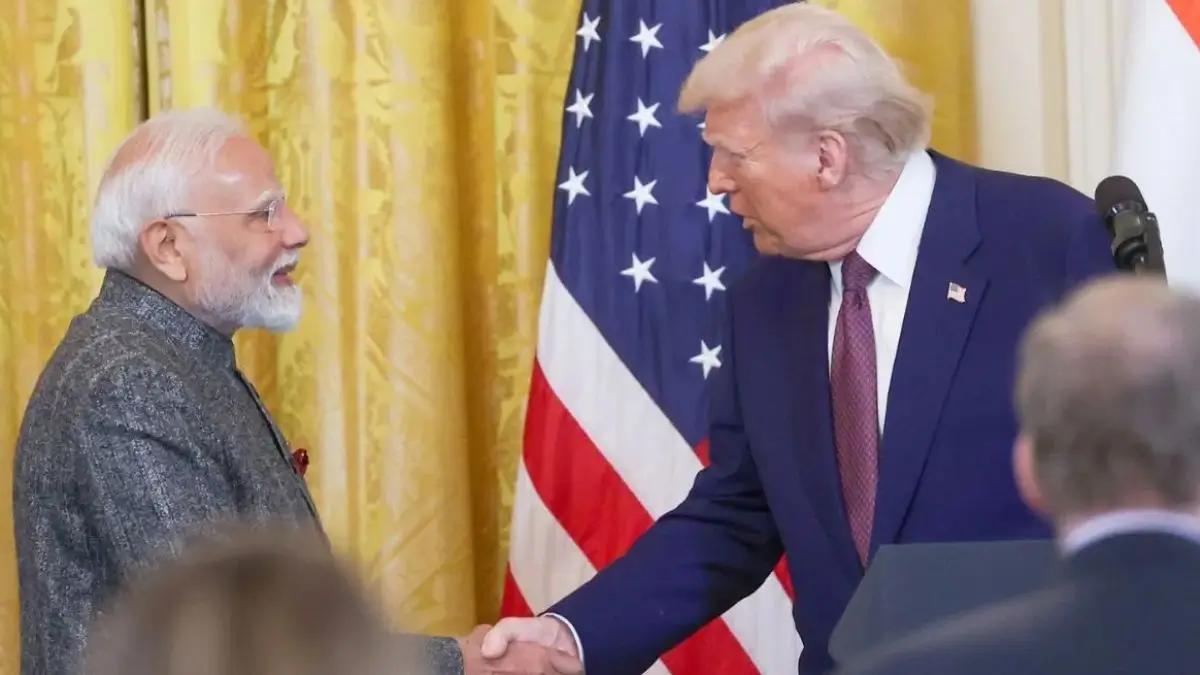
On 2nd February 2026, U.S. President Donald Trump claimed that the United States and India have reached a trade deal, with tariffs set to be reduced immediately. The announcement followed a direct call with Indian Prime Minister Narendra Modi. The deal promises lower tariffs, higher trade volumes, and major shifts in energy purchases, but questions remain over its legal status and long-term implications. resident Donald Trump announced that the U.S. and India agreed to a trade deal, reducing the U.S. “reciprocal tariff” on Indian goods from 25% to 18%, effective immediately.
What Trump Announced About the Trade Deal
- According to President Trump, the U.S. will lower reciprocal tariffs on Indian goods to 18%, while India will move towards reducing tariffs and non-tariff barriers on U.S. products to zero.
- Trump also stated that India committed to buying American products at a much higher level, including over $500 billion worth of U.S. energy, technology, agriculture, coal, and other goods.
- The announcement was made via Truth Social, signalling immediate implementation, although no official treaty text has yet been released.
Energy and Geopolitics: Russian Oil Angle
- A key geopolitical element of the announcement was Trump’s claim that Prime Minister Modi agreed to stop buying Russian oil and instead increase purchases from the United States and potentially Venezuela.
- This move, according to Trump, would help weaken Russia’s war effort in Ukraine.
- India’s energy choices have been a sensitive issue in U.S.-India relations, especially after Washington imposed higher tariffs last year citing India’s continued Russian oil imports.
India’s Response and Official Confirmation
- Prime Minister Modi later confirmed the reduction in U.S. tariffs in a post on X, welcoming the move for “Made in India” products.
- He described the agreement as beneficial for both democracies and emphasised cooperation for global peace, stability, and prosperity.
- However, Indian authorities have not yet released detailed commitments on tariff elimination or oil import changes, leaving room for interpretation and future negotiation.
Legal and Institutional Questions
- Despite the strong language used by Trump, the legal status of the deal remains unclear.
- The White House and the U.S. Trade Representative’s office have not released official documentation.
- Legal experts and some U.S. lawmakers have questioned whether the President can finalise binding trade agreements without Congressional approval.
- Trade professionals also note that such changes become official only after notification in the Federal Register, specifying tariff codes and effective dates.
Key Summary at a Glance
| Aspect | Details |
| Why in News? | Trump announces U.S.-India trade deal |
| Tariff Change | U.S. cuts tariff on India from 25% to 18% |
| India’s Commitment | Higher imports from U.S., tariff reduction |
| Energy Angle | Shift away from Russian oil claimed |
| Key Uncertainty | Deal text and legal approval pending |
Question
Q. According to Trump, the revised reciprocal tariff on Indian goods is,
A. 25%
B. 20%
C. 18%
D. 15%


 José Antonio Kast Rist Takes Oath as the...
 U.S. and South Korea Kick Off Massive Jo...
 India Overtakes China as Top Exporter of...