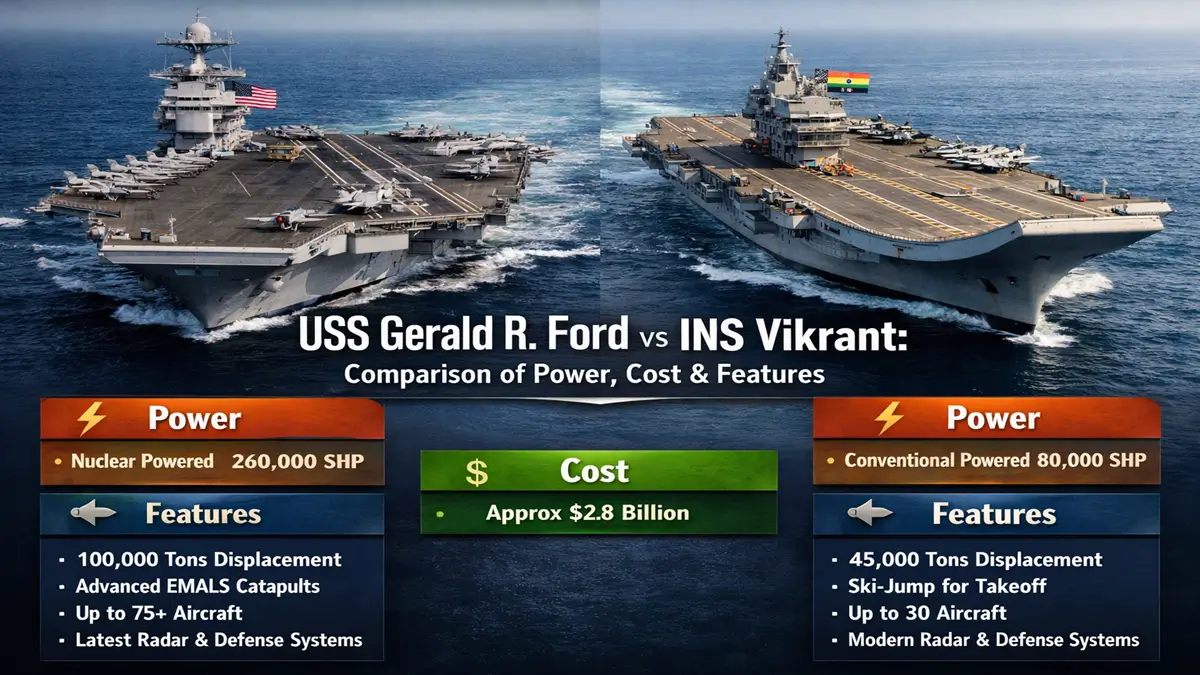
Aircraft carriers are among the most powerful assets in modern naval warfare. They act as floating airbases, allowing countries to project military power far beyond their shores. The United States operates the world’s most advanced aircraft carrier, USS Gerald R Ford, while India has developed its first indigenous carrier, INS Vikrant.
Although both are modern warships, they differ significantly in terms of size, technology, and operational capability.
Overview of USS Gerald R Ford
USS Gerald R Ford represents the latest generation of aircraft carriers. It is designed with advanced technology, high automation, and future warfare capabilities.
Key highlights include:
- Nuclear powered propulsion for long endurance
- Electromagnetic Aircraft Launch System for efficient aircraft operations
- Higher sortie generation compared to older carriers
- Advanced radar and combat systems
This carrier is built to support global missions and long-duration deployments without frequent refueling.
Overview of INS Vikrant
INS Vikrant is India’s first indigenously built aircraft carrier and a major milestone in defense manufacturing. It strengthens India’s naval presence in the Indian Ocean region.
Key highlights include:
- Conventional gas turbine propulsion
- Ski jump launch system for aircraft takeoff
- Designed for regional maritime security
- Built under the Make in India initiative
It reflects India’s growing capability in indigenous shipbuilding and defense technology.
Key Differences Between USS Gerald R Ford and INS Vikrant
Size and Power
USS Gerald R Ford is significantly larger, with a displacement of around 100000 tons, while INS Vikrant is about 43000 tons.
- Larger size allows Ford to carry more aircraft and equipment
- Nuclear propulsion gives Ford unlimited operational range
- Vikrant, being fuel powered, has limited endurance
This makes USS Ford suitable for global operations, while Vikrant is optimized for regional defense.
Aircraft Capacity and Operations
The aircraft capacity and launch systems create a major difference between the two carriers.
- USS Ford can carry 75 to 90 aircraft
- INS Vikrant can carry around 30 to 35 aircraft
In terms of launch systems:
- Ford uses electromagnetic catapult EMALS
- Vikrant uses ski jump STOBAR system
EMALS allows heavier and more advanced aircraft, while ski jump limits flexibility.
Technology and Automation
USS Gerald R Ford is equipped with next generation systems that reduce manpower and increase efficiency.
- Advanced automation reduces crew size despite larger ship
- Better sortie rate improves combat readiness
- Supports future technologies like drones
INS Vikrant is modern but follows conventional carrier design.
- Relies more on manual operations
- Limited automation compared to Ford
- Focused on reliability and cost efficiency
Cost and Strategic Role
Cost is another major difference.
- USS Ford costs around 13 billion dollars
- INS Vikrant costs around 3 billion dollars
Strategically:
- USS Ford is built for global power projection
- INS Vikrant is designed for Indian Ocean dominance
Both carriers align with their country’s defense priorities.


 INS Aridhaman Nuclear Submarine Joins In...
 INS Sunayna Reaches Male, Boosting Marit...
 BRO's Project Chetak Turns 47: How It St...