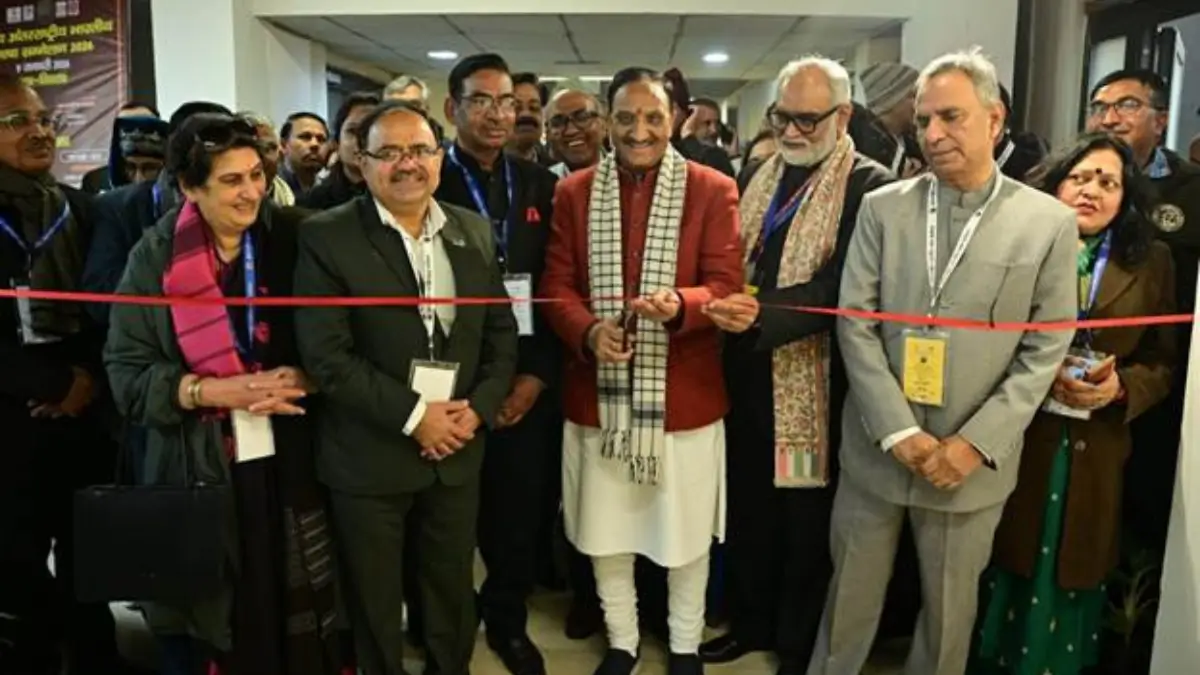
India’s Vice-President, C. P. Radhakrishnan, recently inaugurated the Third International Conference on Indian Languages in New Delhi. The event brought together scholars, language experts, and international delegates to discuss the protection, study, and global promotion of Indian languages. He stressed that languages are not only tools of communication but also the foundation of culture, democracy, and knowledge.
Language – The Soul of Human Civilization
While addressing the conference, the Vice-President said that language is the “conscience of civilisation.” He explained that languages carry history, ideas, values, and traditions from one generation to another. From ancient stone carvings and palm-leaf manuscripts to modern digital writing, languages have helped preserve science, philosophy, literature, and moral teachings.
He also shared his experience from the Siddha Day celebrations in Chennai, where palm-leaf manuscripts showed how India’s knowledge systems have survived for centuries through written records in different languages.
India’s Strength Lies in Linguistic Diversity
The Vice-President highlighted that India has many languages, but this diversity has never weakened the nation. Instead, it has strengthened unity and cultural understanding. Indian languages have played a major role in the growth of medicine, science, governance, spirituality, and philosophy.
As the Chairman of the Rajya Sabha, he observed that more Members of Parliament now speak in their mother tongues. This, he said, shows the maturity of Indian democracy, where people can express themselves freely in the language they know best.
Constitution and Respect for All Languages
He recalled that President Droupadi Murmu recently released a translated copy of the Constitution of India in the Santhali language. He described this as a historic step towards language inclusion.
The Vice-President explained that the Eighth Schedule of the Constitution recognises many Indian languages and protects their status. According to him, true national unity is built on respect for differences, not on forcing everyone to be the same. Democracy becomes stronger when citizens can speak and participate in their own language.
Role of Education and Technology in Saving Languages
The Vice-President also spoke about the danger faced by many indigenous languages around the world. He said international conferences help countries work together on research, documentation, and preservation of old manuscripts.
He mentioned important government initiatives such as the National Education Policy 2020 and the Gyan Bharatam Mission, which aim to promote multilingual education and protect India’s language heritage. He supported the use of digital archives, artificial intelligence translation tools, and multilingual online platforms so that Indian languages can grow in the modern world.
Important Facts for Exams
- The Eighth Schedule of the Constitution recognises India’s linguistic diversity.
- Santhali is one of the languages included in the Eighth Schedule.
- National Education Policy 2020 promotes multilingual education.
- Palm-leaf manuscripts preserve ancient Indian knowledge.
- Digital tools and AI can help protect and promote languages.

 Which Place is known as the Diamond Capi...
 List of Major LPG Gas Companies in India...
 WHO Foundation and Novo Nordisk Launch I...