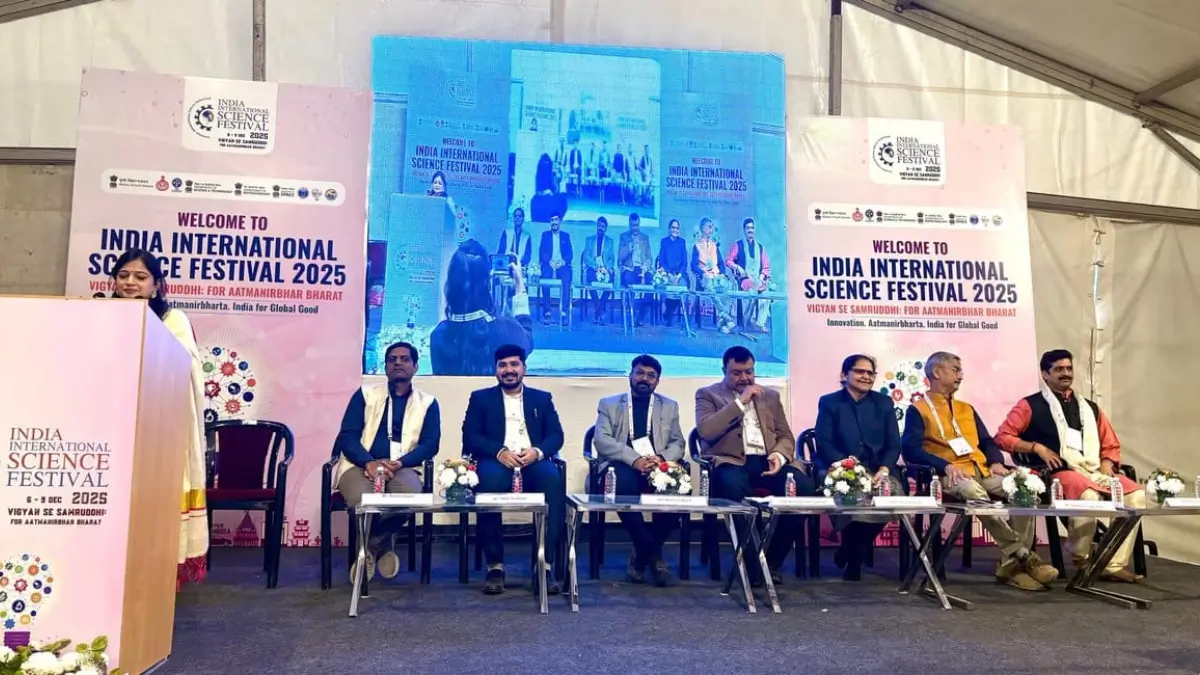
Vigyanika: Science Literature Festival 2025 was organised on 8–9 December 2025 in New Delhi as a major part of the India International Science Festival (IISF). The event was hosted by CSIR–NIScPR along with Vijnana Bharti (VIBHA), the Indian Institute of Tropical Meteorology (IITM), Pune, and Panjab University, Chandigarh. The festival celebrated how science can be shared through simple language, creative writing, and Indian cultural forms. Many well-known scientists, writers, editors, and science communicators took part.
Opening Sessions: Literature and Media in Indian Science
The festival began with an inaugural session titled “Bhartiya Vigyan Vimarsh me Sahitya aur Sanchar Madhyamo ki Bhoomika.”
Speakers discussed how literature and communication tools help shape India’s scientific thinking.
- Dr. Paramananda Barman from CSIR–NIScPR introduced the festival.
- Dr. Neel Sarovar Bhavesh of VIBHA explained why India needs to communicate science in a culturally rooted way.
- Shri Vivekananda Pai, General Secretary of VIBHA, delivered the keynote address and spoke about the importance of having an Indian viewpoint in science communication.
- Prof. Arun Kumar Grover, former Vice-Chancellor of Panjab University, highlighted India’s long history of scientific institutions.
- Dr. Geetha Vani Rayasam, Director of CSIR–NIScPR, talked about NIScPR’s role in making science easy for the public.
- Dr. Rashmi Sharma from NCSTC, DST discussed today’s modern methods of reaching people with science.
- Dr. Atul Kumar Srivastava from IITM presented the Vote of Thanks.
Vigyan Kavi Sammelan: Poetry Meets Science
The first day also featured a special Vigyan Kavi Sammelan, where poets blended science with poetry.
Well-known science poets such as Prof. Manoj Kumar Patairiya, Prof. Rajesh Kumar, Mohan Sagoria, Ms. Radha Gupta, Prof. Neera Raghav, Yashpal Singh ‘Yash’, TSRS Sandeep, and Dr. Anurag Gaur presented their creative works.
Their poems showed how scientific ideas can be explained beautifully through simple and emotional expressions.
Day 2: Science for a Self-Reliant India
The second day opened with a session titled “Vigyan Se Samruddhi – For Atmanirbhar Bharat.” This session focused on India’s traditional knowledge and how it can help build a self-reliant nation.
Speakers included:
- Dr. Arvind Ranade, Director, NIF – He stressed the need to protect traditional knowledge and give proper credit to its original holders.
- Dr. Viswajanani J. Sattigeri, CSIR–TKDL – She explained the importance of documenting and sharing traditional knowledge.
- Dr. N. Srikanth, DDG, CCRAS – He discussed adding scientific value to traditional practices.
- Dr. Kanupriya Vashishth, DBT-BIRAC – She highlighted new developments in life sciences and biotechnology.
- The session underlined how India’s old wisdom can work with modern science for growth and innovation.
Apni Bhasha Apna Vigyan: Power of Indian Languages
A panel discussion titled “Apni Bhasha Apna Vigyan” highlighted how science becomes easier when shared in Indian languages.
Speakers such as Prof. Arun Kumar Grover, Shri Debobrat Ghose, Dr. Manish Mohan Gore, Dr. H. S. Sudhira, and Dr. Nanaocha Sharma explained that people understand science better when it is communicated in their own mother tongue.


 IPL 2026: Full Schedule, Teams, Format a...
 IIM Ahmedabad Launches Krishnamurthy Tan...
 Where is the Bab-el-Mandeb Strait Locate...