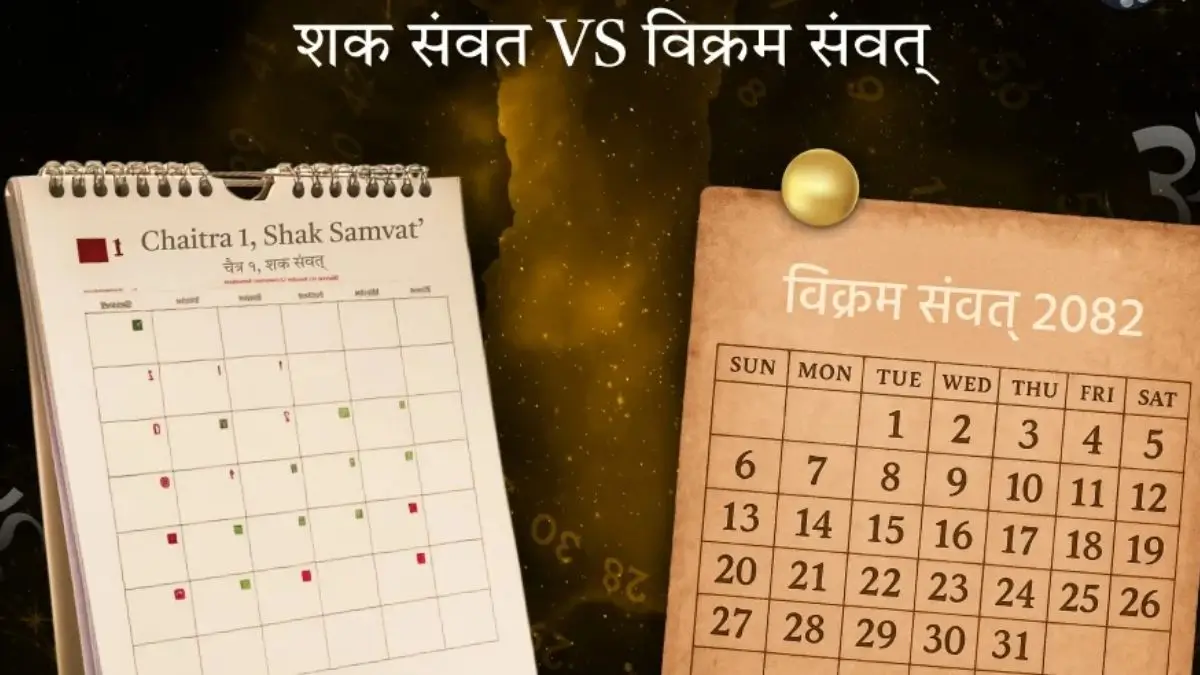
Vikram Samvat and Saka Samvat are two very important calendar systems in India’s history. Vikram Samvat is said to have begun in 57 BCE. Saka Samvat began in 78 CE. Vikram Samvat is widely used for religious festivals and New Year in different regions. The Saka Calendar is the basis for the National Calendar of India.
Vikram Samvat and Saka Samvat – Origins and History
1. Vikram Samvat (57 BCE)
Vikram Samvat is traditionally named after the King Vikramaditya of the Ujjain. This system began in the 57 BCE and traditionally commemorates the King’s victory over the Sakas.
This calendar is also known in history as Krita Samvat. Historians have questioned the precise identity of Vikramaditya and the reasons behind its creation. Vikramaditya could have also been the name for a royal title that multiple rulers had.
Today, Vikram Samvat is still widely used in North and Western areas of India.
2. Saka Samvat (78 CE)
Saka Samvat is traditionally known as the Shalivahana Saka Era. This system began in 78 CE. This calendar has been historically connected to King Shalivahana but historians have also debated whether there could have been links with other rulers like Kanishka from the Kushan dynasty.
This calendar has appeared in many inscriptions throughout history. This calendar was later used to create the National Calendar of India.
Vikram Samvat vs Saka Samvat
| Feature | Vikram Samvat | Saka Samvat |
| Tradional Starting Year | 57 BCE | 78 CE |
| Tradionally Named After | King Vikramaditya | King Shalivahana |
| Calendar System | Lunisolar | Tradional Calendar has regional variations. National Calendar is Solar. |
| Number of Months in Year | 12 Lunar months. Extra month added if needed. | National Calendar has Solar year. |
| New Years | Regional variations. | Chaitra 1 (Generally 22nd March). |
| Used For | Religious, Cultural and Regional Calendars. | National Calendar |
| Historical | Tradional Calendar of Ujjain. | Used widely in inscriptions and official time keeping. |
The Saka calendar is related to the National Calendar. They are not exactly the same. As shown above, Vikram Samvat has regional variations on when the year begins.
Calendar Systems – Lunisolar and Solar
There are differences between the two calendar systems.
Vikram Samvat – Lunisolar
- Vikram Samvat uses a Lunisolar system. This means, the calendar includes both the Moon and Sun. The months are based on lunar cycles, however adjustments are made to keep in line with the Solar calendar.
- An extra month called Adhik Maas is added in to keep the calendar in line. The lunar calendar has around 354 days so adding an extra month ensures that it does not drift too far off.
- There are variations in the New Years. In Gujarat, the calendar year traditionally begins the day after Diwali. Chaitra is the New Year for several regions.
Saka Samvat – Solar
- The National Calendar of India today (based on the Saka calendar) uses a Solar system. This has 12 months with a regular year of 365 days and leap year of 366 days.
- The first month of the year is Chaitra. This begins on the 22nd March in regular years and the 21st March in leap years.
Calendar Reform Committee
After Independence, India used the Gregorian calendar for official use. However, many traditional calendars were still being used in different regions. To help increase consistency within calendars, the Government of India created the Calendar Reform Committee in 1952. This was under the Council of Scientific and Industrial Research (CSIR). The committee was led by famous Astrophysicist Dr Meghnad Saha. N.C. Lahiri was the member-secretary.
The committee looked into what calendar system was used in different areas of India. They suggested that a scientific standardised calendar would be best. This would use the Saka calendar.
The reform calendar was adopted by the Government on the 22nd March 1957. This was equivalent to 1 Chaitra 1879 Saka Era.
It is used with the Gregorian calendar for certain official use. This includes the Gazette of India, Government Calendars, All India Radio News and Government Communications.
Use Around Country
Vikram Samvat is widely used in Rajasthan, Gujarat, Uttar Pradesh, Madhya Pradesh and Nepal. Vikram Samvat is used in traditional Panchangs to decide when religious events are, when festivals happen and what lucky dates are. In Gujarat, the New Year is based around Kartik. This is celebrated as Bestu Varas after Diwali.
Saka Samvat is historically significant in several areas of India. It is used to create the National Calendar. Many regions celebrate their New Year festivals such as Gudi Padwa (Maharashtra) and Ugadi (parts of South India) around the beginning of Chaitra. These have variations depending on the local area.
The Saka calendar is also very significant for historical research. The calendar can be found in inscriptions and records to help work out the timeline of ancient and medieval India.




 Countries That Celebrate Diwali Around t...
 Diwali GK Quiz 2026: Attempt Important M...
 Which District of Uttar Pradesh is Known...