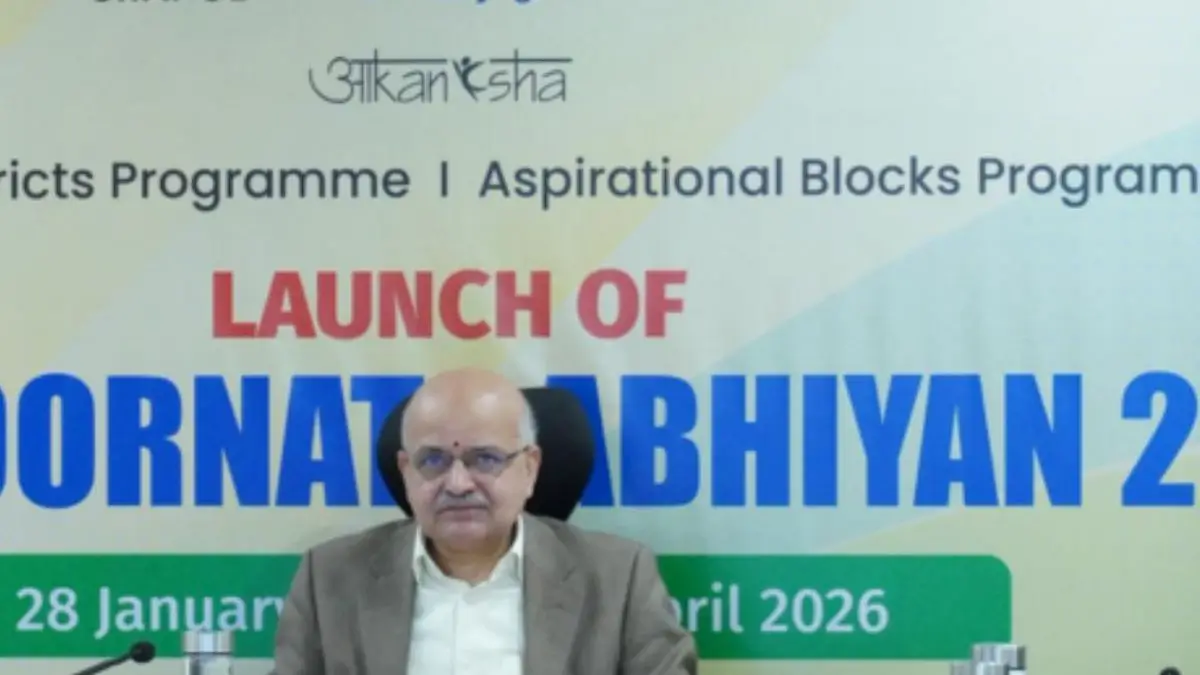
NITI Aayog has started a fresh nationwide push called Sampoornata Abhiyan 2.0 to improve basic services in India’s most underdeveloped districts and blocks. The campaign begins on January 28, 2026, and will run for three months. It focuses on health, nutrition, sanitation, education and animal vaccination. The idea is simple is to ensure that every eligible person actually receives essential government services. This mission builds on earlier aspirational programmes and aims to deliver visible, measurable change at the grassroots level within a short and fixed timeframe.
What is Sampoornata Abhiyan 2.0?
- Sampoornata Abhiyan 2.0 is a time-bound, three-month campaign running till April 14, 2026.
- Its main aim is to close last-mile gaps in essential public services.
- Instead of partial improvement, the focus is on full saturation, meaning no eligible beneficiary should be left out.
- Districts and blocks will prepare action plans, track progress every month and adjust strategies if needed.
- The programme builds on the success of the 2024 Sampoornata drive, which showed that focused efforts over a short period can deliver strong results.
- The mission reflects outcome-based governance rather than paperwork-driven implementation.
Key Indicators for Aspirational Blocks
Under the campaign, six Key Performance Indicators (KPIs) have been identified for Aspirational Blocks.
- These include regular supplementary nutrition for children under ICDS, accurate growth measurement at Anganwadi Centres, availability of functional toilets and drinking water in Anganwadis, adequate girls toilets in schools, and vaccination of bovine animals against Foot and Mouth Disease.
- These indicators directly affect child health, hygiene, school attendance and rural livelihoods.
- By targeting these basics, the programme aims to strengthen foundational services at the block level, where delivery gaps are often most visible and impactful.
Key Indicators for Aspirational Districts
- For Aspirational Districts, the focus is on five KPIs.
- These include weighing of newborn babies, tuberculosis case notification from both public and private facilities, conduct of Village and Urban Health Sanitation and Nutrition Days, availability of functional girls’ toilets in schools, and animal vaccination coverage.
- These indicators reflect broader district-level outcomes in healthcare systems, disease monitoring, sanitation awareness and education infrastructure.
- Improving these areas helps districts move closer to national standards while also strengthening coordination between health, education and local administration.
How Will the Campaign Be Implemented?
- Each district and block will prepare a three-month action plan focused on achieving saturation of the selected indicators.
- Progress will be reviewed monthly using data dashboards.
- Awareness and behaviour-change activities will be conducted to involve communities.
- District-level officers will carry out regular field visits for monitoring. NITI Aayog will work closely with central ministries, state governments and development partners to support planning, capacity building and fast problem-solving.
- This approach ensures accountability, quick feedback and visible results within the campaign period.
About Aspirational Programmes
- The Aspirational Districts Programme was launched in 2018, covering 112 districts to improve health, education, agriculture, financial inclusion and infrastructure.
- Building on this, the Aspirational Blocks Programme was launched in 2023 and now covers 513 blocks.
- Both programmes use data, competition and cooperation to speed up development in underserved areas.
About NITI AAYOG
| Basic Information |
|
| Objectives |
|
| Key Initiatives |
|
| Composition of NITI Aayog | Leadership
Members
|
Key Summary at a Glance
| Aspect | Details |
| Why in News? | Launch of Sampoornata Abhiyan 2.0 |
| Launched By | NITI Aayog |
| Duration | Jan 28 – Apr 14, 2026 |
| Coverage | 112 Districts, 513 Blocks |
| Focus Areas | Health, nutrition, sanitation, education |
| Main Goal | Saturation of key indicators |
Question
Q. Sampoornata Abhiyan 2.0 is aimed at achieving:
A. Infrastructure privatisation
B. Saturation of basic development indicators
C. Urban housing expansion
D. Defence export


 India's First Digital Census 2027 Begins...
 PM Modi Launches Kaynes Semiconductor Pl...
 India Census 2027 Digital: Phase 1 Start...