
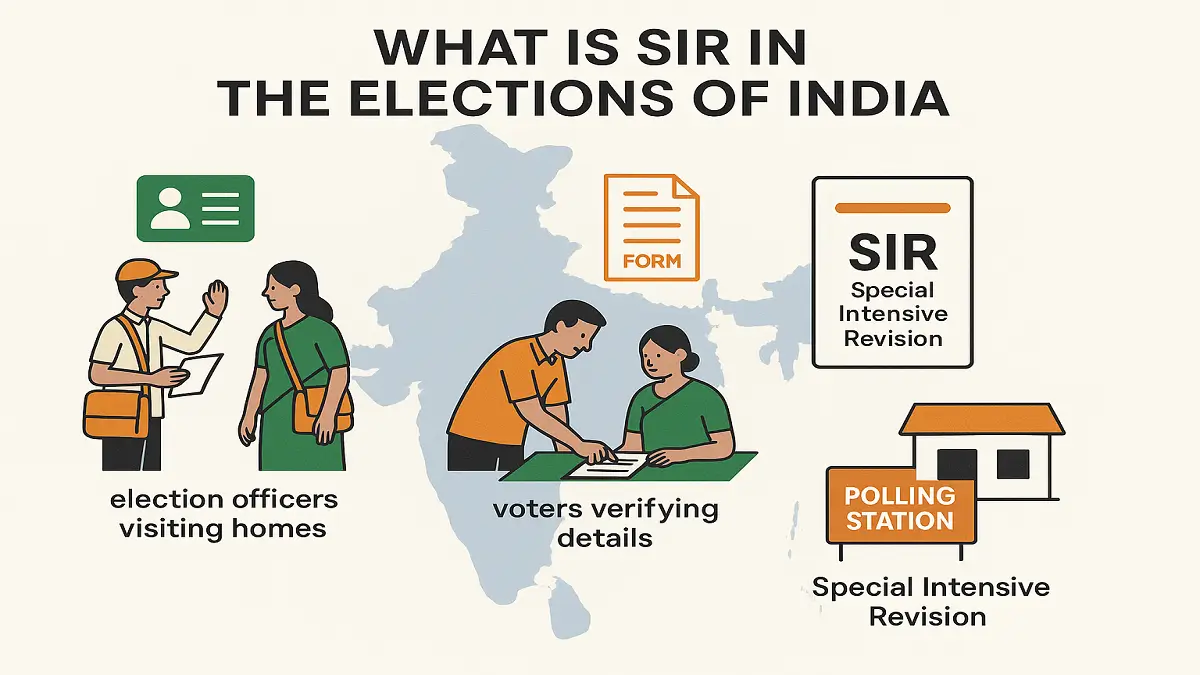
In the Indian electoral system, SIR stands for Special Intensive Revision. It is a special drive launched by the Election Commission of India (ECI) to ensure that the electoral rolls (voter lists) are accurate, complete, and up to date.
The purpose of this process is to include eligible voters who may have been left out and to remove names of those who are no longer eligible, such as deceased or shifted persons. This exercise plays a crucial role in maintaining the purity and accuracy of India’s voter lists.
Meaning of SIR
Special Intensive Revision (SIR) is a comprehensive, door-to-door verification process of electoral rolls. Unlike the regular annual or summary revision, SIR is a time-bound and deeper verification exercise undertaken in specific areas or states where large-scale errors, omissions, or irregularities in voter lists are noticed. During this revision, officials visit households to verify voter details, accept new applications, and remove duplicate or invalid entries.
Objective of Special Intensive Revision
The main objectives of the SIR are:
- To ensure every eligible citizen’s inclusion in the electoral roll.
- To remove ineligible or duplicate entries such as names of deceased or migrated persons.
- To improve the accuracy and transparency of the voter list before upcoming elections.
- To encourage voter participation by making registration easier and accessible.
This process strengthens India’s democratic foundation by ensuring that every vote truly represents a living, eligible citizen.
Process of SIR
The Special Intensive Revision generally includes the following steps:
- House-to-house verification by Booth Level Officers (BLOs) to confirm existing voter details.
- Distribution of forms to citizens for adding, deleting, or correcting their voter information.
- Public display of draft rolls for citizens to check and raise objections if needed.
- Submission of claims and objections within a fixed time period.
- Final publication of revised electoral rolls after verification and corrections.
Legal Basis
The legal authority for SIR comes from Section 21 of the Representation of the People Act, 1950. This section empowers the Election Commission to conduct a special revision of electoral rolls in any constituency at any time, if it is considered necessary to maintain accuracy and fairness.
Example: Bihar SIR 2025
A recent example is the Special Intensive Revision of Electoral Rolls in Bihar (2025).
- The process began in June 2025 under the direction of the Election Commission of India.
- Voters were required to verify their details and could submit one of 11 approved identity documents (Aadhaar was not mandatory).
- The objective was to clean up the voter list and ensure every eligible citizen’s name was correctly recorded before the next elections.
This case shows how SIR ensures better voter inclusion and reduces chances of duplication or fraud.
Importance of SIR
The SIR is a key step in strengthening India’s democratic process. Its importance can be seen in several areas:
- Transparency: Ensures fairness by preventing fake or duplicate votes.
- Inclusion: Helps new voters, especially youth, women, and migrants, get added to the rolls.
- Accountability: Encourages citizens to verify and update their details.
- Election readiness: Ensures accurate rolls before major elections, reducing last-minute disputes.


 Jan Vishwas Amendment Bill 2026 Passed: ...
 India's First Digital Census 2027 Begins...
 PM Modi Launches Kaynes Semiconductor Pl...











