Recently, Adivasis from the Ho tribe in Jharkhand’s Kolhan region staged protests against alleged government interference in their traditional Manki-Munda system of self-governance. This incident has drawn attention to one of the most unique and centuries-old tribal governance models in India, its colonial history, and its place in contemporary tribal life.
What is the Manki-Munda System?
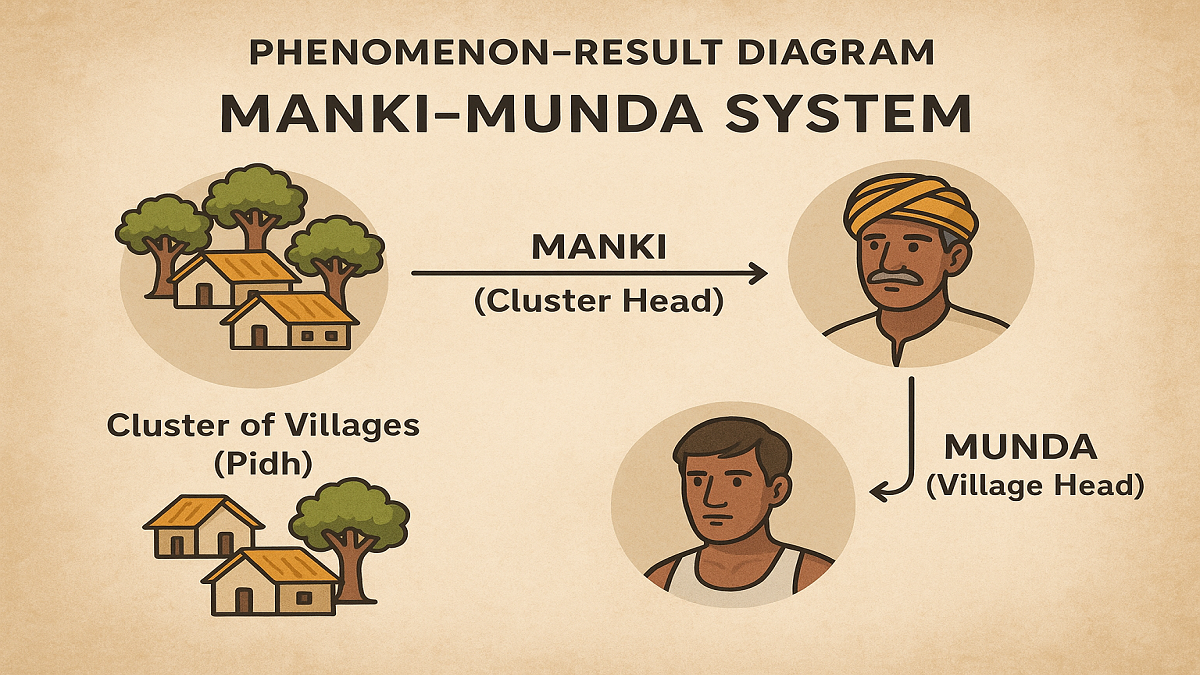
The Manki-Munda system is a traditional, decentralized governance framework of the Ho tribe, followed in Jharkhand’s Kolhan region for centuries.
- Village Level (Munda): Each village is headed by a hereditary Munda, who resolves local disputes and maintains social order.
- Cluster Level (Manki): A group of 8–15 villages forms a pidh, headed by a Manki, who takes up cases unresolved at the village level.
- Nature: The system is purely socio-political, not economic—there is no role in land revenue, taxation, or land management.
British Intervention
- After the Battle of Plassey (1757) and Battle of Buxar (1764), the East India Company acquired diwani rights and imposed land revenue systems.
- With the Permanent Settlement Act (1793), zamindars were empowered to extract revenue, which caused widespread alienation of Ho lands.
- This triggered major tribal uprisings like the Ho revolt (1821–22) and the Kol revolt (1831).
- To control the region, the British chose not to dismantle the system but co-opted it.
- In 1833, Captain Thomas Wilkinson codified the system under Wilkinson’s Rules, formally recognizing the roles of Mankis and Mundas.
- This marked a major shift, as private property and pattas (land deeds) were introduced, weakening traditional collective landholding and opening Kolhan to outsiders (dikkus).
Post-Independence
- Even after 1947, Kolhan largely continued under Wilkinson’s Rules, with courts recognizing the system as a valid custom.
- However, in Mora Ho vs State of Bihar (2000), the Patna High Court clarified that these are customary practices, not codified law—but allowed their continuation.
- In 2021, Jharkhand proposed reforms through the Nyay Manch initiative, but they were not implemented.
Who are the Ho Tribe?
The Ho or Kolha people are among the most prominent Austroasiatic Munda ethnic groups in India, concentrated mainly in Jharkhand’s Kolhan region and adjoining parts of Odisha.
Key Facts
Language: The Ho language belongs to the Austroasiatic family, related to Mundari. It is written in Devanagari, Latin, and Warang Citi, a unique script developed by Lako Bodra.
History:
- Presence dates back 3500–4000 years, with ancestral roots in Southeast Asia.
- Active participants in the Kol Uprising (1831–33) against exploitative landlords and outsiders.
- Played a role in the 1857 revolt under the Raja of Porahat.
- Known for resisting Mughal, Maratha, and British encroachments.
Society & Culture:
- Governed through the Manki-Munda system.
- Celebrate festivals like Mage Parab (creator god festival), Baa Parab (flowers festival), Sohrai (cattle and agriculture), and Jomnama Parab (harvest).
- Dance, music, and community gatherings in the akhra (village ground) play a central role in cultural life.
Economy & Forests:
- Over 80% engaged in agriculture, being among the first Adivasi communities to adopt settled farming.
- Depend heavily on sal forests for livelihood.
- Strongly oppose replacement of sal with teak plantations.
- Mining activities also employ a section of the population.
Why is the Manki-Munda System in the News Today?
Recent protests reflect the tensions between tradition and modern governance. Issues include:
- Vacant hereditary posts leading to inefficiency.
- Concerns of administrative interference by state authorities.
- Debates over reform vs preservation of the system.
For the Ho people, this system is not just about governance—it is a symbol of identity, autonomy, and resistance against external domination.


 Chandrababu Naidu Launches ‘Araku Kouni’...
 Yogi Adityanath Inaugurates IBM’s AI Gov...
 Rajasthan Budget 2026–27 Presented with ...