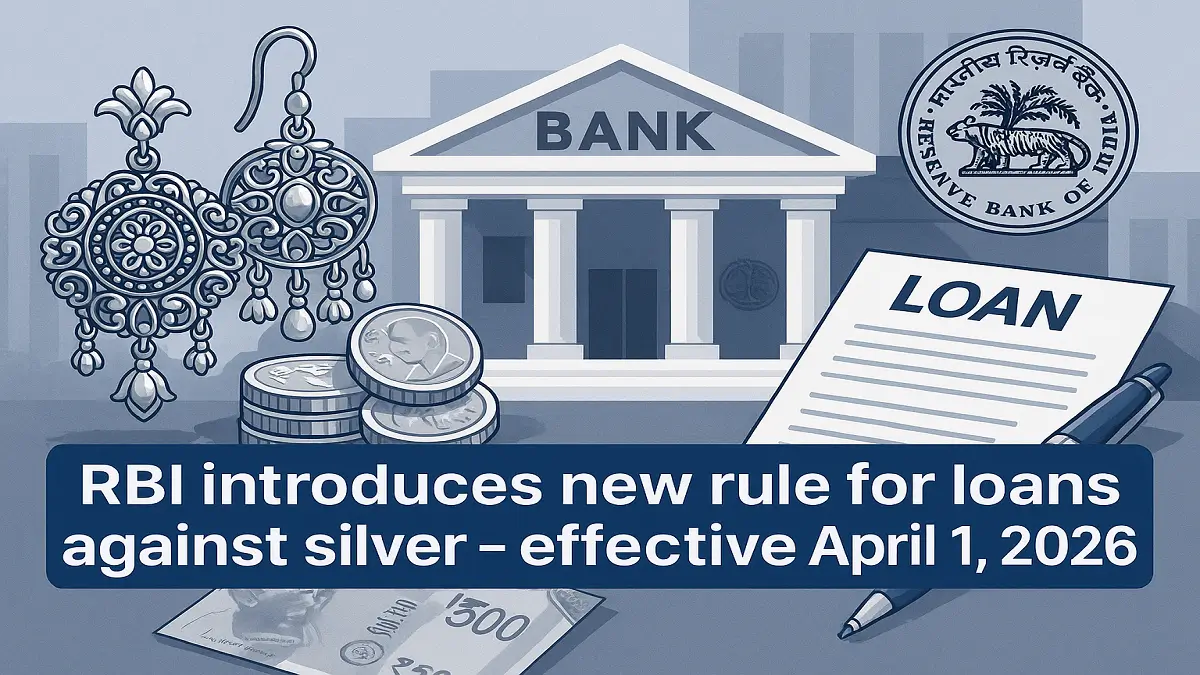
The Reserve Bank of India (RBI) has announced new rules under the “Reserve Bank of India (Lending Against Gold and Silver Collateral) Directions, 2025”, effective from April 1, 2026. These new norms officially allow people to take loans against silver ornaments and coins, not just gold, with strict limits on the weight and value that can be pledged. Silver ornaments up to 10 kilograms and silver coins up to 500 grams can be used as collateral. The loan-to-value (LTV) ratio will range from 85% to 75%, depending on the loan size.
What is the new RBI rule about loan against silver?
For the first time, the RBI has allowed banks and financial institutions to extend loans against silver, much like the popular gold loans already available in India. Under the new guidelines, borrowers can pledge silver jewellery, ornaments, or coins to get short-term financing.
These loans will be offered by commercial banks, small finance and regional rural banks, urban and rural co-operative banks, and non-banking financial companies (NBFCs), including housing finance firms.
However, there’s a catch — loans can’t be given against silver bullion (like bars or bricks) or financial assets backed by silver, such as mutual fund or exchange-traded fund (ETF) units. The RBI has made this restriction due to macro-prudential concerns to prevent financial instability.
How much silver can you pledge for a loan?
The RBI circular specifies clear limits on how much gold or silver can be pledged by a borrower.
- Silver ornaments: Maximum limit is 10 kilograms per borrower.
- Silver coins: Maximum limit is 500 grams per borrower.
- Gold ornaments: Up to 1 kilogram.
- Gold coins: Up to 50 grams.
This means that a person can pledge up to 10 kilograms of silver ornaments or 500 grams of silver coins, but not more, across all loans combined.
How much loan can you get against silver?
The Loan-to-Value (LTV) ratio determines how much loan you can get for every ₹100 worth of silver. The RBI has introduced a tiered system based on the total loan amount:
| Loan Amount | Maximum LTV Ratio |
|---|---|
| Up to ₹2.5 lakh | 85% |
| ₹2.5–5 lakh | 80% |
| Above ₹5 lakh | 75% |
So, for example, if your silver ornaments are valued at ₹1 lakh, you can borrow up to ₹85,000. If the pledged silver is worth ₹7 lakh, you can get up to ₹5.25 lakh, depending on the value slab.
How will silver be valued for a loan?
The RBI has set a transparent valuation system to ensure fairness for borrowers. The value of silver will be determined as the lower of:
- The average closing price of silver of the same purity over the last 30 days, or
- The closing price of silver of that purity on the previous day.
These rates will be based on data published by the India Bullion and Jewellers Association (IBJA) or a commodity exchange regulated by the Securities and Exchange Board of India (SEBI).
Importantly, the valuation will consider only the intrinsic value of silver — not additional decorative elements like gems or stones.
What happens after repayment or in case of default?
After full repayment, the lender must release the pledged silver within seven working days. If there’s any delay due to the lender, they’ll have to compensate the borrower at ₹5,000 per day of delay.
If a borrower fails to repay the loan, the lender can auction the pledged silver. But before doing so, they must:
- Give prior notice to the borrower,
- Issue a public notice if the borrower is untraceable, and
- Wait at least one month before starting the auction.
The reserve price for auction must be at least 90% of the current value, and if the auction fails twice, the minimum reserve can be 85% of the current value.
Why did the RBI introduce silver loans now?
Gold loans have been extremely popular in India for decades, especially during financial emergencies. By extending similar facilities to silver, the RBI aims to:
- Expand access to short-term credit for households,
- Encourage formal lending instead of unregulated pawn broking,
- Increase transparency and standardization in metal-based lending, and
- Protect borrowers’ rights through stricter auditing and compensation norms.
With these new rules, silver — often called the “white metal” — joins gold as a mainstream collateral option for Indians seeking small or medium-sized loans.


 RBI Tightens Forex Market Controls With ...
 RBI Payments Vision 2028: Big Shift Towa...
 Now Get Home Loan From Anywhere: NHB Lau...