
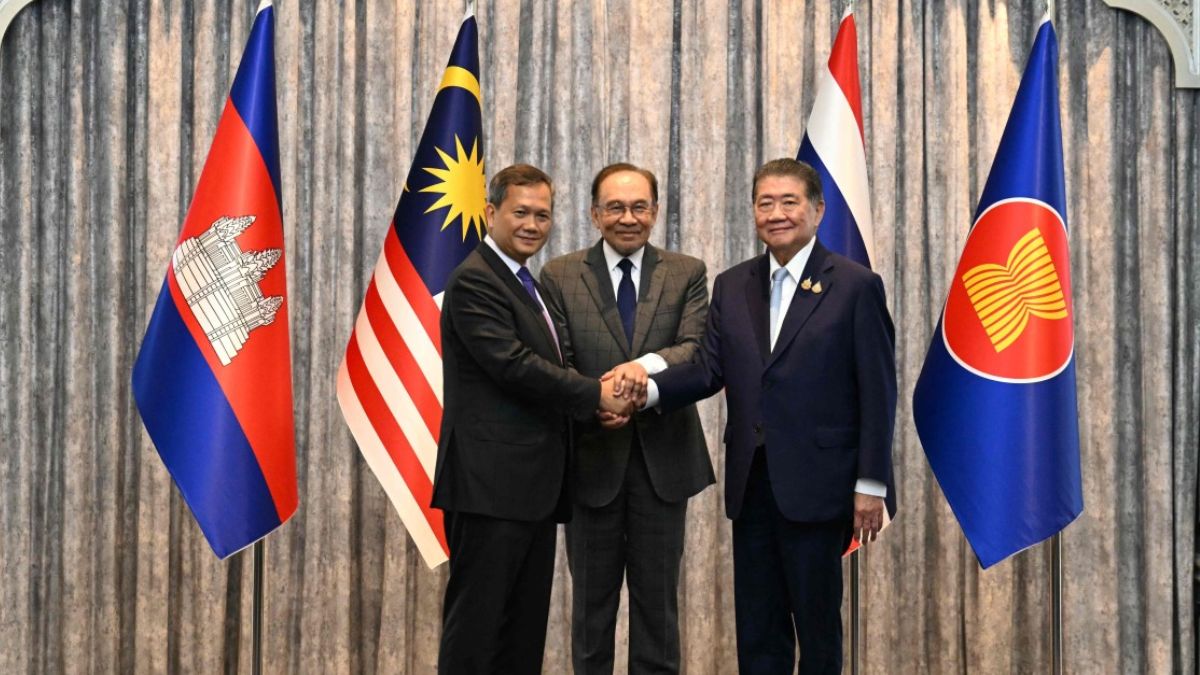
A ceasefire agreement between Thailand and Cambodia took effect on July 28, 2025, marking the end of a five-day border battle that killed at least 38 people, mostly civilians, and displaced over 300,000 residents. The conflict, one of the deadliest between the two Southeast Asian neighbors in more than a decade, was halted after mediation efforts by Malaysia, the United States, and China. Former U.S. President Donald Trump played a crucial role, linking peace to the resumption of trade talks.
What is Truce Agreement?
A truce agreement is a formal arrangement between opposing parties in a conflict to temporarily stop fighting, usually for a specific period of time and in a specific area. It does not end the war or conflict permanently, but rather serves as a pause in hostilities so that negotiations, humanitarian aid, or peace talks can take place.
Key Points about a Truce Agreement
- Temporary Halt: It suspends fighting but does not resolve the root causes of conflict.
- Not a Peace Treaty: Unlike a peace treaty, it does not legally end the state of war.
- Humanitarian Purpose: Often used to allow the evacuation of civilians, medical assistance, or prisoner exchanges.
- White Flag Protection: During a truce, those carrying a white flag are protected from attack. Misusing the white flag is considered a war crime.
- Historical Use: Before the UN Charter (1945), terms like truce, armistice, and peace treaty were used distinctly. Today, the word ceasefire is often used interchangeably with truce.
Background of the Conflict
The Thailand–Cambodia border has long been a source of territorial disputes, with tensions escalating since the killing of a Cambodian soldier in May 2025, leading to troop buildups. The clashes began on July 24, quickly intensifying from small arms fire to heavy artillery and even the scrambling of a Thai F-16 fighter jet for airstrikes. Both nations accused each other of unprovoked aggression. Thailand alleged that Cambodian forces laid landmines that injured Thai soldiers. Cambodia, on the other hand, accused Thailand of firing at civilian targets, including schools and hospitals.
Mediation Efforts
- The ceasefire was brokered in Putrajaya, Malaysia, following two hours of intense talks mediated by Malaysian Prime Minister Anwar Ibrahim.
- U.S. President Donald Trump pressured both leaders by warning that the U.S. would not proceed with trade deals if fighting continued.
- Both Thailand and Cambodia face a 36% tariff on exports to the U.S., their largest trading partner.
- China also played a constructive role in pushing for dialogue.
- The agreement included resuming direct communications and establishing a monitoring mechanism to implement the ceasefire.
Humanitarian Impact
The fighting devastated border communities,
- Houses in Sisaket province (Thailand) were destroyed by artillery.
- Civilians sought refuge in evacuation centers, with reports of food distribution and families separated.
- Residents expressed a strong desire to return to their homes once safety was assured.


 Iran–US Ceasefire: Iran’s 10 Conditions ...
 Russia and China Veto UN Resolution to R...
 France Hosts One Health Summit Under G7 ...











