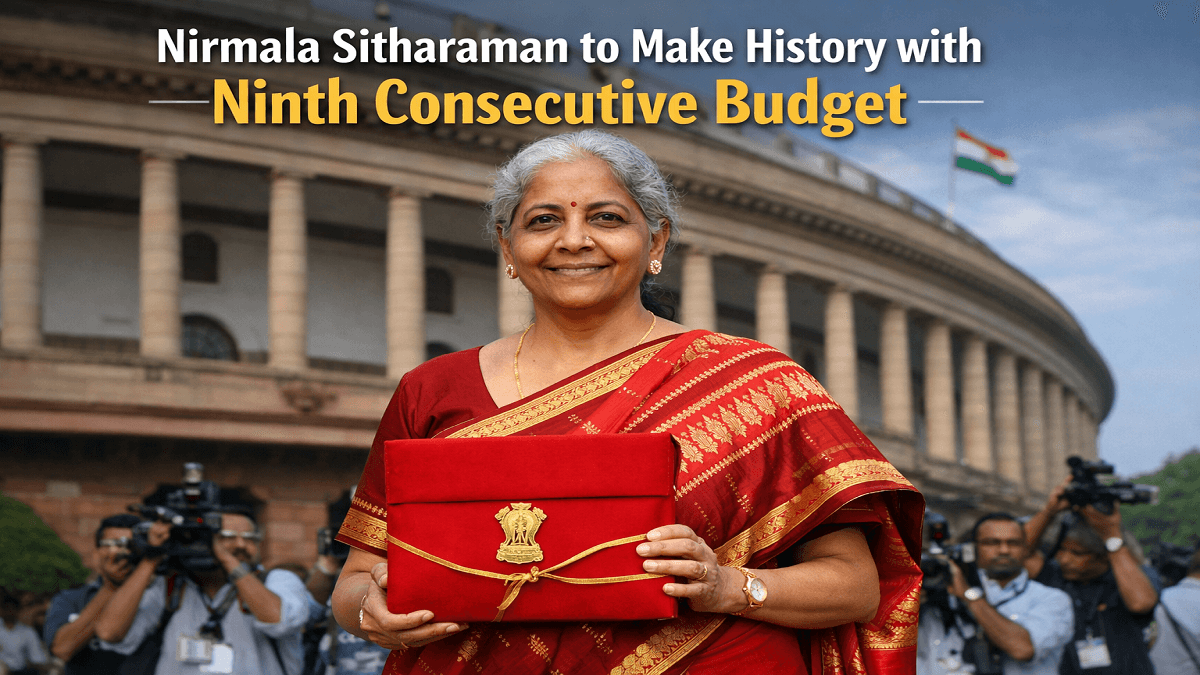
Union Finance Minister Nirmala Sitharaman will present a record ninth consecutive Budget on February 1, 2026, making history as she continues to hold the distinction of presenting the most Budgets on the trot in independent India. This unprecedented achievement reflects her consistent tenure as India’s first full-time woman Finance Minister under Prime Minister Narendra Modi’s administration.
A Historic Milestone
When Sitharaman presents the Budget on February 1, 2026, she will be making her ninth straight budget presentation. This remarkable streak began in 2019 when she was appointed as India’s first full-time woman Finance Minister after Prime Minister Modi secured a decisive second term. Despite political changes, she has retained her finance portfolio after Modi won the 2024 elections for a third consecutive term.
So far, she has presented a total of eight straight Budgets, including an interim one in February 2024. The ninth consecutive Budget will further cement her position as a record-breaker in Indian financial history.
Approaching the All-Time Record
While Sitharaman’s achievement is remarkable, she remains one budget short of the all-time record. Former Prime Minister Morarji Desai holds the record for presenting the largest number of Budgets overall, with a total of 10 Budgets presented during his tenure as Finance Minister under Prime Ministers Jawaharlal Nehru and Lal Bahadur Shastri.
However, Sitharaman’s record is distinctive because her nine consecutive Budgets under a single Prime Minister (Modi) surpasses the achievements of other notable Finance Ministers:
- Morarji Desai: 10 Budgets total, but not all consecutive
- P. Chidambaram: 9 Budgets under different Prime Ministers
- Pranab Mukherjee: 8 Budgets under different Prime Ministers
- Manmohan Singh: 5 consecutive Budgets (1991-1995)
Budget Expected to Focus on Economic Growth
The Budget expected on February 1 is anticipated to contain reform measures aimed at shoring up economic growth amid a volatile geopolitical situation. This comes at a time when India faces several economic headwinds, including a steep 50% U.S. tariff on shipments from India and broader geopolitical uncertainties.
The presentation will require strategic fiscal and monetary measures to maintain India’s growth trajectory while addressing these external challenges.
Historical Facts About Budget Presentations in Independent India
The First Budget of Independent India
The first-ever Union Budget of independent India was presented on November 26, 1947, by the nation’s first Finance Minister, R.K. Shanmukham Chetty. This historic budget laid the foundation for India’s financial management as a sovereign nation.
Budget Records and Achievements
Longest Budget Speech
Nirmala Sitharaman holds the record for the longest Budget speech in independent India. Her presentation on February 1, 2020, lasted an impressive two hours and 40 minutes. Notably, she had to cut short her speech with two pages remaining, highlighting the exhaustive nature of budget presentations and the extensive reforms she outlined.
This lengthy speech demonstrated the depth and complexity of modern budget proposals, covering numerous policy changes and economic measures.
Shortest Budget Speech
In contrast, Hirubhai Mulljibhai Patel’s interim Budget speech in 1977 holds the record for being the shortest, consisting of just 800 words. This reflects how budget speeches have evolved significantly in length and detail over the decades.
Evolution of Budget Timing
The time at which the Budget is presented has undergone significant changes since independence.
Traditional Timing (Colonial Era Practice)
The Budget was traditionally presented on the last day of February at 5 p.m. This timing followed a colonial era practice dating back to British rule. The specific timing was chosen because India is 4 hours and 30 minutes ahead of British Summer Time. Presenting the budget at 5 p.m. in India ensured that announcements could be made simultaneously in London and India, allowing British financial markets to respond appropriately.
This practice continued even after independence as a legacy of colonial administration.
Change in Timing (1999)
The timing was changed in 1999 when then Finance Minister Yashwant Sinha, serving in the Atal Bihari Vajpayee government, presented the budget at 11 a.m. instead of 5 p.m.
Since this change, all Budgets have been presented at 11 a.m., making the morning presentation the standard practice in modern India.
Budget Presentation Date
The budget presentation date underwent another significant change in 2017. It was shifted to February 1 instead of the last day of February.
Reason for the Change
This change was introduced to allow the government to:
- Complete the Parliamentary approval process by March-end
- Enable budget implementation from the start of the fiscal year (April 1)
When budgets were presented on February 29, implementation could not begin before May or June, after accounting for 2-3 months of the parliamentary approval process. By moving the presentation to February 1, the government gained additional time for parliamentary discussions and procedures, allowing full implementation from the fiscal year’s start.
Budget Records: Most Number of Budgets Presented
1. Morarji Desai – 10 Budgets (Record Holder)
Former Prime Minister Morarji Desai holds the record for presenting the largest number of Budgets in independent India. He presented 10 Budgets total during his tenure as Finance Minister under Prime Ministers Jawaharlal Nehru and Lal Bahadur Shastri.
Timeline:
- First Budget: February 28, 1959
- Two full Budgets in the following two years
- One interim Budget in 1962
- Two full Budgets following
- One interim Budget in 1967 (after a four-year gap)
- Three full Budgets in 1967, 1968, and 1969
- Total: 10 Budgets
2. P. Chidambaram – 9 Budgets (Second Highest)
Former Finance Minister P. Chidambaram presented the Budget on nine occasions across different governments.
Timeline:
- First Budget: March 19, 1996 (United Front government under PM H.D. Deve Gowda)
- Another Budget under the same government the next year
- Five Budgets between 2004 and 2008 (Congress-led UPA government)
- Two more Budgets in 2013 and 2014 (after returning as Finance Minister from Home Ministry tenure)
- Total: 9 Budgets
3. Pranab Mukherjee – 8 Budgets (Third Highest)
Former Finance Minister Pranab Mukherjee presented 8 Budgets during his tenure.
Timeline:
- Three Budgets in 1982, 1983, and 1984
- Five consecutive Budgets between February 2009 and March 2012 (Congress-led UPA government)
- Total: 8 Budgets
4. Manmohan Singh – 5 Budgets (Consecutive Record)
Former Prime Minister Manmohan Singh presented 5 consecutive Budgets between 1991 and 1995 when he was Finance Minister in the P.V. Narasimha Rao government. These consecutive budgets were crucial during India’s economic liberalization period.
Significance of Sitharaman’s Achievement
Nirmala Sitharaman’s ninth consecutive budget represents several significant milestones:
- First Full-Time Woman Finance Minister: She broke the glass ceiling in Indian finance ministry, becoming the first woman to hold the position full-time.
- Continuous Tenure: Her nine consecutive budgets under PM Modi demonstrate political stability and consistent economic stewardship.
- Economic Stewardship: Despite global uncertainties, including the 2020 pandemic, economic slowdowns, and geopolitical tensions, she has maintained continuity in India’s fiscal policy.
- Approach to Diverse Challenges: Her budgets have addressed multiple economic challenges—from pandemic recovery to managing inflation, handling geopolitical tensions, and maintaining growth.
- Reform Focus: Each budget has contained significant reform measures, reflecting her commitment to economic modernization.
What to Expect from Budget 2026
The Budget to be presented on February 1, 2026, is expected to:
- Focus on maintaining India’s economic growth momentum amid global uncertainties
- Address challenges posed by U.S. tariffs and geopolitical risks
- Introduce reform measures to strengthen India’s economic fundamentals
- Continue focus on infrastructure development, social welfare, and fiscal sustainability
- Balance growth aspirations with fiscal prudence


 India's Fiscal Deficit Narrows to ₹12.5 ...
 India’s Forex Reserves Drop Sharply by $...
 India GDP Growth FY27: Assocham Forecast...